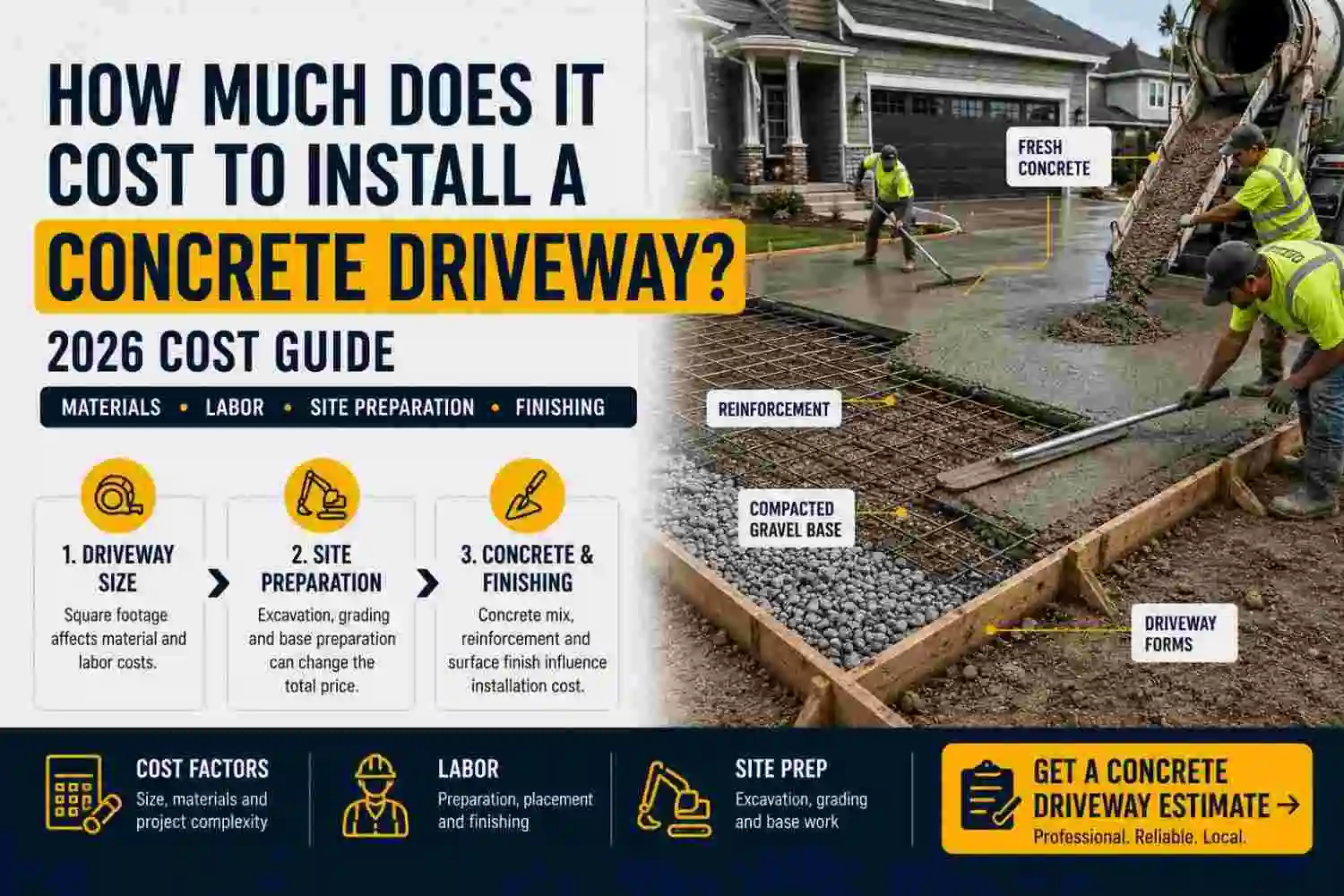
Three contractors walked your driveway last week. Three different numbers came back. The lowest was $4,800. The highest was $12,000. You want to know which one is fair. That gap exists for a reason, and every factor behind it has a name. This guide names each one so the next quote makes sense.
A concrete driveway costs $8 to $20 per square foot installed nationally. Most homeowners spend $3,500 to $10,000 for a complete installation. A standard 600 sq ft two-car driveway runs $4,800 to $12,000. Cost depends on size, thickness, reinforcement, and finish.
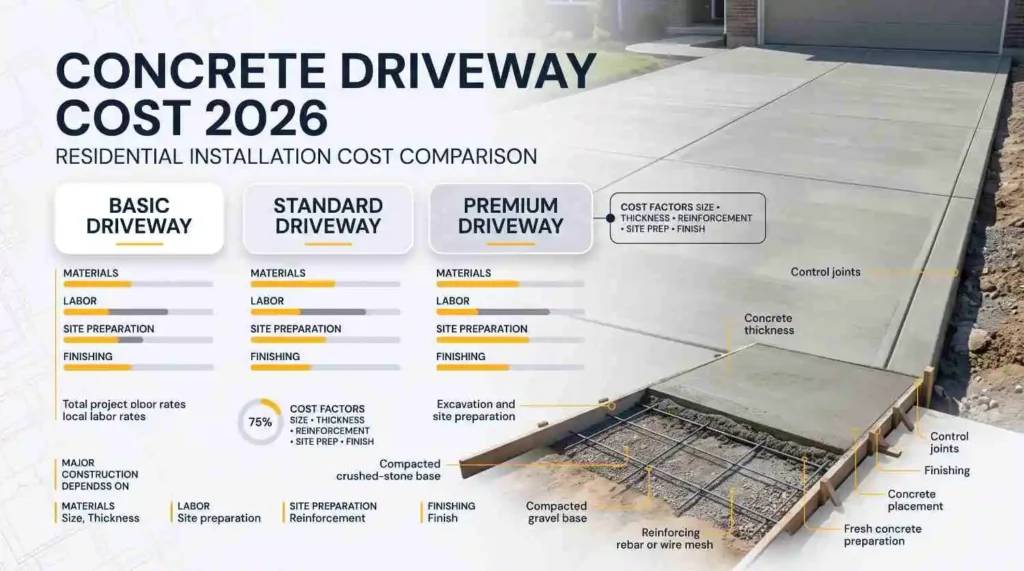
How Much Does a Concrete Driveway Cost on Average?
Concrete driveway installation costs $8 to $20 per square foot nationally. Most homeowners spend $3,500 to $10,000 for a complete professional installation. A standard 600 sq ft two-car driveway runs $4,800 to $12,000. Site conditions, thickness, and stylistic choices set the final price.
For an exact price on your driveway, Rockzen Construction provides free on-site quotes.
2026 Average Total Cost
The typical spend for a new driveway falls between $3,500 and $10,000. A standard two-car driveway lands at $4,800 to $12,000. Premium finishes and major metros push projects higher.
National Average Compared to Regional Pricing
National average pricing runs $8 to $20 per square foot for standard installations. Major metropolitan areas run higher. San Francisco Bay Area and New York City projects can reach $10 to $28 per square foot.
Is $17 Per Square Foot Reasonable?
Yes. Seventeen dollars per square foot sits squarely in the 2026 national range. Standard broom-finish work runs $5 to $12 per square foot. Mid-range and decorative finishes push into the $12 to $28 range.
What Is the Average Concrete Driveway Cost Per Square Foot?
Concrete driveway cost estimates per square foot runs $5 to $12 for a standard broom finish. Mid-range decorative work runs $12 to $18. High-end custom finishes run $18 to $28 or more. Finish type is the single biggest driver of per-square-foot cost variation.
| Finish Level | Cost Per Square Foot |
|---|---|
| Standard plain finish (broom) | $5 to $12 |
| Mid-range decorative | $12 to $18 |
| High-end custom (stamped, multi-color, exposed aggregate) | $18 to $28+ |
Standard Plain Finish Cost
A classic gray concrete driveway with a textured broom finish runs $5 to $12 per square foot. The broom texture provides traction and is the most budget-friendly option. This covers a 4-inch slab with wire mesh and no decorative treatment.
Mid-Range Decorative Cost
Mid-range work runs $12 to $18 per square foot installed. This includes basic concrete dyes and simple border designs. It adds visual interest without full stamped-pattern complexity.
High-End Custom Cost
High-end custom finishes run $18 to $28 or more per square foot. These feature elaborate stamped patterns, multiple colors, and exposed aggregate surfaces. Complex color combinations sit at the top of this range.
How Much Does a Concrete Driveway Cost by Size?
Concrete driveway cost scales directly with square footage. Fixed site preparation costs spread across larger areas on bigger jobs. Per-square-foot cost often drops slightly as project size grows. The three most common driveway categories cover most residential projects.
| Driveway Type | Typical Size | Cost Range |
|---|---|---|
| Single-car | 200 to 400 sq ft | $1,600 to $4,800 |
| Double-car (standard) | 500 to 700 sq ft | $4,000 to $9,600 |
| Large or extended | 1,000 to 1,400 sq ft | $8,000 to $22,400 |
Prices assume standard 4-inch thickness. Decorative finishes, difficult access, or heavy reinforcement push totals higher.
Single-Car Driveway Cost
A single-car driveway covers 200 to 400 square feet. Total installed cost runs $1,600 to $4,800. This size fits one vehicle with limited room alongside.
Double-Car Standard Driveway Cost
A double-car driveway covers 500 to 700 square feet. Total installed cost runs $4,000 to $9,600. This is the most common size for single-family homes with two vehicles.
Large or Extended Driveway Cost
A large driveway covers 1,000 to 1,400 square feet. Total installed cost runs $8,000 to $22,400. This size fits three or more vehicles or accommodates circular designs with an island.
What Factors Affect the Cost of a Concrete Driveway?
Six factors move concrete driveway pricing above or below the average. Driveway size determines total material volume. Thickness affects material cost directly. Reinforcement, finish choice, site conditions, and regional labor rates account for the rest.
Demolition and Removal
An existing asphalt or concrete driveway must come out first. Demolition and haul-away runs $2 to $3 per square foot. Confirm whether disposal fees are included in the quote.
Site Preparation
Heavily sloped properties add 20 to 40 percent to the total quote. Extensive excavation, leveling, or a thick gravel base drives that increase. Sites where the concrete truck cannot discharge directly also cost more.
Concrete Thickness
Standard residential driveways use 4-inch concrete. Heavy commercial trucks or large RVs require 5 or 6-inch thickness. The upgrade increases material cost proportionally to the added volume.
Reinforcement Type
Rebar or wire mesh adds roughly $1.40 per linear foot of rebar. Both reinforce the slab against structural cracking. Skipping reinforcement shortens driveway lifespan significantly.
Finish and Surface Design
A broom finish is standard and adds no premium over base labor. Basic dyes and borders push cost into the mid-range. Full stamped patterns with multi-color hardener double or triple the base labor time.
Geographic Location
Labor rates vary significantly by market. Major metros including the San Francisco Bay Area and New York City run $10 to $28 per square foot. Rural markets sit at the lower end of the national range.
How Much Does Demolition and Removal Cost?
Removing an existing driveway costs $2 to $3 per square foot. A 600 square foot removal runs $1,200 to $1,800. Debris hauling and disposal fees may be billed separately. Always confirm whether disposal is included before comparing bids.
Demolition Cost Per Square Foot
Saw cutting and jackhammer work runs $2 to $3 per square foot. Concrete saw cutting adds precision where neighboring surfaces must be protected. Slab thickness does not change demolition labor time significantly.
Debris Hauling and Disposal Fees
Hauling broken concrete or asphalt is usually included in the $2 to $3 per square foot figure. Disposal fees vary by region and dump policy. Always confirm this in writing before signing.
Combined Removal and Replacement Cost
Removal plus new installation runs the demolition cost plus the new driveway cost. A 600 square foot project totals $1,200 for demolition plus $4,800 to $12,000 for new construction. That comes to $6,000 to $13,200 combined.
How Much Does Site Preparation Cost?
Site preparation is the first cost on every concrete driveway project. Standard sites need excavation, grading, and base preparation. Sloped or difficult sites add 20 to 40 percent to the total. Poor site prep leads to pooling water and early slab failure.
Grading and Drainage Slope Cost
Proper drainage slope is required before any concrete goes down. On flat sites, grading is bundled into the base quote. On sloped or complex sites, grading and drainage correction can push the site prep line item significantly higher.
Gravel Base and Subgrade Compaction Cost
A crushed stone base sits under every concrete driveway. Base and compaction are typically included in the installer’s all-in price. Clay-heavy soil needs a thicker base to compensate for poor natural drainage.
Steep Slope and Retaining Wall Cost
Heavily sloped sites may need a retaining wall before the driveway can be poured. This adds $2,000 to $8,000 or more to the project. Slope work is typically quoted as a separate line item.
How Does Concrete Thickness Affect Driveway Cost?
Concrete thickness determines both material volume and structural capacity. A 4-inch slab suits passenger cars. A 5-inch or 6-inch slab suits heavy commercial trucks and large RVs. Load capacity scales with both thickness and reinforcement type combined.
Standard 4-Inch Thickness
A 4-inch slab is the standard thickness for residential driveways with normal passenger vehicles. Material volume for a 600 square foot project runs about 7.4 cubic yards. This handles daily use for a typical family.
Heavy-Duty 5-Inch and 6-Inch Thickness
A 5-inch or 6-inch slab handles heavy commercial trucks, large RVs, and equipment. The extra inches add material cost proportionally. Forming and labor time increase slightly alongside the material cost.
Is 2 Inches of Concrete Enough for a Driveway?
No. Two inches of concrete is not enough for vehicle traffic. It cracks under a passenger car within a single season. Minimum residential thickness is 4 inches. Heavy-vehicle applications need 5 or 6 inches.
How Much Does Reinforcement Cost for a Concrete Driveway?
Reinforcement is critical for preventing heavy cracking and extending driveway lifespan. Rebar or wire mesh adds roughly $1.40 per linear foot of rebar. Both options strengthen the slab against structural failure over time. Skipping reinforcement shortens lifespan significantly.
Rebar Cost and Coverage
Rebar costs roughly $1.40 per linear foot. It handles structural loads and works well in areas with heavy vehicles or unstable soil. The rebar grid is placed before the pour and tied at every intersection.
Wire Mesh Cost and Coverage
Wire mesh is the standard residential choice. It reduces surface cracking across the slab and installs faster than rebar. It suits typical passenger-car driveways where extreme loads are not a concern.
Fibermesh in the Concrete Mix
Fibermesh is bundled into the concrete mix rather than laid separately. It controls surface cracking but does not replace structural reinforcement. Rebar or wire mesh still handles the load-bearing role.
How Much Does Decorative Concrete Cost for a Driveway?
Decorative finishes take the base price into the mid-range or high-end tier. Standard broom finish sits at $5 to $12 per square foot. Mid-range decorative work runs $12 to $18. High-end custom stamped concrete runs $18 to $28 or more.
| Decorative Option | Cost Per Sq Ft |
|---|---|
| Standard broom finish | $5 to $12 |
| Basic dyes and borders (mid-range) | $12 to $18 |
| Stamped patterns and multi-color | $18 to $28+ |
| Exposed aggregate | $18 to $28+ |
Stamped Concrete Driveway Cost
Stamped concrete runs $18 to $28 or more per square foot when combined with multi-color hardener. The pattern and color combination determine where the cost lands. A 600 square foot stamped surface adds $8,000 or more over plain concrete.
Stained or Colored Concrete Cost
Basic dyes and integral color fall into the mid-range at $12 to $18 per square foot. This adds visual character without full stamped-pattern complexity. It suits homeowners who want more than plain gray but not full custom work.
Exposed Aggregate Concrete Cost
Exposed aggregate reveals the stone below the surface paste. Combined with premium finishing, it falls into the high-end tier at $18 to $28 per square foot. Sealing is more critical on exposed aggregate than smooth surfaces.
How Much Does Do-It-Yourself Concrete Driveway Installation Cost?
A do-it-yourself approach saves on labor but carries real equipment rental and pour risk. Materials for a 600 square foot project run $2,000 to $4,000. Equipment rental adds $300 to $800 on top. Redoing a failed pour means full demolition and starting over.
DIY Material Cost
Concrete, base materials, reinforcement, and forms run about $3.50 to $6 per square foot in materials only. A 600 square foot project runs $2,100 to $3,600 in materials. Ready-mix delivery pricing runs on top of that.
Equipment Rental Cost
A plate compactor rents for $80 to $150 per day. Bull float, screed, and edging tools add $50 to $100 per day. A concrete pump rental runs $500 to $1,000 for a half-day.
When DIY Makes Financial Sense
A pad of 100 to 200 square feet is a realistic DIY scope. Anything larger needs a crew, and a crew costs close to professional rates. The labor savings on a project above 200 square feet rarely justify the risk.
Risk and Hidden Cost of DIY Concrete Work
Concrete has a narrow finishing window. A mistake during the pour cannot be corrected once the slab sets. A failed pour on a 600 square foot driveway means paying for demolition, disposal, and a full second installation.
Is Concrete Cheaper Than Asphalt or Pavers?
Concrete costs more upfront than asphalt but less than most paver installations. Asphalt runs $4 to $10 per square foot installed. Concrete runs $8 to $20 per square foot depending on finish and region. Pavers run $10 to $25 or more. Concrete’s longer lifespan makes it cheaper per year in most cases.
| Material | Upfront Cost Per Sq Ft | Lifespan | Annual Maintenance |
|---|---|---|---|
| Gravel | $1 to $3 | Ongoing | High |
| Asphalt | $4 to $10 | 15 to 25 years | Medium |
| Concrete | $8 to $20 | 30 to 50 years | Low |
| Pavers | $10 to $25 | 30 to 50 years | Medium |
Concrete and Asphalt Cost Comparison
Asphalt costs less upfront at $4 to $10 per square foot. Asphalt needs resealing every 3 to 5 years. It needs full replacement in 15 to 25 years. Concrete skips the resealing cycle and lasts 30 to 50 years.
Concrete and Paver Cost Comparison
Pavers cost $10 to $25 per square foot installed. They allow easier spot repair but carry a higher initial cost. Decorative concrete achieves a similar look for less money per square foot.
What Is the Cheapest Driveway to Install?
Gravel is the cheapest surface at $1 to $3 per square foot. Asphalt is the cheapest paved option. Concrete costs more upfront but less per year over its full lifespan.
What Is the Long-Term Value of a Concrete Driveway?
A concrete driveway adds measurable resale value to a residential property. Lifespan runs 30 to 50 years with proper maintenance. Resealing and overlay cycles do not apply the way they do with asphalt. Long-term cost of ownership is often lower on a per-year basis.
How Long a Concrete Driveway Lasts
A properly installed driveway lasts 30 to 50 years. Poor base preparation or inadequate curing shortens that to 10 to 15 years. Sealing every 3 to 5 years extends the upper end of the lifespan range.
Total Cost of Ownership Over 20 Years
A concrete driveway installed for $8,000 costs roughly $10,000 over 20 years. Sealing every 3 to 5 years adds about $2,000 over that period. Asphalt resealing and a mid-life overlay add $3,000 to $6,000 over the same window. Concrete’s ownership cost is often lower per year.
Return on Investment at Resale
A well-maintained concrete driveway returns 50 to 80 percent of its cost at resale. Cracked or stained concrete detracts from curb appeal. A clean driveway is one of the first things a buyer notices.
What Do Concrete Driveway Maintenance and Repair Costs Add Up To?
Concrete driveway maintenance costs less than asphalt over the same ownership period. Sealing every 3 to 5 years runs $1 to $3 per square foot per application. Crack repair costs $200 to $600 per event. Concrete driveway repair can address cracks, surface damage, settlement, and other problems before they require full replacement. Resurfacing runs $3 to $7 per square foot when needed.
Sealing Cost and Schedule
Concrete driveway sealing runs every 3 to 5 years for a standard surface. Application costs $1 to $3 per square foot for materials and labor combined. A 600 square foot driveway sealing costs $600 to $1,800 per application. Asphalt requires periodic maintenance, including driveway sealcoating, to protect the surface from UV exposure and water penetration.
Crack Repair Cost
A small crack repair costs $200 to $400. A larger structural crack runs $400 to $800. Cracks caught early stay small and cost less to fix.
Resurfacing and Overlay Cost
Concrete resurfacing applies a new layer over a worn but structurally sound surface. A basic resurfacing runs $3 to $7 per square foot. Resurfacing over base failure cracks again. The new surface cannot fix what is below.
What Is the Best Time of Year to Install a Concrete Driveway?
Spring and fall offer the best conditions for installation in most regions. Summer demand pushes prices higher. Winter installation is possible but adds cold-weather protection cost. Off-peak season savings of 10 to 20 percent are realistic.
Off-Peak Season Cost Savings
Late fall and early spring see lower contractor demand in most markets. Scheduling in this window can reduce total cost by 10 to 20 percent. More scheduling flexibility is also available outside the busy season.
Weather Effects on Installation Cost
Temperatures below 40 degrees Fahrenheit require insulated curing blankets. Hot, dry summer conditions need extra curing compound to prevent surface cracking. Both weather extremes add labor and material cost to the base estimate.
Storm Season and Emergency Pricing
Contractor demand spikes after major weather events. Emergency replacement pricing runs 20 to 50 percent above standard rates. Scheduling non-urgent work outside storm season avoids that premium.
How Do You Choose a Concrete Driveway Contractor?
A good contractor names the concrete grade and base depth before quoting. Reinforcement type and finish should also appear in writing before work starts. A written estimate naming each item is the sign of a reliable contractor. Three quotes on the same scope reveal the fair price for your area.
Licensing and Insurance Requirements
A concrete contractor should carry active general liability insurance. Workers compensation coverage protects the crew during demolition and pouring. Ask for certificates directly before any work begins.
What a Free Estimate Should Include
A written estimate should specify the following:
- Total square footage and planned thickness
- Concrete grade in pounds per square inch and mix design
- Reinforcement type, rebar or wire mesh
- Finish type and surface design
- Whether permit filing is included
- Labor and material cost broken out separately
- Payment schedule and warranty terms in writing
Why Choose Rockzen Construction
Rockzen Construction installs concrete driveways for residential and commercial clients. Every estimate specifies the mix design and base depth before signing. Free on-site quotes are available, with most scheduled within 48 hours. Rockzen’s guide on installing a concrete driveway covers every step in detail.
What Do Property Owners Ask About Concrete Driveway Cost?
How much does a two-car concrete driveway cost?
A standard 600 sq ft two-car driveway runs $4,800 to $12,000. Standard broom finish sits at the lower end. Decorative or stamped finishes push toward the upper end.
What is the cheapest driveway material to install?
Gravel is the cheapest at $1 to $3 per square foot. Asphalt is the cheapest paved option at $4 to $10 per square foot. Concrete costs more upfront but less per year over its full lifespan.
Is concrete cheaper than asphalt upfront?
No. Asphalt costs less upfront at $4 to $10 per square foot. Concrete runs $8 to $20 per square foot depending on finish and region. Asphalt also needs more maintenance and replacement sooner.
Is 2 inches of concrete enough for a driveway?
No. Two inches of concrete is not enough for vehicle traffic. Minimum residential driveway thickness is 4 inches. Heavy vehicles need 5 or 6 inches.
What is soil-cement and can it be used for a driveway?
Soil-cement is a mixture of Portland cement, native soil, and water. It costs less than ready-mix concrete but does not perform the same under vehicle load. It suits low-traffic paths and rural access lanes rather than residential driveways.
What does Coca-Cola do for concrete?
Coca-Cola is sometimes used to clean oil stains and rust from concrete surfaces. The phosphoric acid in the drink breaks down mineral deposits. It is a cleaning agent, not a structural treatment.
Is $17 per square foot reasonable for a concrete driveway?
Yes. Seventeen dollars per square foot sits within the 2026 national range. Standard broom-finish work runs $5 to $12 per square foot. Mid-range decorative work runs $12 to $18. High-end custom finishes reach $18 to $28 or more.
Why do prices vary so much between contractors?
Contractors quote different scope even on the same project. Thickness, reinforcement, base depth, and finish all move the total. A written estimate naming each item is the only way to compare quotes fairly.
How much extra does it cost in major metros?
Major metropolitan areas including the San Francisco Bay Area and New York City run $10 to $28 per square foot. Urban labor rates and material delivery costs drive the premium. Rural and suburban markets sit at the lower end of the national range.
Three contractors. Three different numbers. Now every factor behind the gap has a name. Size, thickness, reinforcement, finish, access, and region all play a role. A written estimate that names each one is a quote worth trusting.
Need a Professional Concrete Driveway Installation?
Rockzen Construction helps NYC property owners install durable, high-quality concrete driveways with proper site preparation, excavation, base installation, reinforcement, concrete placement, leveling, and finishing. Every project starts with a free on-site assessment to determine the right approach for your property and driveway requirements. You receive a written cost estimate with clear project details and next steps. Most assessments are booked within 48 hours.