New York driveways take a beating. Freeze thaw winters, heavy traffic, and tree roots crack and buckle surfaces faster than in most states. Rockzen Construction repairs driveways across all five boroughs, Long Island, Nassau County, and Suffolk County.
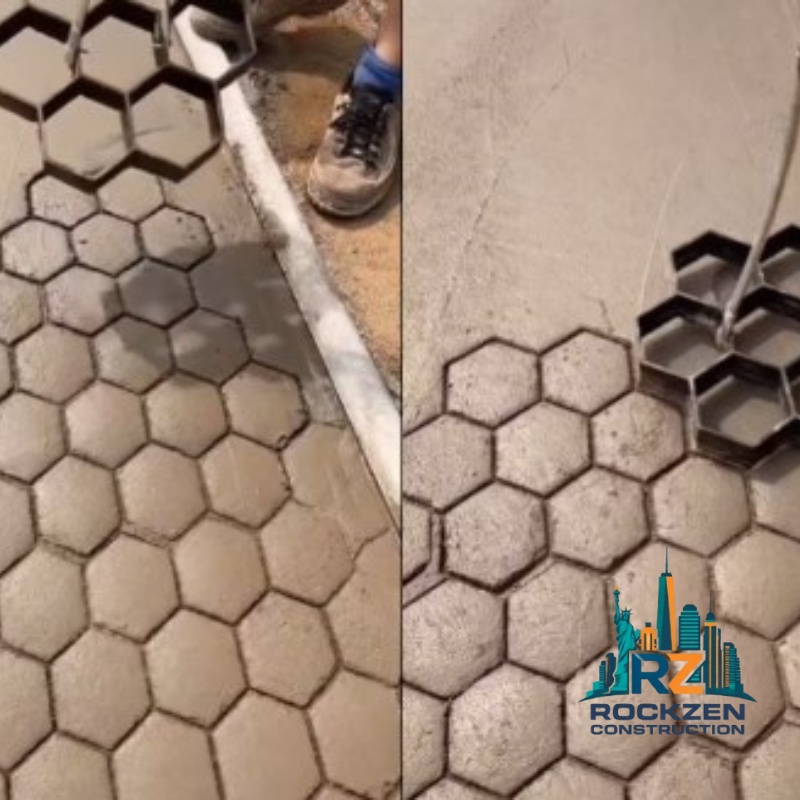
Driveway repair restores damaged asphalt and concrete surfaces to safe, structurally sound condition. Services cover crack sealing, pothole patching, resurfacing, leveling, and full reconstruction. NYC Department of Buildings (DOB) regulates driveway construction on properties connecting to public streets through curb cuts.
NYC DOT issues curb cut permits controlling driveway width, drainage specifications, and construction requirements. Licensed paving contractors perform all DOB-compliant driveway work on NY residential and commercial properties. Permit compliance before work begins prevents stop work orders and code violations.
New York City property owners are fully responsible for maintaining driveways on their property. NYC DOB oversees driveway construction for properties that connect to public street curbs. NYC DOT controls dimensional and drainage specifications through curb cut permits.
Commercial property owners carry additional obligations under NYC DOB regulations. Damaged commercial driveways creating pedestrian hazards generate NYC DOB violation notices. Licensed contractor repair within the stated deadline resolves commercial driveway violations.
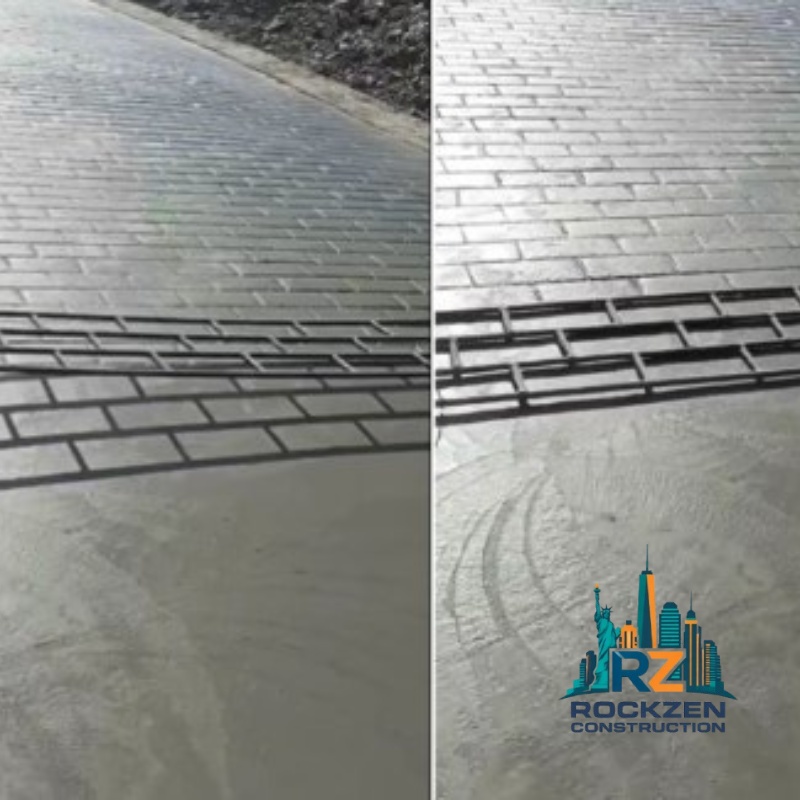
Rockzen Construction offers ten driveway repair services for New York homeowners and businesses. Services cover all five NYC boroughs. Every project uses specifications matched to driveway type, traffic loading, and NYC DOB requirements.
Asphalt driveway repair addresses crack formation, pothole development, surface raveling, and edge deterioration. Rockzen Construction uses hot mix asphalt for permanent pothole patching. Hot mix achieves full compaction strength within 24 hours. Vehicle access returns the next day.
Concrete driveway repair addresses surface spalling, joint failure, panel cracking, and settlement. Rockzen Construction uses polymer modified concrete patching compounds with strong adhesion to existing surfaces. Expansion joint restoration prevents thermal stress cracking from recurring across concrete panels.
Asphalt resurfacing adds a new hot mix layer over existing driveways that are still strong. Rockzen Construction uses polymer modified overlays on concrete driveways that have surface wear. Resurfacing costs 40 to 60 percent less than full reconstruction for driveways with a solid base.
Polyurethane foam injection lifts sunken asphalt and concrete without demolition. The foam expands under sunken panels, raising the surface to the correct level. It cures in 15 minutes, so qualifying residential driveways can have same day vehicle traffic.
Flexible rubberized crack sealant fills surface cracks under half inch (1.27 cm) width. Sealant prevents water infiltration before freeze thaw damage worsens surface conditions. Hot mix asphalt or polymer modified concrete restores structural integrity at isolated pothole locations.
Coal tar or asphalt emulsion sealcoating protects blacktop surfaces from ultraviolet oxidation. Sealcoating prevents fuel spills from soaking in and stops de icing salt from being absorbed at the surface. Rockzen Construction sealcoats qualifying asphalt driveways. First, they prepare and clean the surface.
Drainage correction restores minimum 2 percent surface grade directing water away from the driveway. Rockzen Construction installs channel drains at driveway base transitions on sites with limited natural slope. Drainage correction eliminates the primary source of subgrade saturation and surface deterioration.
Residential repair covers single family homes, multi family buildings, and co-op properties across all residential neighborhoods. Rockzen Construction coordinates with homeowners, property managers, and co-op boards. All residential work includes NYC DOB permit handling and a written project completion guarantee.
Active sinkholes, complete surface collapse, and dangerous pothole formations require emergency response. Rockzen Construction mobilizes emergency repair crews within 24 hours across all service areas. Emergency scope covers temporary hazard containment followed by permanent compliant repair after permit approval.
Rockzen USA Construction driveway repair follows six sequential steps from initial inspection through final sign off. Every step aligns with NYC DOB permit requirements and material specifications. A licensed contractor documents each stage throughout the process.
01.
A licensed paving contractor inspects the full surface. The inspection documents crack patterns, pothole locations, depressions, and drainage conditions. Subgrade stability testing reveals whether the project needs repair, resurfacing, or full reconstruction.
02.
NYC DOB permits are required for all driveway construction, replacement, and curb cut modification. Complete applications include repair scope, contractor license number, and insurance certificate. Standard NYC DOB driveway permit approval takes two to four weeks from complete submission.
03.
Damaged asphalt or concrete is removed by cold milling or saw cutting based on project scope. New aggregate base material is added and graded after surface removal. Subbase compaction meets design specifications before new surface installation begins.
04.
Hot mix asphalt arrives at 280 to 325 degrees Fahrenheit (137.8 to 162.8 degrees Celsius). Crews compact asphalt with vibratory roller equipment before heat loss affects density. Minimum 92 percent compaction of maximum theoretical density determines long term surface performance. Concrete pours in a single continuous pour per panel. Concrete mix achieves minimum 4,000 PSI (27.58 MPa) compressive strength at 28 day cure.
05.
Asphalt receives final roller passes producing smooth, uniform grade meeting drainage slope specifications. Concrete receives a broom finish texture providing the required slip resistance. Workers install expansion joints at concrete panel intervals to accommodate thermal movement.
06.
Final walkthrough confirms drainage slope, surface finish quality, edge treatment, and permit compliance. Asphalt accepts light vehicle traffic within 24 to 48 hours after final compaction. Concrete needs at least 7 days to cure before vehicles can use residential and commercial surfaces.
Single pothole patching starts around $300 on residential driveways. Full driveway reconstruction on large properties ranges from $8,000 to $30,000 dollars. Commercial driveway reconstruction reaches $75,000 dollars or more on extensive projects.
| Cost Factor | Lower Cost | Higher Cost |
|---|---|---|
| Driveway size | Under 400 sq ft (37.16 sq m) | Over 2,000 sq ft (185.81 sq m) |
| Material type | Asphalt resurfacing | Full concrete replacement |
| Subgrade condition | Sound existing base | Full base removal and reconstruction |
| Damage extent | Isolated crack or pothole | Widespread alligator cracking |
| Permit requirements | No permit needed | NYC DOB permit and site plan |
| Vehicle loading | Residential passenger cars | Commercial delivery vehicles |
| Location access | Open residential lot | Limited access urban site |
Active driveway repair work completes within one to five days on most properties. Full reconstruction takes longer due to permit processing, subbase preparation, and curing requirements. NYC DOB permit approval adds two to four weeks on replacement projects.
Asphalt accepts light vehicle traffic within 24 to 48 hours after final compaction. Full asphalt design strength develops over six to twelve months as binder hardens. New asphalt requires a minimum 30 day cure before sealcoating.
Concrete requires a 7 day minimum cure before vehicle traffic. Full 4,000 PSI (27.58 MPa) design strength develops at 28 days post-installation.
| Repair Scope | Active Work Duration |
|---|---|
| Crack sealing and pothole patching | 1 to 4 hours |
| Asphalt resurfacing overlay | 1 to 2 days |
| Full asphalt driveway replacement | 2 to 4 days |
| Full concrete driveway replacement | 3 to 5 days plus curing |
Spring and early fall are the optimal repair seasons in New York. Hot mix asphalt needs to stay above 50°F (10°C) for proper compaction. The best times are from April to June and September to October. This is before freeze thaw cycling starts.
Asphalt placed below that temperature cools too fast for proper compaction density. Summer sealcoating from June to August works well because warm temperatures help the sealer dry faster. Sealing cracks before winter in October gives the best results for driveway care.
Sealed driveway cracks block water infiltration before winter freeze thaw cycles widen them further.
Yes. NYC DOB requires permits for driveway work. This includes construction, replacement, and curb cut changes. Getting a permit helps avoid stop work orders and code violations.
Work Categories Requiring a Permit
NYC DOB driveway permits cover four types of work:
New driveway construction where there is no existing curb cut
Full driveway replacement involving complete surface and subbase removal
Curb cut modification that changes width, location, or drainage
Commercial driveway construction connecting to public street right of way
When applying for a permit, you need to verify the contractor’s license and provide insurance certificates. The site plan must show drainage direction and comply with NYC DOB driveway dimensions.
New York driveway deterioration stems from five conditions. Freeze thaw cracking and water penetration cause the most violations. Subgrade failure, heavy vehicle overloading, and tree root expansion account for the remainder. Most asphalt and concrete driveways fail due to freeze thaw cycles and water infiltration. Identifying the correct cause before repair prevents recurring surface damage.
New York driveways deteriorate from five primary causes. Each cause produces distinct damage patterns on asphalt and concrete surfaces.
New York City experiences over 100 freeze thaw cycles annually between November and March. Water enters surface cracks overnight and freezes. Expansion fractures asphalt binder and concrete structure from inside.
Concrete and asphalt expand by 9% in volume when temperatures go below 32°F (0°C). Potholes and surface raveling appear every spring. Cold patch applications address winter pothole formation on a temporary basis.
Water seeps through cracks and reaches the aggregate base layer. When the subgrade is saturated, it can’t support vehicle loads. This leads to surface depressions and structural failure.
A poor driveway drainage slope causes water to pool near building foundations. Fixing the slope during repairs targets water infiltration at its source.
Subgrade base failure happens when the layer of aggregate under asphalt or concrete loses its strength. Water saturation, frost heave, and insufficient original compaction all cause subgrade failure. Subgrade failure produces alligator cracking patterns across wide surface areas.
Only full reconstruction with proper subgrade stabilization can ensure a lasting fix for base failure. Resurfacing over a failed subgrade produces repeat cracking within two to three years.
Driveways serving delivery vehicles, oil trucks, and contractors experience accelerated surface wear. Heavy vehicle axle loads exceed residential driveway design capacity. Surface rutting, deformation, and edge collapse result from overloading residential driveways.
Commercial driveways must reinforced concrete or heavy duty asphalt specifications. Licensed paving contractors determine correct specifications based on actual vehicle loading patterns.
Mature trees adjacent to residential driveways grow roots horizontally beneath the surface. Root pressure increases as root diameter expands each growing season. Root induced lifting and cracking appear with increasing severity across tree adjacent driveways.
Root barrier installation during driveway replacement redirects future root growth downward. These barriers stop surface damage from happening on new driveways near mature trees.
Repairing costs a fraction of full replacement when the subbase is structurally sound. A licensed paving contractor evaluates four structural criteria before recommending either option. The table below compares repair conditions with those that need replacement.
Criteria
Repair Appropriate:
Cracking extent: Less than 25% of surface.
Pothole pattern: Isolated potholes, no base cracking.
Surface settling: No significant depression.
Driveway age: Under 20 years.
Cost advantage: 30% to 60% less than replacement.
Full Replacement Required:
Crack coverage: Alligator cracking over 25%.
Pothole pattern: Potholes recurring within 1 to 2 years.
Surface settling: Settling exceeds 2 inches (5.08 cm).
Driveway age: Over 25 to 30 years for asphalt, 40 years for concrete.
Cost advantage: Full reconstruction with a 20 to 30 year life.
Driveway repair is appropriate when four conditions are confirmed:
Surface cracks cover less than 25 percent of the total driveway area
Potholes are isolated without alligator cracking indicating base failure
Subgrade base layer remains structurally sound without water saturation voids
Driveway age is under 20 years without previous major structural repair
Qualifying driveways cost 30 to 60 percent less to repair than to replace.
You must fully replace when four conditions are present:
Alligator cracking covers more than 25 percent of the total driveway surface area
Multiple potholes fail within one to two years of previous repair work.
Surface settling exceeds 2 inches (5.08 cm) indicating significant subgrade voids.
Driveway age exceeds 25 to 30 years for asphalt or 40 years for concrete, indicating the end of its functional lifespan.
New reconstruction with proper subgrade stabilization delivers 20 to 30 additional.
Proactive maintenance reduces long-term driveway repair costs significantly. Asphalt driveways with consistent maintenance reach 20 to 30 years of service life. Concrete driveways with correct joint maintenance reach 30 to 50 years.
Annual Inspection
Spring driveway inspection after freeze-thaw season identifies new cracks, potholes, depressions, and drainage problems. Walking the full surface annually documents condition changes before structural base damage develops. Photographs create maintenance records for future contractor assessments.
Crack Sealing
Surface cracks under half-inch (1.27 cm) width qualify for flexible rubberized crack sealant application. Annual crack sealing extends asphalt driveway lifespan by five to ten years beyond unsealed surfaces. Timely sealing prevents water infiltration before structural base damage develops.
Preventive Sealcoating
Sealcoating blocks ultraviolet oxidation that causes asphalt binder hardening and surface brittleness. New York residential asphalt driveways benefit from sealcoating every three to five years. Fresh sealcoating restores surface appearance and protects against fuel and oil penetration.
Drainage Control
Maintaining minimum 2 percent drainage slope prevents subgrade saturation from standing water. Clearing debris from drainage paths twice annually prevents pooling during heavy rainfall events. Channel drains at base transitions manage water flow on sites with limited natural slope.
Winter Surface Protection
Sand provides effective traction on icy driveways without chemical damage to concrete surfaces. Asphalt driveways tolerate de-icing salt better than concrete on residential properties. Sand reduces surface deterioration on both asphalt and concrete compared to chloride-based de-icing compounds.
Yes. Concrete driveways with surface wear but no panel cracking qualify for polymer-modified overlay. Full panel replacement is required when cracks penetrate through the slab. Panels settled more than 2 inches (5.08 cm) also require full replacement.
Resurfacing installs a new hot mix layer over a structurally sound existing driveway. Full replacement removes the existing surface and subbase and rebuilds from the ground up. Resurfacing costs 40 to 60 percent less than full replacement on sound-base driveways.
Yes. Concrete driveways with surface wear but no panel cracking qualify for polymer-modified overlay. Full panel replacement is required when cracks penetrate through the slab. Panels settled more than 2 inches (5.08 cm) also require full replacement.
Resurfacing Versus Full Replacement
Resurfacing installs a new hot mix layer over a structurally sound existing driveway. Full replacement removes the existing surface and subbase and rebuilds from the ground up. Resurfacing costs 40 to 60 percent less than full replacement on sound-base driveways.
Rockzen Construction repairs driveways across all five NYC boroughs, Long Island, Nassau County, and Suffolk County. Every project includes NYC DOB permit handling where required. A written completion guarantee covers every project from start to finish.
Brooklyn
Brooklyn row houses and brownstone properties contain asphalt driveways accessing rear yards and garages. Heavy residential parking demand accelerates driveway edge wear from repeated vehicle maneuvering. Pre-war Brooklyn driveways frequently require specialist matching of aging concrete or brick apron materials.
Queens
Queens holds the highest concentration of single-family residential properties in NYC. Lots in Jamaica Estates, Forest Hills, and Bayside expose extended driveways to full freeze-thaw cycling. Cracking from seasonal temperature stress is the most common repair condition in Queens.
Commercial corridors on Queens Boulevard and Jamaica Avenue require commercial-grade asphalt reconstruction. Heavy delivery vehicle loading exceeds standard residential driveway design capacity across these corridors.
Manhattan driveway repair concentrates on townhouses, loading dock approaches, and parking structure entrances. Limited access urban sites require specialized equipment selection before repair begins. NYC DOB permit processing for Manhattan work involves longer borough-specific review timelines than outer boroughs.
Bronx residential driveways in Riverdale, Morris Park, and Pelham Bay experience elevated freeze-thaw damage. Inland temperature cycling produces more severe winter cracking than coastal boroughs. Aging concrete driveways from 1950s and 1960s construction frequently require full reconstruction.
Heavy commercial vehicle traffic accelerates deterioration on Bronx commercial driveways beyond residential design parameters.
Staten Island holds the highest percentage of single-family residential properties in NYC. Average driveway sizes exceed all other boroughs per property. De-icing salt accelerates surface spalling in the harbor-area climate on both asphalt and concrete surfaces.
Staten Island hillside properties require drainage slope correction during repair. Corrected slope prevents water runoff from eroding adjacent landscaping.
Nassau County communities including Garden City, Great Neck, and Hempstead contain large multi-car driveways. Mature suburban street tree canopy generates consistent root-related cracking requiring root barrier installation. Nassau County municipal permit requirements differ from NYC DOB requirements on every Long Island project.
Suffolk County communities from Valley Stream to Southampton experience full Long Island freeze-thaw cycling. Without urban heat island effects, seasonal surface damage is more severe than in the five boroughs. Sandy soil subgrade conditions across Suffolk County require aggregate base reinforcement during reconstruction.
Commercial properties along Sunrise Highway and Montauk Highway require commercial-grade asphalt for heavy vehicles.
Rockzen Construction has all the licenses, permits, certifications, and material credentials needed for driveway repair in New York. Non-compliant contractors produce premature surface failure from incorrect material specifications. Missing NYC DOB permits produce stop-work orders and violation notices. Poor subgrade preparation causes surface failure within three to five years. Rockzen Construction eliminates all three risks from the first inspection forward.
Rockzen Construction holds active NYC DOB contractor licensing for driveway construction and replacement. Every project is covered by full general liability insurance and bonding. OSHA-compliant work zone safety protocols apply from day one on every site.
Rockzen Construction delivers active hands-on expertise across both primary driveway material systems. Hot mix asphalt installation and concrete panel replacement fall within active project scope. Polyurethane foam lifting is also available on qualifying driveways. Material selection is based on structural assessment and site conditions, not material cost alone.
Rockzen Construction uses concrete mixes approved by NYC DOB. They also use hot mix asphalt that meets ASTM standards for all projects. Air-entrained concrete resists freeze-thaw damage through over 100 annual New York winter cycles. Polymer-modified asphalt binders extend resurfacing overlay lifespan beyond standard mixes.
500-plus completed construction projects across residential, commercial, and industrial properties
Driveway repair and replacement completed across all five NYC boroughs and Long Island
95 percent of permitted projects pass NYC DOB inspection on first attempt
A+ rating with the Better Business Bureau (BBB)
Verified client reviews from property owners across all service areas
Ten-plus years of active New York asphalt and concrete driveway repair experience
Every Rockzen Construction project closes with a written completion guarantee. The guarantee shows that we meet material specs, drainage fixes, and NYC DOB rules.