Got a DOT sidewalk violation in the mail? Take a breath. The clock is running, but this is fixable. You have 75 days. Rockzen USA has cleared these across all 5 boroughs. We pull the permits, pour the concrete, and get the official dismissal.
NYC sidewalk violation removal means fixing DOT-flagged defects within 75 days of the notice. Rockzen USA handles permits, demolishes defective flags, pours 4,000 PSI concrete, and requests the dismissal inspection. Every violation gets removed officially through NYC DOT.
Rockzen USA is a DOT-registered NYC sidewalk contractor. Ten years of NYC sidewalk experience back every project. Over 500 completed projects across all 5 boroughs. An A+ Better Business Bureau rating reflects consistent quality.
Rockzen holds active NYC DOT and DCWP licensing. Full liability insurance protects property owners during the work. Workers compensation covers every crew member on the job.
You never contact the DOT directly. Rockzen files the permit, does the concrete work, and requests the dismissal inspection. One team runs the whole process for you.
Every Rockzen sidewalk repair is built to pass DOT dismissal inspection. If our work does not pass, we fix it at no cost until it does.
Rockzen mobilizes on new violation notices within 5 business days. Most standard residential repairs finish within 10 business days of permit approval. Emergency Unsafe classifications get 24 to 72 hour response.
Rockzen serves Manhattan, Brooklyn, Queens, the Bronx, and Staten Island. Local knowledge of borough-specific inspector patterns applies to every job.
Rockzen provides free on-site sidewalk assessments across all 5 boroughs. Every assessment includes flag-by-flag review, cost breakdown, and permit strategy.
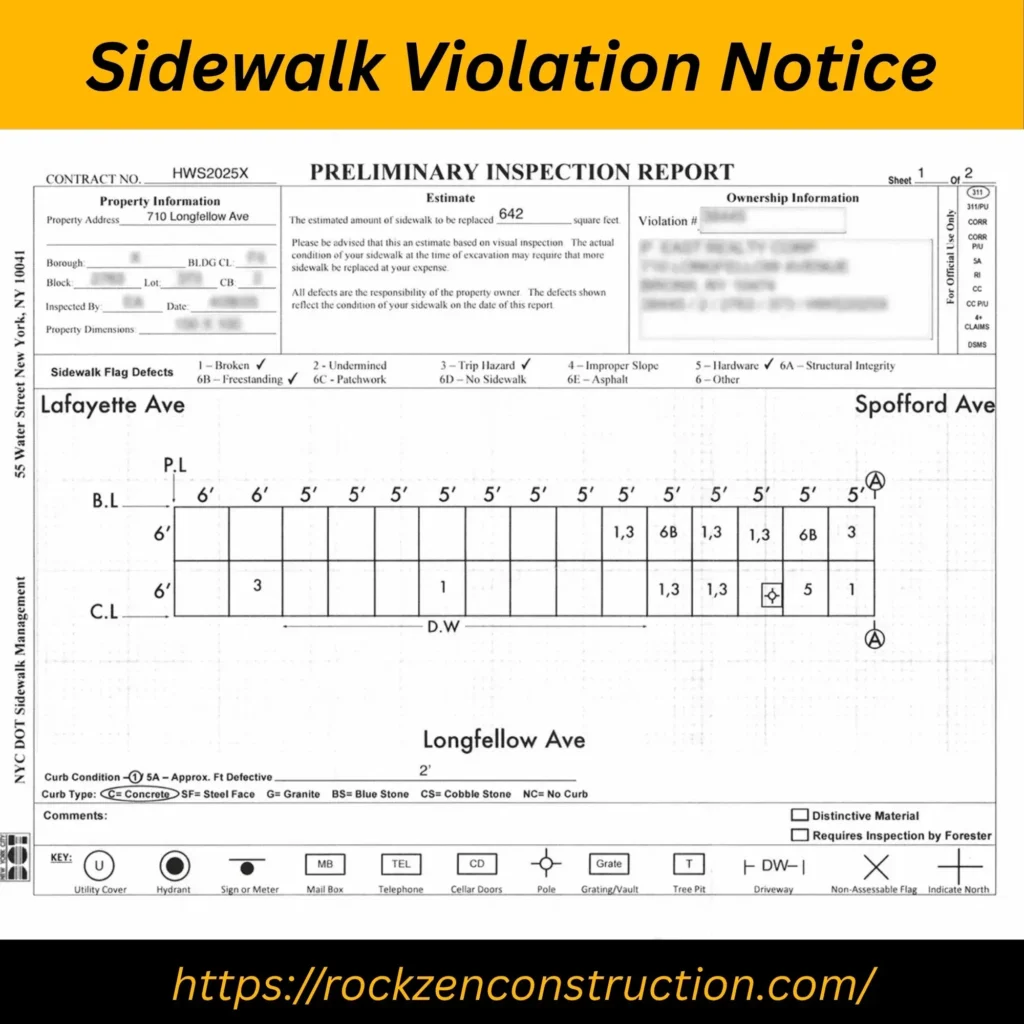
A NYC sidewalk violation is a formal notice from NYC DOT that flags defective concrete flags in front of your property. Property owners have 75 days from the mail date to fix the flagged flags. NYC DOT issues violations under NYC Administrative Code Section 19-152.
Every violation notice comes with a Preliminary Inspection Report (PIR). The PIR lists each defective flag by location, defect type, and dimension. NYC DOT requires 4,000 PSI Portland cement concrete for all repairs.
The Notice of Violation is the formal document NYC DOT mails to the property owner. The notice includes the PIR, the 75-day deadline, and instructions for filing a permit. The 75-day clock starts on the mail date, not the day you open the envelope.
An ignored violation converts into a civil penalty and eventually a property lien. City-dispatched contractors then do the work at 2 to 3 times private contractor rates. The Environmental Control Board (ECB) hears disputes on penalty amounts.
Property owners are responsible for maintaining sidewalks next to their property. NYC Administrative Code Section 19-152 applies to residential buildings, commercial properties, and mixed-use buildings across all 5 boroughs. Repair responsibility falls on the owner regardless of what caused the damage.
NYC DOT fixes only sidewalks damaged by city-owned trees on qualifying properties. The city Trees and Sidewalks Program has limited eligibility and scheduling. Most property owners get faster results by hiring a private contractor.
Tenants are generally not responsible for sidewalk violations. Some commercial lease agreements shift sidewalk maintenance to the tenant. Check your lease before assuming responsibility either way.
NYC DOT building inspectors identify defective flags during routine surveys. Inspectors document each defect with photos and measurements. The inspection becomes the Preliminary Inspection Report attached to the violation notice.
NYC DOT issues sidewalk violations for six main defect types. Tree root damage and freeze-thaw cracking cause the largest share of violations. Early identification helps property owners act before a formal notice arrives.
NYC has 50 to 60 freeze-thaw cycles each year. Each cycle expands trapped water by 9% inside concrete flags. That repeated stress fractures sidewalk surfaces over time.
NYC DOT issues violations for cracks wider than half an inch. All repair work needs 4,000 PSI Portland cement concrete with reinforcement mesh. That specification handles NYC seasonal freeze-thaw conditions.
Flag elevation differences over half an inch trigger a DOT violation. Raised flags happen when tree roots lift concrete or when soil settles after utility work. NYC DOT inspectors measure these differences precisely during every PIR assessment.
Replacing non-compliant flags with reinforced 4,000 PSI concrete fixes elevation issues. Sub-base compaction testing before replacement confirms subgrade stability. That step keeps the repaired surface level and DOT-compliant long term.
City-owned tree roots damage sidewalks on many tree-lined streets across NYC. Owners hold repair responsibility under Section 19-152 even when city trees caused the damage. Qualifying owners can apply to the NYC Trees and Sidewalks Program before hiring a private contractor.
NYC DOT classifies a sidewalk as Unsafe when defects create an immediate pedestrian fall hazard. The Unsafe classification requires same-day hazard protection and expedited permits. Emergency work resolves Unsafe conditions within 24 to 72 hours.
NYC DOT classifies missing or fully deteriorated flags as immediate violations. Full replacement uses 4,000 PSI concrete poured monolithically. Monolithic pouring reduces cold joints and produces a structurally unified surface.
NYC DOT requires a drainage pitch of half an inch per foot toward the street. Improper pitch causes standing water and accelerates freeze-thaw damage. Pitch correction requires full flag removal, sub-base regrading, and laser-level form setting.
Rockzen USA removes nine NYC DOT sidewalk violation types across all 5 boroughs. Every repair uses 4,000 PSI concrete with reinforcement mesh to DOT specifications. Every project comes with full permit management and dismissal inspection support.
Surface fissures over half an inch or structural cracking qualify. Rockzen resolves surface fissures through grouting and structural failures through full flag replacement.
NYC DOT issues an uneven surface violation when flag elevation differences exceed half an inch. Rockzen removes displaced flags and compacts the sub-base before installing new concrete. Leveling the surface removes trip hazards and supports a passing DOT inspection.
NYC DOT issues a drainage pitch violation when the sidewalk slope fails to meet the half-inch-per-foot standard. Rockzen removes all affected flags and uses laser-level tools to restore proper pitch. Correct drainage helps prevent standing water and future freeze-thaw citations.
NYC DOT issues a spalling violation when surface scaling compromises concrete structural integrity. Rockzen removes spalled flags and pours 4,000 PSI concrete using monolithic technique. Monolithic pouring reduces cold joints and produces a dismissal-ready surface.
NYC DOT issues curb cut violations when pedestrian ramps do not meet ADA standards. Rockzen installs ramps that meet ADA standards. New ramps have a 2 percent cross slope and detectable warning surfaces. Ramp running slopes meet the 8.33 percent standard to help reduce federal ADA liability.
NYC DOT issues an ADA surface violation when ramp cross slopes fail federal standards. Rockzen resurfaces these areas to meet ADA specs and DOT approval. A compliant install clears the DOT record and reduces federal ADA legal risk.
NYC DOT issues a tree root violation when city tree roots displace flags above compliance. Rockzen handles NYC Parks root pruning permits and coordinates the full removal and replacement. Expansion joints in the new concrete accommodate future root growth and help stop repeat violations.
NYC DOT issues a vault violation when concrete above subsurface vault structures deteriorates. Rockzen conducts a structural load-bearing assessment before any concrete removal on vaulted sections. New concrete installation restores DOT compliance and the structural integrity of the vault cover.
NYC DOT issues a cellar hatch violation when sidewalk door installations fail DOT load requirements. Rockzen fabricates custom replacement doors matching the existing surface finish and dimensions. Custom fabrication meets NYC DOB load requirements and restores full DOT compliance.
NYC sidewalk violation removal follows six sequential steps from notice to dismissal. A DOT-registered contractor handles each step for the owner. The owner never contacts a city agency directly.
Step: 01
Read the DOT Notice of Violation and the Preliminary Inspection Report. The PIR lists every defective flag by location, defect type, and dimension. Confirm the violation matches your property first. Wrong-property violations get disputed through an NYC 311 re-inspection request.
Only a DOT-registered contractor can pull the sidewalk repair opening permit. Confirm DOT and DCWP licensing before signing any contract. Every permit, inspection, and dismissal request runs through that contractor.
The contractor files the opening permit for the owner. NYC DOT requires the permit before any repair begins. Tree root and historic district properties need additional permits: 1. Standard sidewalk opening permit for all violation repairs 2. NYC Parks tree work permit for tree root damage 3. LPC permit for historic landmark district properties
Step: 04.
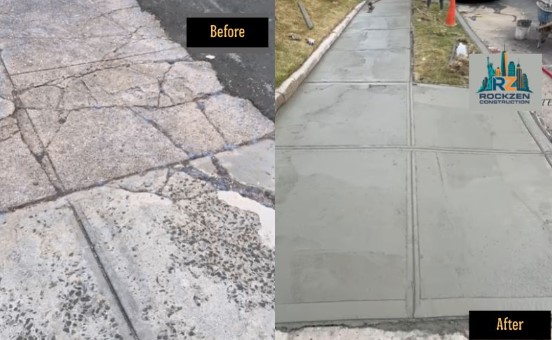
The contractor removes defective flags with pneumatic equipment. Compaction testing confirms subgrade stability before the pour. The new pour uses 4,000 PSI Portland cement concrete with reinforcement mesh: Drainage slope pitched toward the street Expansion joints at 5-foot intervals Surface finish matching adjacent existing flags
Step: 05.
The contractor requests a dismissal inspection through NYC 311 after curing. NYC DOT inspects the repair against the Preliminary Inspection Report. A dismissal inspection is required to close a violation.
Step: 06.
NYC DOT removes the violation once the repair passes. NYC DOT then notifies the County Clerk to update the record. The County Clerk clears any recorded lien after that notice.
Rockzen Construction provides complete information on how to look up a sidewalk violation in NYC, check violation details, find the property status, and understand the next steps for resolving the issue.
NYC DOT sidewalk violation removal costs typically range from $12 to $30 per square foot. The cost to repair a single standard broken concrete slab (flag) typically ranges from $500 to $800. A complete residential NYC sidewalk repair typically ranges from $1,500 to $3,000.
| Repair Type | Scope | Estimated Cost |
|---|---|---|
| Small flag violation repair | 1–2 flags, up to 25 sq. ft. | $600–$800 per flag |
| Medium violation repair | 2–5 flags, 25–100 sq. ft. | $1,500–$3,000 |
| Full sidewalk replacement | 5+ flags, 100–300 sq. ft. | $3,000–$8,000 |
| Large commercial repair | 300+ sq. ft. | $12–$30 per sq. ft. |
| Curb violation repair | Per linear foot | $45–$85 |
| Landmark District repair | Any scope | $35–$55 per sq. ft. |
| Standard permit fee | Per 300 linear ft. | $70 |
| City-imposed repair | After 75-day deadline | $50–$75 per sq. ft. |
Four factors set the total project cost:
NYC sidewalk violation removal takes 1 to 6 weeks from inspection to dismissal confirmation. Most standard residential projects finish within 5 to 10 business days after DOT permit approval.
| Stage | Time Required |
|---|---|
| DOT permit processing | 1 to 2 weeks residential, 2 to 4 weeks commercial |
| Concrete demolition and installation | 1 to 3 business days |
| Concrete curing before pedestrian use | 24 to 48 hours |
| Full concrete cure strength | 28 days |
| Dismissal inspection scheduling | 5 to 10 business days after request |
| County Clerk lien release processing | 15 to 30 business days after dismissal |
NYC sidewalk violation removal requires at minimum one NYC DOT permit before demolition begins. Tree root, historic district, and curb cut projects need additional permits. A DOT-registered contractor files every permit application.
| Permit Type | Issuing Authority | When Required |
|---|---|---|
| Sidewalk repair opening permit | NYC DOT | All concrete demolition and replacement |
| Tree work permit | NYC Parks | Damage adjacent to street trees |
| LPC permit | Landmark Preservation Commission | Historic district properties |
| Expedited permit | NYC DOT | Fewer than 30 days to the deadline |
The sidewalk repair opening permit authorizes concrete demolition and replacement on the public right-of-way. The fee is $70 per 300 linear feet for standard residential properties.
The NYC Parks tree work permit authorizes root pruning near street trees. Pruning completes before concrete demolition begins. A licensed contractor manages all NYC Parks scheduling for the owner.
NYC historic district properties need an LPC permit before work begins. Approved materials include bluestone, granite, and period-appropriate finishes. LPC repairs cost $35 to $55 per square foot.
An ignored DOT violation converts into a civil penalty and eventually a property lien. City repairs cost 2 to 3 times the private contractor rate. Timely violation removal prevents every one of these outcomes.
The DOT 75-day deadline starts on the mailing date, not the day the letter opens. Four steps must complete before the deadline:
A missed DOT deadline triggers city-dispatched contractors. City billing runs 2 to 3 times the private contractor rate. A $3,000 private repair can reach $6,000 to $9,000 under city billing. Unpaid city bills convert to property liens after 90 days. A lien blocks property sale, refinancing, and title transfer until full resolution.
Owners can dispute a civil penalty through an Environmental Control Board (ECB) hearing. The hearing does not extend the 75-day repair deadline. Hire the contractor and dispute separately if there is a real basis for challenge.
Rockzen USA offers sidewalk violation removal across all 5 NYC boroughs. NYC DOT rules apply uniformly citywide. Borough-specific inspector patterns and permit processing timelines shape each project.
Rockzen USA offers sidewalk violation removal across Manhattan. Work concentrates in historic districts like the Upper West Side, Greenwich Village, and Harlem. LPC permits apply on landmark district properties. Tight street access requires careful staging and permit sequencing.
Rockzen USA offers sidewalk violation removal across Queens. Coverage includes Astoria, Long Island City, Forest Hills, and Flushing. Post-war residential neighborhoods see frequent freeze-thaw and tree root violations. Commercial corridors need staged work to keep pedestrian access open.
Rockzen USA offers sidewalk violation removal across Brooklyn. Park Slope, Carroll Gardens, and Brooklyn Heights hold the highest concentration of brownstone sidewalk work. Tree root damage from mature street trees drives most Brooklyn violations. Landmark district properties need LPC coordination.
Rockzen USA offers sidewalk violation removal across the Bronx. Riverdale and Grand Concourse are active areas for tree root damage repairs. Pre-war apartment buildings often need larger multi-flag repair scopes. Coordination with adjacent properties speeds permit processing.
Rockzen USA offers sidewalk violation removal across Staten Island. Coverage includes St. George, New Dorp, and Great Kills. Suburban residential properties often need drainage pitch corrections. Waterfront exposure accelerates freeze-thaw damage on coastal properties.