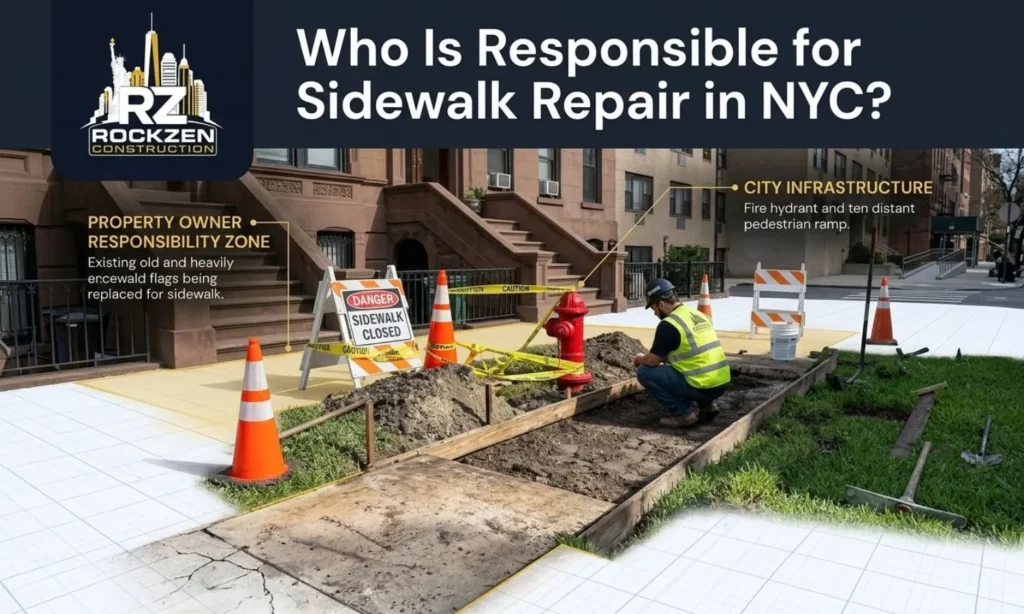
NYC property owners are responsible for sidewalk repair in front of their property. NYC Administrative Code Section 19-152 requires home or office owners to install, repair, and maintain adjoining sidewalks. Section 7-210 means owners can be held liable for pedestrian injuries caused by sidewalk defects. The City of New York carries the repair duty in three situations. These situations are city-owned frontages, city street tree damage on one-, two-, and three-family properties, and hazards created by city action.
Is the Property Owner or the City Responsible for a NYC Sidewalk?
The property owner is responsible. According to the NYC Department of Transportation (DOT), Section 19-152 makes owners responsible for installing, repairing, and maintaining the sidewalk next to their property. Section 7-210 means owners can be held liable for personal injuries caused by a sidewalk defect.
What do Section 19-152 and Section 7-210 Require?
Section 19-152 requires the repair, and Section 7-210 assigns liability for an injury. Both sections apply to the same owner at the same time.
| Attribute | Section 19-152 | Section 7-210 |
|---|---|---|
| Duty created | Install, repair, and maintain the sidewalk | Injury liability |
| Effective date | Predates Section 7-210 | September 14, 2003 |
| Who answers | Owner, through a DOT violation | Owner, sued directly |
| Trigger | Defective flag observed | Pedestrian injury |
| Enforcement | Notice of Sidewalk Violation | Civil court |
| Exemption | None | Owner-occupied one-, two-, and three-family homes (injury liability only) |
What is a sidewalk flag?
A sidewalk flag is one rectangular concrete panel. DOT documents defects flag by flag in a Preliminary Inspection Report (PIR). A single frontage can have one defective flag or ten.
Which property types carry the sidewalk repair duty?
Every NYC property type carries the Section 19-152 repair duty. One property type receives the Section 7-210 injury liability exemption, and one property type receives the city-tree repair exemption.
| Property Type | Repair Duty | Injury Liability |
|---|---|---|
| Owner-occupied one-, two-, or three-family home | Owner, except damage caused solely by city trees | Exempt under Section 7-210 |
| Residential building with 4 or more units | Owner, including city-tree damage | Owner |
| Commercial property, any size | Owner, including city-tree damage | Owner |
| Mixed-use building | Owner | Owner |
| Co-op or condo | Owner entity | Owner entity |
| Vacant lot | Owner, including city-tree damage | Owner |
| City-owned frontage | City | City |
| Corner lot | Owner, both frontages | Owner, both frontages |
The table lists each property type, who carries the repair duty, and who carries injury liability.
Does an owner-occupied small home have a sidewalk exemption?
Yes. Section 7-210 exempts owner-occupied one-, two-, and three-family homes from sidewalk injury liability, and the City of New York keeps that liability instead. The home must be owner-occupied in whole or in part and used exclusively for residential purposes. A ground-floor storefront removes the exemption, and so does a property the owner does not occupy.
Who is responsible for buildings with four or more units?
Residential buildings with four or more units carry the full duty. The repair obligation and the injury liability both sit with the owner.
Who is responsible for commercial and mixed-use property?
Commercial and mixed-use owners carry the full repair and injury duty at any size. No exemption exists. Retail frontages, office buildings, and industrial properties share the same obligation.
Who is responsible for co-ops and condos?
The owning entity carries the duty: the corporation for a co-op, and the board or association for a condo. Individual shareholders and unit owners do not answer directly.
When does the City of New York take sidewalk responsibility?
The City of New York carries sidewalk repair responsibility in three situations:
- Frontages the city owns
- Damage caused solely by city street trees on one-, two-, and three-family properties
- Hazards created by city action
Every other frontage belongs to the adjacent owner. A lease, tenant relationship, or private contract does not transfer this legal duty away from the owner.
Which frontages does the city own?
City-owned frontages include public parks, government buildings, schools, and municipal facilities. The NYC Department of Parks and Recreation (NYC Parks) maintains park-adjacent sidewalks. The property line beneath the sidewalk flag decides ownership.
Does the city pay for street tree root damage?
Yes, for one-, two-, and three-family properties. According to NYC DOT, NYC does not charge owners of these properties for sidewalk damage from a city tree or its roots. The city no longer issues violations or liens on these properties when city trees alone caused the damage.
Tree-related defects next to buildings with four or more units, commercial buildings, and vacant lots remain the owner’s responsibility, according to NYC311. Cutting or shaving city tree roots is prohibited.
Example: a Queens owner-occupied two-family home has one flag lifted by a city street tree root. City trees alone caused the damage, so NYC does not charge the owner for the repair. The same lifted flag in front of a six-unit building remains the owner’s repair and cost.
How does an owner apply for the Trees and Sidewalks Program?
Owners report the damaged location to NYC Parks through a 311 complaint, which creates the record. NYC Parks inspects the site to confirm city tree root involvement. Approval places the property in the repair queue. The program does not cover damage from privately owned trees, freeze-thaw cracking, vehicle impact, or settlement. An open DOT violation does not pause during the wait.
Source: https://www.nycgovparks.org/programs/
Which city actions return the sidewalk duty to NYC?
City vehicle damage and failed city repair work return responsibility to the city. A utility company or contractor that damages a sidewalk handles the repair. The owner documents the damage with photographs, dated records, and permit numbers, and contacts that party.
How does reimbursement work after a self-funded repair?
Reimbursement is limited. Owners who repair city tree damage themselves can pursue a claim afterward. Claims for city-caused damage go to the Office of the Comptroller within 90 days of the damage. Photographs, dated records, and the tree location support the claim.
Can a sidewalk repair duty be delegated to a tenant or manager?
No. The legal duty cannot be handed to someone else, because it is non-delegable under NYC law. A commercial lease can assign the maintenance work to a tenant, and the legal liability stays with the owner.
An injured pedestrian sues the owner directly. Courts do not require injured people to trace private contracts between owners and tenants. The owner recovers from the tenant afterward under the lease.
Example: a Manhattan landlord leases a ground-floor retail space, and the lease makes the tenant responsible for the sidewalk. A pedestrian falls on a raised flag and sues the landlord. The landlord answers the lawsuit first, then claims the cost from the tenant under the lease.
What does this mean for landlords?
A commercial landlord who leases to a retail tenant still answers the injury lawsuit. The tenant may reimburse the landlord under the lease, and that claim is a separate legal action.
What does this mean for property managers?
Property management companies do not carry the legal duty. The owner or owning entity does. A management contract can require the manager to coordinate repairs, and the owner remains legally responsible.
Which sidewalk conditions trigger a NYC DOT violation?
NYC311 lists four violation types:
- An empty space such as a void or gap below the flags (an “undermined” condition)
- Loose, cracked, uneven, or missing sections
- Improper slope causing drainage issues
- Patchwork or hardware sticking out
A trip hazard is a height difference of 0.5 inch (13 mm) or more between adjacent flags.
| Violation Type | Condition |
|---|---|
| Undermined flags | Void or gap below the flags |
| Loose, cracked, uneven, or missing flags | Rocking, broken, or missing sections, including trip hazards |
| Improper slope | Drainage problems |
| Protruding patchwork or hardware | Patchwork or hardware sticking out |
The table lists the four violation types in NYC311’s wording and the condition each one describes.
What does NYC DOT do?
DOT inspects sidewalks across all five boroughs and documents defective flags in the PIR. DOT issues a Notice of Sidewalk Violation to the owner. DOT reinspects after the owner requests a dismissal inspection. Inspections follow blocks where injuries or complaints were reported, and residents can report defects through NYC 311.
What does NYC DOT not do?
DOT does not repair sidewalks on request, does not fund repairs for owners, and does not extend the 75-day period when a permit is issued. DOT treats the newest violation as the one that replaces earlier notices.
What happens after a Notice of Sidewalk Violation in NYC?
A Notice of Sidewalk Violation gives the owner 75 days to repair the sidewalk. The 75 days start on the certified mail receipt date, or on the posting date when the notice is posted. The violation carries no fine. A copy is filed with the County Clerk until the city confirms satisfactory repairs, and the violation can complicate selling or refinancing the property.
Example: a Brooklyn owner of a four-unit building receives a Notice of Sidewalk Violation by certified mail on March 3. The 75 days end on May 17. A permit filed on April 1 does not move that date. The owner hires a DCWP-licensed contractor, finishes the repair on May 2, and submits the dismissal inspection request with the violation number and the permit number.
How long does an owner have to repair the sidewalk?
An owner has 75 days from receipt, and a sidewalk permit does not extend the period. Work waits for weather when a violation is issued in winter.
How does an owner verify or correct the violation?
Some violations are issued to the wrong owner. Compare the notice address, block, and lot number against the deed. A wrong-owner correction goes by mail to the Department of Finance Correspondence Unit. A status request or a copy request uses the 4 to 6 digit violation number.
How does an owner appeal a sidewalk violation?
An owner appeals within 75 days of receiving the notice when the defects marked in the PIR do not exist. DOT schedules a reinspection within 180 days of the request. A different inspector performs it without the original report, and the result is final.
What does DOT charge when an owner does not repair?
DOT may hire a contractor after 75 days without repairs, and the Department of Finance bills the owner. The estimated charge equals the PIR square footage multiplied by the cost per square foot printed in the violation letter. Driveway areas use the 7-inch concrete rate, and all other areas use the 4-inch rate.
Owners have 90 days to pay before interest is added. After 90 days, interest accrues and a monetary lien may be placed on the property. The city contractor’s work carries an 18-month guarantee. Flags marked “X” may be replaced at no charge at the engineer’s discretion.
How does an open violation affect a sale or refinance?
Open violations and liens surface in title searches. Buyers and lenders ask for resolution before closing. Removing a County Clerk lien may require a dismissal inspection first.
How does an owner repair a NYC sidewalk legally?
An owner repairs a sidewalk in four steps: hire a licensed contractor, obtain the permit, complete the repair, and request a dismissal inspection.
Which license must the sidewalk contractor hold?
Any sidewalk repair costing more than $200 requires a contractor holding a Department of Consumer and Worker Protection (DCWP) Home Improvement Contractor License. The contractor obtains the sidewalk construction permit. Owners verify the license in the DCWP database, which lists complaints against contractors.
Does an owner need a permit to fix a NYC sidewalk?
Yes. NYC DOT requires a sidewalk construction permit before sidewalk concrete work begins. A contractor applies through the NYC Streets portal, and homeowners doing their own work can apply by mail. Full flag replacement and any concrete removal or replacement require a permit.
How much does a NYC sidewalk permit cost?
The permit fee is $70 for every 300 linear feet (91 m) of sidewalk on one property. A corner property needs two permits, one for each frontage, at $140 total.
How does a homeowner apply for the permit by mail?
A homeowner’s mail application includes the application form, a notarized Affidavit of Ownership, a stamped self-addressed envelope, and a certified check payable to NYC DOT. The violation number goes on the “For the Purpose of” line.
A homeowner’s mail application includes the application form, a notarized Affidavit of Ownership, a stamped self-addressed envelope, and a certified check payable to NYC DOT. The violation number goes on the “For the Purpose of” line.
How does an owner request a dismissal inspection?
After repair, the owner submits a dismissal inspection request with the violation number and the permit number. A DOT inspector confirms the work, and the violation is removed.
When is the city liable for a sidewalk injury?
The City of New York is liable for a sidewalk injury in three situations. City action caused the defect, the city received prior written notice of the defect and did not repair it, or the sidewalk is in front of an owner-occupied one-, two-, or three-family home covered by the Section 7-210 exemption.
What is the prior written notice requirement?
Prior written notice means the city was told about the defect in writing before the injury. New York requires it before the city carries liability for most sidewalk defects. The injured person files a Notice of Claim within 90 days of the injury under General Municipal Law §50-e. A lawsuit follows within one year and 90 days.
The deadline runs from the incident date, not from discovery of the injury. Missing the window closes the claim against the city.
Does insurance cover sidewalk repair or pedestrian injuries?
When is New York City responsible for sidewalk repair?
The City of New York carries sidewalk repair responsibility in three specific situations. City-owned frontages. Damage from city-owned street trees under a dedicated program. Hazards created directly by city action.
Every other frontage in NYC belongs to the adjacent property owner. No lease agreement, tenant relationship, or private contract transfers this legal duty away from the owner.
What are city-owned frontages?
The City owns the sidewalk duty on public parks, government buildings, schools, and municipal facilities. NYC Department of Parks and Recreation maintains park-adjacent sidewalks directly. The property line beneath the sidewalk flag decides ownership.
What damage does the city cover from street trees?
NYC Department of Parks and Recreation owns most street trees in the city. Tree roots that lift adjacent sidewalks qualify for the NYC Trees and Sidewalks Program. The city pays for these repairs. Program details sit at NYC Parks.
What hazards from city action shift liability?
City vehicle damage returns responsibility to NYC. Failed city repair work does the same. Utility work under city permit can shift responsibility to the utility company. Photographs, dated records, and permit numbers carry the claim. Big Apple Pothole and Sidewalk Protection Corporation maps document defects for prior written notice requirements.
What does NYC DOT do and not do for sidewalks?
NYC DOT enforces sidewalk compliance but does not perform routine repairs on private property. The agency inspects sidewalks, issues violation notices, sets repair deadlines, and reinspects completed work. DOT hires contractors only after property owners ignore the 75-day repair window.
What does NYC DOT do?
DOT inspects sidewalks across all five boroughs. Inspectors document defective flags and issue Notice of Violation letters. Notices go to the property owner of record at the address filed with the city. DOT reinspects after property owners request final inspection. City agency inspectors also respond to NYC 311 sidewalk complaints from residents.
What does NYC DOT not do?
DOT does not repair sidewalks proactively on private property. The agency does not fund repairs for property owners. DOT does not extend the 75-day deadline for disputes or hardship claims. Full DOT specifications sit at NYC DOT sidewalks.
What counts as a sidewalk defect in NYC?
NYC DOT classifies four sidewalk defect types under Section 19-152. Trip hazards, structural failures, surface deterioration, and improper slope. Each defect type triggers a violation when inspectors document it. Sidewalk crack conditions above quarter-inch width also qualify as defects.
Sidewalk defect categories
| Defect Type | Damage Condition |
|---|---|
| Trip Hazard | Vertical displacement over half inch |
| Structural Failure | Cracked or missing concrete panels |
| Surface Deterioration | Spalling, scaling, or worn surface |
| Improper Slope | Non-compliant drainage or ADA grade |
Section 7-210 vs Section 19-152 comparison
| Attribute | Section 7-210 | Section 19-152 |
|---|---|---|
| Duty Created | Injury liability | Physical repair |
| Effective | September 14, 2003 | Predates Section 7-210 |
| Who Answers | Owner, sued directly | Owner, via DOT violation |
| Exemption | Owner-occupied 1–3 family homes | See truth range below |
| Trigger | Pedestrian injury | Defective flag observed |
| Enforcement | Civil court | Notice of violation |
Can property owner liability for sidewalks be delegated?
No. Sidewalk responsibility is a non-delegable duty under NYC law. This principle protects pedestrians. A commercial lease can assign the maintenance work to a tenant, but the legal liability stays with the property owner.
Why does the duty not transfer?
An injured pedestrian sues the property owner directly. Courts do not require injured people to chase private contracts between owners and tenants. The property owner recovers from the tenant later through the lease agreement.
What does this mean for landlords?
A commercial landlord who leases to a retail tenant still answers the injury lawsuit. The tenant might reimburse the landlord under the lease. That is a separate legal action after the primary claim resolves. Sidewalk cafe operators face similar arrangements with underlying property owners.
What does this mean for property managers?
Property management companies do not carry the legal duty. The owner or owning entity does. A management contract can require the manager to coordinate repairs, but the owner remains legally responsible. This applies to residential and commercial properties across NYC.
Who is responsible by NYC property type?
Property type determines whether the Section 7-210 injury exemption applies. Every NYC property type carries the Section 19-152 repair duty. Only one property type gets the injury liability exemption.
NYC sidewalk responsibility by property type
| Property Type | Repair Duty | Injury Liability |
|---|---|---|
| Owner-occupied 1–3 family | Owner | City, under 7-210 exemption |
| Residential, 4 or more units | Owner | Owner |
| Commercial, any size | Owner | Owner |
| Mixed-use building | Owner | Owner |
| Co-op or condo | Owner entity | Owner entity |
| City-owned frontage | City | City |
| Corner lot | Owner, both frontages | Owner, both frontages |
Who is responsible for owner-occupied small homes?
Section 7-210 exempts owner-occupied one, two, and three-family homes from injury liability. The property must serve exclusively residential purposes. An owner living elsewhere loses the exemption. A ground floor storefront removes it. Full tenant occupancy also removes it.
Who is responsible for larger residential buildings?
Residential buildings above three units carry the full duty. Both the repair obligation and the injury liability sit with the owner. Building size does not soften either duty.
Who is responsible for commercial and mixed-use property?
Commercial property owners carry full repair and liability duty at any size. No exemption exists. Retail frontages, office buildings, industrial properties, and mixed-use buildings share the same obligation. Pedestrian volume raises the exposure. The legal duty stays identical.
Who is responsible for co-ops and condos?
The owning entity carries the duty. For a co-op the corporation carries it. For a condo the board or association carries it. Individual shareholders and unit owners do not answer directly. This applies to buildings under management by any type of board structure.
When is the city liable for sidewalk injuries?
The City of New York carries injury liability only when city action caused the defect or when the property owner falls under the Section 7-210 exemption. Even then, prior written notice requirements often apply.
What is the prior written notice requirement?
New York requires prior written notice before the city carries liability for most sidewalk defects. Big Apple Pothole and Sidewalk Protection Corporation maps document defects for this purpose. New York General Municipal Law sets the Notice of Claim window at 90 days.
Missing the 90-day window closes the claim against the city. The deadline runs from the incident date, not from discovery of the injury.
What is city action liability?
City vehicles that damage sidewalks return liability to NYC. Failed city repair work does the same. Utility contractors working under city permit can carry responsibility for damage they cause. Documentation carries the claim.
How does the Section 7-210 exemption transfer liability?
Owner-occupied one to three family homes shift injury liability to the city. This is the only property-type exemption in Section 7-210. The property must be exclusively residential and owner-occupied to qualify.
What is the free sidewalk repair program in NYC?
The NYC Trees and Sidewalks Program is the only city-funded sidewalk repair program. NYC Department of Parks and Recreation covers the full cost when city-owned street trees caused the damage. The program does not cover damage from any other cause.
What does the program cover?
The program covers flags lifted or cracked by city street tree roots. Damage from privately owned trees does not qualify. Freeze-thaw cracking, vehicle damage, and settlement do not qualify.
How do you apply for the sidewalk repair program?
Property owners report the damaged location to NYC Parks Department. A NYC 311 complaint creates the record. NYC Parks inspects the site to confirm city tree root involvement. Approval places the property in the repair queue.
Waits run into multiple years at current demand. An open DOT violation does not pause while owners wait in the queue. Owner-occupied small homes receive priority consideration.
How does reimbursement work after self-funded repair?
Reimbursement exists and stays limited. Property owners who repair city tree damage can pursue a claim afterward. Filing through the program first preserves the stronger position. Photographs, dated records, and tree location support the causation claim.
What happens if you receive a sidewalk violation?
A NYC DOT Notice of Violation gives 75 days to complete the repair through a licensed contractor. The violation carries no immediate fine. The city records it with the county clerk as a public property record. Ignoring the notice transfers the work to the city at higher cost.
What is the 75-day repair window?
NYC DOT starts the clock on the issuance date, not the delivery date. Notices go to the owner address on file with the city. A stale address costs weeks of the window. NYC property owners should verify their address is current with the Department of Finance.
What happens if you ignore the notice?
The City of New York repairs an ignored violation directly. City-contracted repair costs $50 to $75 per square foot. A 20 percent administrative fee gets added through the Department of Finance. Unpaid charges become a property lien within 90 days.
How does an open violation affect sale and refinancing?
Open violations surface in title searches. Title companies flag them as clouds on title. Buyers and lenders ask for resolution before closing. Recorded liens must be satisfied before sale. Refinancing lenders treat open violations as title defects.
What should you do if you own the property?
You have three practical decisions to make after receiving a sidewalk violation notice.
How do you verify the violation is yours?
Some violations get issued to the wrong property. Compare the notice address, block, and lot number against your deed. Wrong-property violations dispute through NYC 311 reinspection requests. Neither dispute pathway extends the 75-day deadline.
How do you hire a licensed contractor?
Only licensed sidewalk contractors can file NYC DOT sidewalk permits. Permits process through the New York City Department of Buildings (DOB) NOW system at DOB NOW. Standard processing takes two to four weeks. Emergency permits process in three to five business days.
What does your insurance actually cover?
Homeowners insurance covers pedestrian injury liability but excludes repair costs. Commercial premises liability policies carry the injury coverage as standard. New York Civil Practice Law and Rules (CPLR) sets personal injury statute of limitations at three years. A sidewalk injury claim can arrive long after the incident.
How much does sidewalk repair cost in NYC?
Cost tracks flag count, defect severity, and permit requirements rather than frontage length. Private licensed contractors charge $12 to $30 per square foot for standard replacement. City takeover after the 75-day deadline runs $50 to $75 per square foot.
| Repair Type | Cost |
|---|---|
| Single flag replacement, up to 25 sq ft | $500 to $800 |
| Standard concrete replacement, per sq ft | $12 to $30 |
| Full residential sidewalk, around 100 sq ft | $1,500 to $3,000 |
| Curb repair, per linear foot | $45 to $85 |
| NYC DOT sidewalk permit, per 300 linear feet | $70 |
| Corner property permits, two required | $140 total |
| City takeover cost, per sq ft | $50 to $75 plus 20% fee |
What drives sidewalk repair costs higher?
Tree root involvement adds $250 to $1,000 for arborist coordination. Americans with Disabilities Act (ADA) curb ramp installation adds $500 to $2,000 per ramp. Historic district properties may need extra material coordination and two to four weeks of approval time. Sidewalk vault work adds significant cost on older Manhattan properties.
How much does NYC charge for sidewalk repair?
NYC charges $50 to $75 per square foot when the city takes over sidewalk repair after the 75-day deadline. A 20 percent administrative fee gets added through the NYC Department of Finance. Total city-charged repair costs run two to three times what a licensed private contractor charges.
Why does NYC charge more than private contractors?
The city hires contractors under emergency procurement rules. Emergency contracting bypasses competitive bidding. Contract rates run higher than open-market pricing. Administrative processing adds cost the property owner never sees on a private quote.
How does NYC bill the property owner?
The Department of Finance issues the bill after the city completes repair work. Payment is due within 30 days of the bill date. Unpaid bills within 90 days become property liens. Property liens attach to the deed and travel with the property through any sale.
🛡️ How do you avoid NYC repair charges?
Hire a licensed private contractor within the 75-day repair window. Private contractors charge $12 to $30 per square foot for standard replacement. Complete permit filing early since DOT permits process in two to four weeks.
Do you need a permit to fix a NYC sidewalk?
Yes. NYC DOT requires a Sidewalk Construction Permit before any sidewalk concrete work begins. Only licensed contractors can file the permit. Property owners cannot pull the permit personally. Unpermitted work produces stop-work orders and additional violations.
How does the permit application work?
Licensed contractors file the permit through the New York City Department of Buildings (DOB) NOW system. Standard processing takes two to four weeks. Emergency permits for Unsafe classification violations process in three to five business days. Full permit specifications sit at NYC DOT street work permits.
What do NYC sidewalk permits cost?
Standard permit costs $70 per 300 linear feet of sidewalk work. Corner properties need two separate permits, one for each street frontage, at $140 total.
What sidewalk work requires a permit?
Full flag replacement requires a permit. Any concrete removal or replacement requires a permit. Crack sealing under 0.25 inches does not require a permit. Surface cleaning does not require a permit. Sidewalk shed installation for construction above sidewalks requires a separate DOB permit.
Is sidewalk repair covered by homeowners insurance?
No. Standard homeowners insurance does not cover sidewalk repair costs. Insurers classify sidewalk repair as maintenance, which falls under standard policy exclusions. Coverage does exist for pedestrian safety and injury liability, but the concrete work itself comes out of the owner’s pocket.
What does homeowners insurance cover?
Personal liability coverage answers pedestrian injury claims from sidewalk falls. Medical payments coverage handles minor injury costs without a formal claim. Umbrella policies extend liability limits for higher-exposure properties.
What does homeowners insurance exclude?
Repair costs for the concrete panels themselves. Wear and tear damage from freeze-thaw cycling. Damage from tree roots. Any defect classified as maintenance failure.
What does commercial property insurance cover?
Commercial premises liability comes standard on business property policies. Limits and exclusions vary between insurers. Higher pedestrian volume justifies higher liability limits. New York experiences 50 to 60 freeze-thaw cycles yearly, which drives ongoing sidewalk deterioration.
How can property owners prevent sidewalk damage in NYC?
Preventive sidewalk maintenance reduces long-term repair costs. Annual inspection catches minor damage before violations develop. Seasonal maintenance protects concrete surfaces from the freeze-thaw damage that hits NYC every winter.
What is a good annual inspection schedule?
Walk your sidewalk frontage every spring after freeze-thaw season. Document new cracks, displacement, and surface spalling with photos. Take photos from the same angles each year to track changes.
How does drainage maintenance prevent damage?
Proper drainage slope directs water away from sidewalk surfaces and building foundations. Clogged drains create standing water that accelerates concrete deterioration. Clear debris from sidewalk drains twice annually to prevent water pooling during heavy rainfall.
When should crack sealing happen?
Pre-winter crack sealing in October prevents water infiltration before freeze-thaw season begins. Sealing surface cracks under 0.25 inches wide costs significantly less than full flag replacement. Annual crack sealing extends sidewalk lifespan by 5 to 10 years.
How should you monitor tree roots?
Tree-adjacent sidewalk sections need closer monitoring than sections without nearby trees. Visible root growth at panel edges signals impending uplift. Contact NYC Parks Department about aggressive root growth from city trees. Coordinated root management prevents the uplift that creates trip hazard violations.
What winter maintenance protects concrete?
Sand provides slip resistance on icy sidewalks without the chemical damage caused by de-icing salt. Chloride compounds in salt attack concrete surfaces and accelerate surface spalling. Switching from salt to sand reduces long-term concrete deterioration.
🚧 Found Out the Sidewalk Is Yours?
The 75-day deadline starts the day NYC DOT issues the notice — not when it reaches your mailbox.
✔ Check My Frontage 📞 646-452-2552