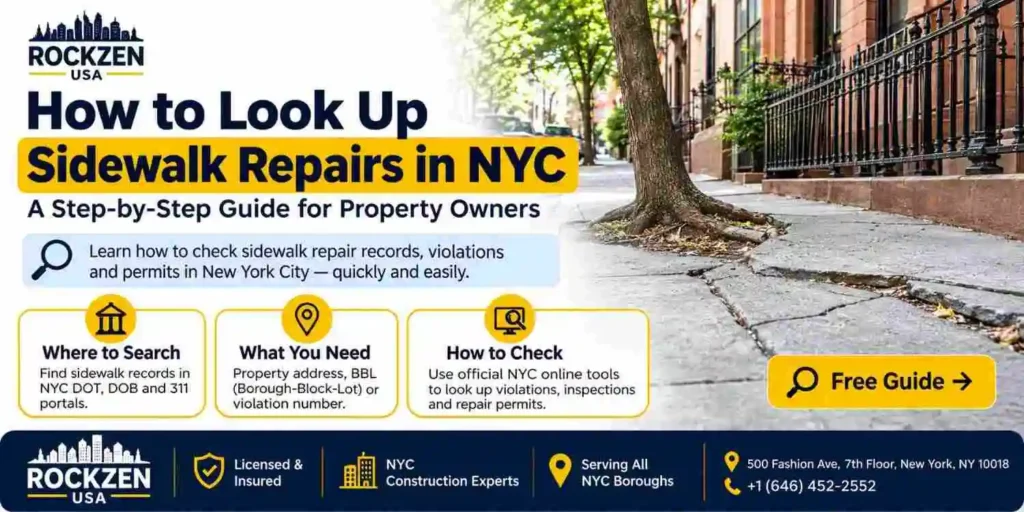
You got a letter about a sidewalk violation, or a neighbor filed a 311 complaint, and now you need to find the actual record. NYC keeps these records in three separate places. Which one you check depends on what you’re looking for. Get that part right and the search takes ten minutes instead of an afternoon.
Sidewalk violations live in the NYC DOT system. 311 complaints live on the NYC 311 status page. Repair permits live in the DOT permit system. You need either the property address or the specific record number to pull any of them.
How Do You Look Up Sidewalk Repairs in NYC?
Three city systems hold sidewalk records. Check the NYC Department of Transportation (DOT) portal for violations. Check the NYC 311 status page for complaints. Check the DOT permit system for repair permits. Each one needs a property address or a record number to return results.
The record you’re after decides where you start. Checking for open violations? Go to DOT. Tracking a complaint you filed? Go to 311. Confirming a repair was done and closed out? Check the permit system.
| Record Type | Where to Search | What You Need |
|---|---|---|
| Sidewalk violation | NYC DOT portal | Address or violation number |
| 311 complaint | NYC 311 status page | Service request number |
| Repair permit | DOT permit system | Address or permit number |
| Inspection record | NYC DOT portal | Violation or permit number |
Which Sidewalk Record Are You Looking For?
There are five record types across the NYC systems. Knowing which one you need keeps you out of the wrong database. Each marks a different point in the process, from the first complaint to the final closed inspection.
Sidewalk Violation
A sidewalk violation is a formal notice from DOT that a sidewalk fails city standards. It names the specific defect, such as a crack, a trip hazard, or an ADA compliance problem. It also names the property owner as responsible and sets a repair deadline. This is the record most owners are looking for.
311 Complaint
A 311 complaint is a report filed by a resident or a pedestrian. It flags a sidewalk problem to the city before any formal violation exists. The complaint can trigger a DOT inspection. Every complaint gets a service request number you use to track it.
Repair Permit
A repair permit authorizes concrete sidewalk work under DOT rules. A licensed contractor pulls the permit before repair starts. The record shows the approved scope, the contractor, and the work dates. A closed permit is proof the repair was done legally.
Repair Status
A repair status tells you where a case stands. The common statuses are open, in progress, completed, and closed. The status links the original violation or complaint to the actual work. Checking it tells you whether you still owe the city anything.
Inspection Record
An inspection record is the DOT inspector’s assessment of the sidewalk. It confirms whether a defect meets violation criteria, or whether completed work passed. This record closes the loop between a violation and its fix. It’s your final proof that the case is resolved.
What Information Do You Need Before Looking Up Sidewalk Records?
You need one of three things: the property address, the Borough, Block, and Lot (BBL), or a record number. Any one of them narrows the search fast. The address works across all three systems. A record number pulls the exact case in one step.
Property Address
The address is your main search key in all three systems. Enter the house number, the street, and the borough. It returns every record tied to that property. Start here when you don’t have a record number.
Borough, Block, and Lot (BBL)
The Borough, Block, and Lot (BBL) is the city’s unique ID for a parcel. It clears up confusion when several properties share a similar address. You’ll find it on your property tax bill or the city’s digital tax map. Some systems let you search by BBL directly.
Service Request, Violation, or Permit Number
A record number pulls one case straight away. The 311 service request number tracks a complaint. The violation number tracks a DOT violation. The permit number tracks approved work. Any of these skips the address search entirely.
How to Look Up a Sidewalk Violation by Address
Search the NYC DOT portal using your property address. Enter the borough, house number, and street in the sidewalk violation search. The system returns any open or closed violations on that property. Each result shows the violation number, the defect, and the status.
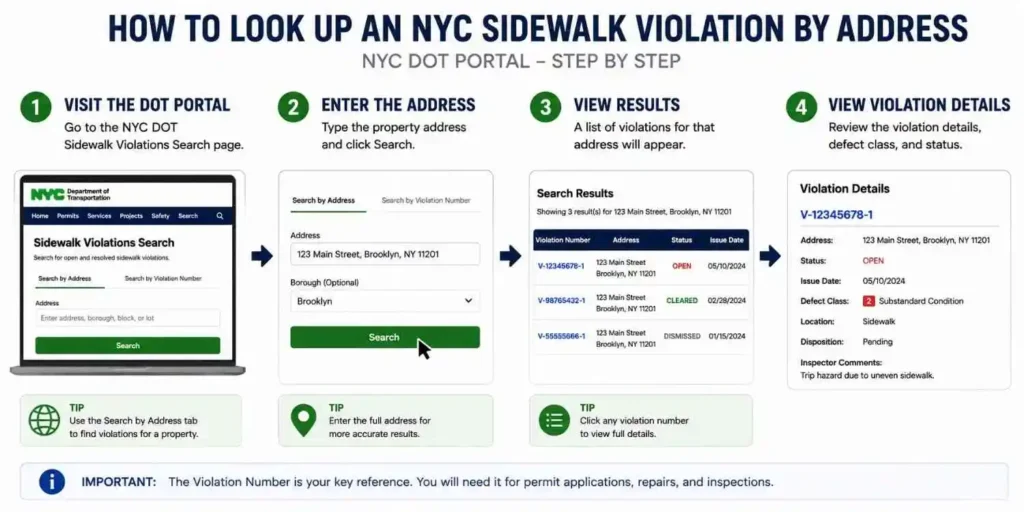
Each violation lists its defect type. A trip hazard, a crack, or a missing section shows up as a separate defect. The record also shows the issue date and the repair deadline. An open status means the work is still on you as the property owner.
No violation came up? The property may have no open record. Or a complaint may exist without a formal violation yet. Check the 311 system to see if a complaint is still sitting there waiting on an inspection.
How to Track an NYC 311 Sidewalk Complaint
Track a 311 sidewalk complaint with the service request number on the 311 status page. Enter the number to see the current stage. The status tells you whether the complaint is open, assigned for inspection, or closed. It also shows which agency picked it up.
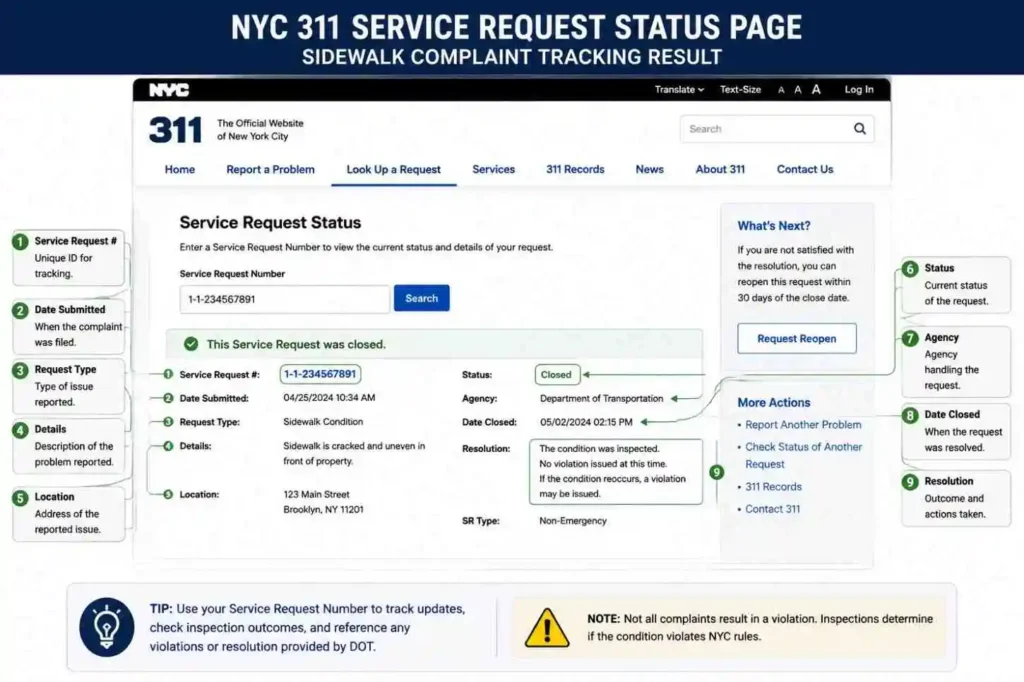
A complaint routed to DOT or the public works department can lead to an inspection. If the inspector confirms a defect, the complaint can turn into a formal violation. Tracking it shows that path from report to inspection to violation.
Lost the service request number? Search recent complaints by address in the NYC Open Data 311 dataset. It lists service requests by location and date. That’s the fallback when the confirmation number is gone.
How to Check Sidewalk Repair Permits
Check a repair permit in the DOT permit system using the address or the permit number. The record shows the approved scope, the licensed contractor, and the permit dates. A closed permit with a passed inspection confirms the work was done legally.
Permit records are useful in a few real situations:
- A buyer confirms prior repair work through the permit history.
- An owner verifies that a contractor actually pulled the permit.
- An open permit with no completion date flags work that was started but never closed out.
| Permit Field | What It Shows |
|---|---|
| Permit number | The unique record ID |
| Work scope | Approved repair type and area |
| Contractor | The licensed company doing the work |
| Issue date | When the work was authorized |
| Status | Open, active, completed, or closed |
What Do Sidewalk Record Statuses Mean?
A record status tells you where the case stands and what you still owe. Each status carries either an obligation or a confirmation. Read it right and you know whether you need to act.
Open is the status that carries risk. It means the city can do the repair and bill you if the deadline passes. Closed is the one you want. It confirms the sidewalk meets city standards and you’re done.
Complaint vs Violation vs Permit vs Repair Record
These four records mark different stages of the same process. A complaint reports the problem. A violation makes it official. A permit authorizes the fix. A repair record confirms it’s done. Mix them up and you’ll search the wrong system.
The stages run in order. A complaint can become a violation. A violation needs a permit to fix. A permit leads to a repair record. That’s why one property can carry several linked records at the same time.
What Should You Do After Finding a Sidewalk Record?
Your next move depends on the record type and its status. An open violation needs action now. A pending complaint needs watching. A closed record just needs to go in your property file.
For an open violation, line up the repair before the deadline. The work needs a licensed contractor and a DOT permit. Get a written cost estimate to set your budget. Finishing before the deadline keeps the city from doing the work and billing you at a much higher rate.
For a pending complaint, watch the status to see if it escalates. Fixing the defect early can head off the formal violation entirely. A proactive repair clears both the safety hazard and your liability.
Why Can’t You Find a Sidewalk Record?
An empty result usually comes down to a few things. The most common is an address that doesn’t match the city’s format. The wrong borough returns nothing. And a brand-new complaint may not be in the public system yet.
- Address format mismatch: the street or number was entered differently than the city has it
- Wrong borough: the same street name exists in more than one borough
- Record lag: a recent complaint or violation hasn’t published to the public portal yet
- No record exists: the property genuinely has no open case
- Wrong system: you’re searching for the record in the wrong database
Searching by BBL instead of address fixes most format problems. The BBL is exact and cuts out street-name confusion. If nothing shows up, call 311 directly to confirm whether a case exists behind the scenes.
Who Is Responsible for Sidewalk Repairs in NYC?
In NYC, the property owner is responsible for the sidewalk repair in front of their property. That covers repair, maintenance, and liability if someone trips and gets hurt. It applies to most residential and commercial properties across all five boroughs. The city takes responsibility only in a few defined cases.
This is the reason the records matter in the first place. A violation names you. A permit gets filed on your behalf. A repair record protects you from liability. For the full breakdown of owner obligations, exemptions, and the governing code, see Rockzen’s sidewalk responsibility guide.
Common Sidewalk Problems That Create Records
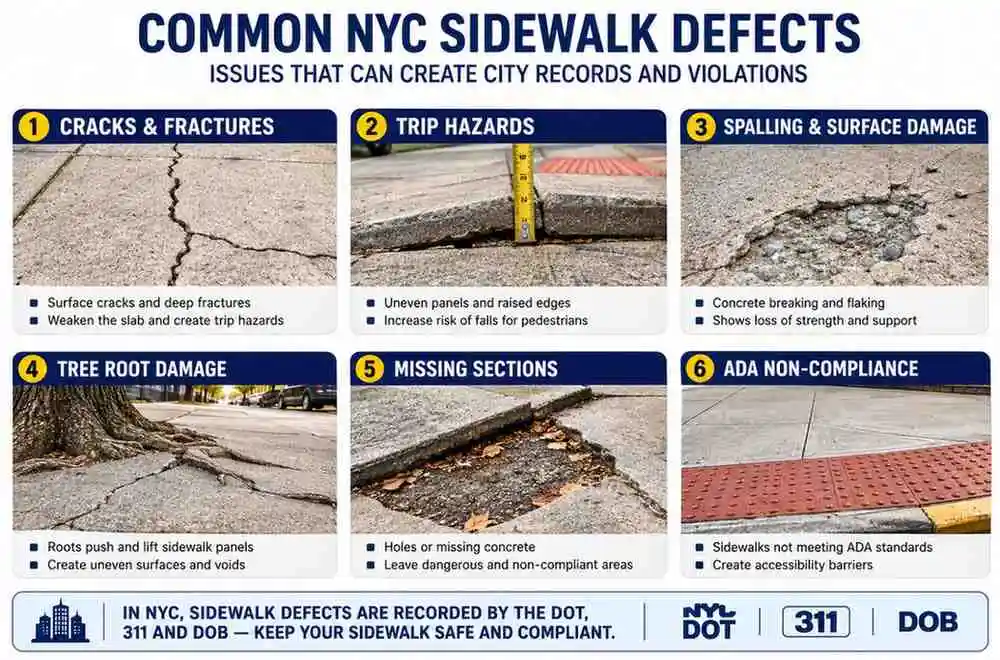
Most sidewalk records come back to a handful of physical defects. Each one maps to a repair method and a record type. Knowing the defect tells you what the record will take to close.
- Cracks from freeze-thaw cycling, sealed or replaced depending on width
- Trip hazards from displaced flags, ground down or replaced
- Spalling from deicing salt, resurfaced or replaced by severity
- Tree root upheaval that needs coordinated concrete and root work
- Missing sections exposing the base, which need full replacement
- ADA compliance failures in slope or surface, which need regrading
Any of these can start as a 311 complaint and become a violation after inspection. The repair method sets the permit scope and the cost. A crack sealed early avoids the trip hazard and violation it would otherwise turn into.
Frequently Asked Questions
Can I look up a sidewalk violation without a violation number?
Yes. Enter the property address in the NYC DOT sidewalk violation portal. It returns every violation on that property. Use the BBL if the address brings back ambiguous results.
Is a 311 complaint the same as a sidewalk violation?
No. A 311 complaint is an informal report from a resident. A violation is a formal notice from a DOT inspector. A complaint can lead to a violation but carries no legal weight on its own.
How do I know if my sidewalk violation is closed?
Check the violation status in the DOT portal. A closed or dismissed status means it’s resolved. Closed follows a passed inspection after the repair is done.
Do I need a permit to repair my sidewalk in NYC?
Yes. Concrete sidewalk repair or replacement needs a DOT permit. A licensed contractor pulls it before work starts. Sealing minor surface cracks may not require one.
How long does a sidewalk violation stay on record?
It stays until the repair is done and inspected. A closed status clears it. Left unresolved, it can lead to city-performed repair billed to you.
Can I find out who repaired a sidewalk before?
Yes. The DOT permit record shows the licensed contractor that did the work. Search the permit history by address to see completed repairs.
Why does my property show a complaint but no violation?
The complaint hasn’t been inspected yet, or it didn’t meet violation criteria. It can still become a violation after an inspection. Fixing the defect early can stop that from happening.
Does homeowners insurance cover sidewalk repair?
Usually no. Standard homeowners policies treat sidewalk wear, cracking, and settlement as maintenance, which isn’t covered. Coverage may apply if a specifically named peril caused the damage, but routine deterioration and DOT violation repairs come out of the owner’s pocket. Liability coverage is separate — if someone trips and sues, your policy’s personal liability section may respond, even though the repair itself isn’t covered. Check your specific policy and ask your agent.
Request a Sidewalk Inspection or Estimate
Rockzen Construction helps NYC property owners clear open sidewalk violations and complaints. Every job starts with a free on-site inspection and a written cost estimate, and includes DOT permit filing and violation closure documentation. Most inspections are booked within 48 hours.