An uneven cement sidewalk stands out in the worst way. The raised edge catches the eye every single morning. The liability grows every day the problem stays unaddressed. The repair options are better than most New York City (NYC) property owners realize.
Most uneven sidewalks do not need full replacement. Concrete grinding removes raised edges in hours. Mudjacking lifts a sunken slab in an afternoon. Polyurethane foam injection levels concrete with minimal disruption. A concrete overlay restores surface unevenness without touching the slab below. This guide covers every repair method, every cost, and every decision point from inspection through prevention. Repairing an uneven cement sidewalk early protects pedestrians, avoids liability, and saves significant money over time.
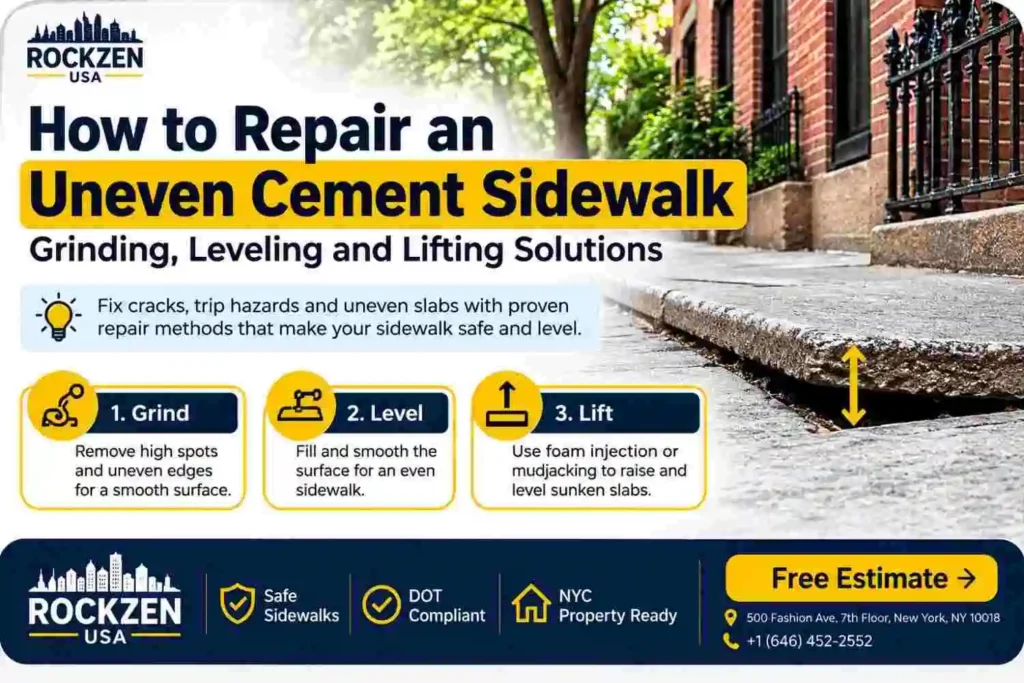
To repair an uneven cement sidewalk, first identify whether the slab is raised, sunken, or surface-damaged. Minor trip hazards can be corrected through concrete grinding. Sunken sections may require mudjacking or polyurethane foam lifting. Severe structural damage may require sidewalk replacement.
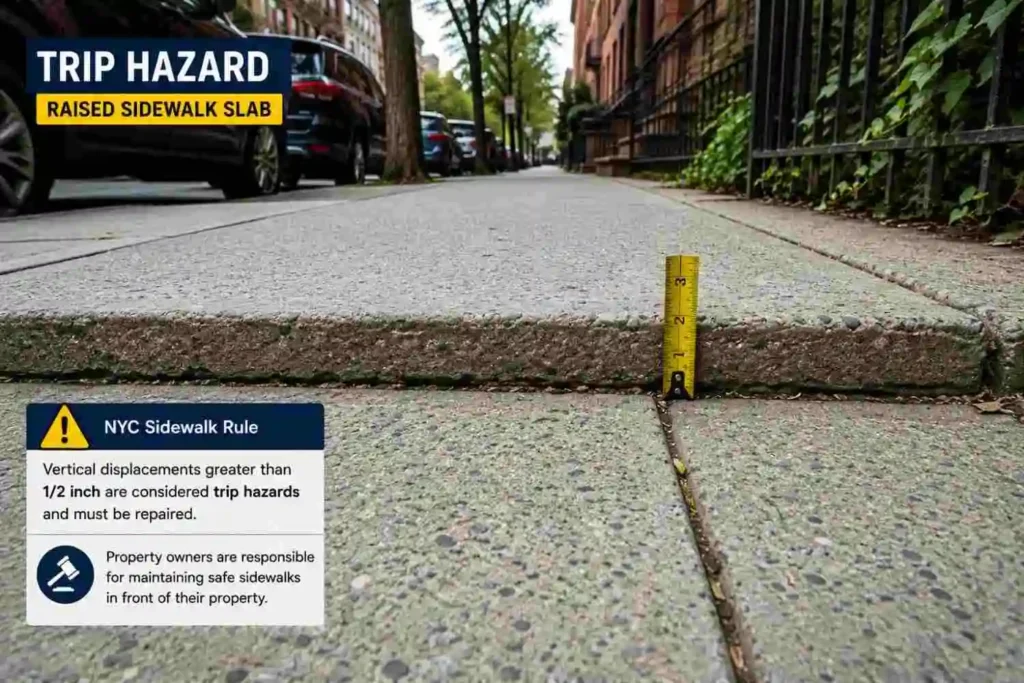
What Does an Uneven Cement Sidewalk Look Like?
An uneven cement sidewalk shows as a height difference between adjacent slabs, a sunken section, a raised edge, or visible surface cracking. New York City sidewalks take more punishment than most. Foot traffic, delivery carts, tree roots, and freeze-thaw cycles push concrete out of position over years.
Identifying the exact problem before any repair begins saves money and prevents wasted work.
Raised Sidewalk Sections
A raised sidewalk section sits higher than the adjacent slab. The height difference creates a ledge at the joint. Raised sections almost always come from something pushing upward from below.
Tree roots are the most common cause in New York. A root growing under a slab lifts from underneath. The slab itself is often intact, which means lifting or grinding fixes the problem without replacement.
Sunken Sidewalk Sections
A sunken section sits lower than surrounding slabs. Soil erosion or settlement beneath the slab creates a void. The slab drops as support disappears.
Sunken concrete is the repair category where mudjacking and foam injection earn their value. Both methods fill the void and lift the slab back to grade. Neither requires tearing out structurally sound concrete.
Trip Hazard Identification
A trip hazard exists when the height difference between two adjacent slabs reaches half an inch or more. Americans with Disabilities Act (ADA) compliance standards define this threshold. NYC property owners face direct liability when trip hazards go unaddressed.
The edge does not need to look dramatic. A half-inch lip catches a shoe heel on a crowded block. That is enough to send someone down.
ADA Trip Hazard Requirements
The ADA sets a maximum vertical change of half an inch at sidewalk joints. Changes between a quarter and half an inch must be beveled at a slope no steeper than 1-to-2. Any change over half an inch requires repair.
NYC Administrative Code Section 7-210 holds property owners responsible for maintaining sidewalks in safe condition. A trip hazard that injures a pedestrian creates direct legal exposure. The repair cost is always less than the liability.
What Causes a Cement Sidewalk to Become Uneven?
Cement sidewalks become uneven from tree root lifting, soil erosion, clay soil movement, freeze-thaw damage, expansion joint failure, and poor installation. Understanding the cause matters before any repair begins. The wrong method on the wrong cause fails within a season.
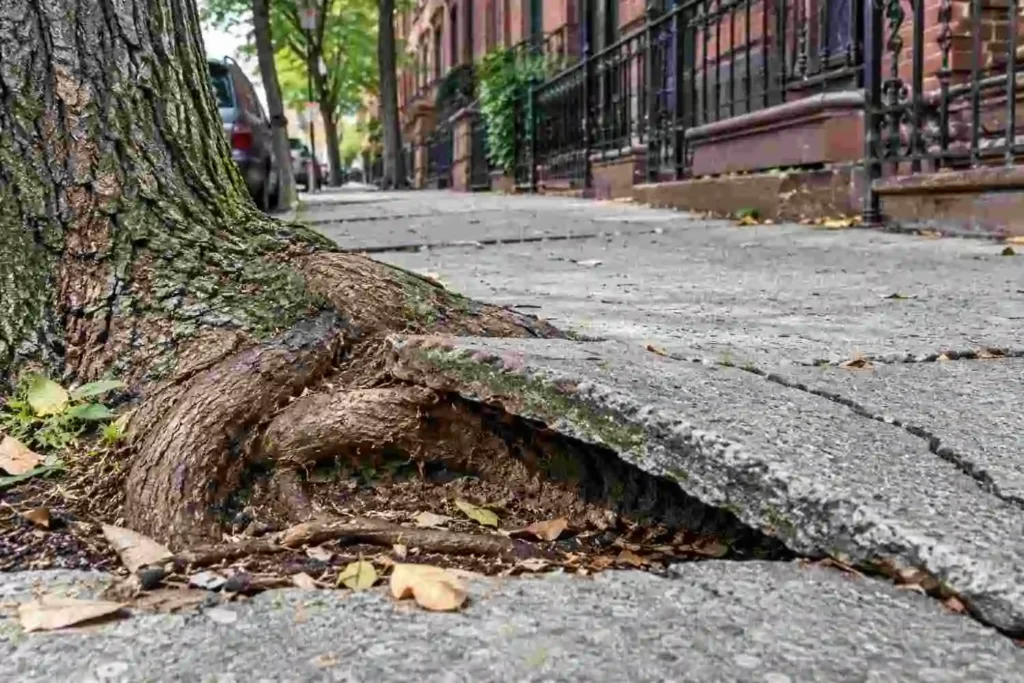
Tree Root Lifting
Tree roots grow toward moisture. Sidewalk joints and the soil beneath slabs hold water after rain. Roots follow that moisture and grow under the concrete.
As the root thickens, upward force increases significantly. A mature tree root lifts a full concrete slab several inches. The slab often remains structurally sound. The root is the problem, not the concrete.
Soil Erosion and Settlement
Water moving through soil carries particles away. Over time, the soil beneath a slab migrates. A void forms where solid ground once supported the concrete.
Settlement happens gradually. The slab begins to rock under foot traffic. Then the slab tilts. Then the slab drops. Addressing soil voids early prevents the full sequence.
Clay Soil Expansion and Contraction
Clay-rich soil expands significantly when wet and contracts when dry. This repeated shrink-swell cycle moves concrete slabs in both directions. A slab sitting on clay shifts position with every rain-and-dry cycle.
Clay soil problems are common in older NYC neighborhoods built on filled or low-lying land. Concrete on clay benefits from proper drainage improvement around the perimeter. Without drainage correction, repair methods address the symptom rather than the source.
Freeze-Thaw Cycle Damage
New York winters subject sidewalks to 30 to 50 freeze-thaw cycles per year. Water enters cracks and concrete pores. Freezing water expands by about 9 percent.
That expansion pushes concrete apart from the inside. Repeated cycles widen cracks and shift slabs. A slab that moved slightly in November may have moved significantly by March.
Expansion Joint Failure
Expansion joints allow concrete to expand and contract with temperature changes. When joints fill with debris or deteriorate, concrete has nowhere to move. Adjacent slabs push against each other and buckle.
A joint packed with stones and debris transmits force instead of absorbing force. Regular joint maintenance prevents this type of unevenness entirely.
Poor Original Installation
Concrete placed over inadequately compacted soil settles as the base consolidates. Slabs poured too thin crack and shift under load. Incorrect joint spacing transmits thermal stress across the wrong distances.
Poor installation problems show up within the first five years. Proper installation with a well-compacted base and correctly placed joints creates a sidewalk lasting 25 to 40 years.
How Do You Inspect an Uneven Sidewalk Before Repairs?
Inspecting an uneven sidewalk means measuring the height difference, checking for voids, assessing slab condition, and determining whether the base has failed. A 15-minute inspection prevents a 15-thousand-dollar mistake. Never commit to a repair method before completing this step.
Raised vs Sunken Slab Identification
Walk the entire sidewalk and observe which direction each slab has moved. A raised slab has something pushing from below. A sunken slab has lost support below. These are opposite problems requiring opposite solutions.
Grinding a sunken slab accomplishes nothing. Mudjacking a raised slab from tree roots fails within a season. Correct diagnosis prevents mismatched repairs.
Trip Hazard Height Measurement
Use a tape measure or straightedge across the joint between two slabs. Measure the vertical gap at the highest point. Record every location where the gap exceeds a quarter inch.
Document measurements with photographs. This creates a repair record and supports insurance or permit documentation. NYC contractors and inspectors expect this level of documentation on sidewalk repair work.
Void Detection Under the Slab
Walk slowly across every sunken or rocking slab and listen. A hollow sound under foot indicates a void below. A solid thud indicates intact soil contact.
Probe the perimeter of suspect slabs with a thin rod. Easy penetration into soft soil confirms erosion beneath. This information determines whether void filling is needed before or alongside leveling.
Base Failure Assessment
Press down on the slab corners. A slab that rocks on a diagonal has lost corner support. A slab that deflects under weight has compromised base material.
Base failure is the threshold between repair and replacement. A slab with compromised structural base concrete cannot be lifted reliably. Replacement becomes the cost-effective option at this point.
Professional Inspection Triggers
Call a licensed concrete contractor when slabs show structural cracking across more than 30 percent of the surface. Call a professional when multiple adjacent slabs have failed. Call when any slab shows vertical movement under foot pressure.
Reputable contractors provide free inspections. Delaying professional assessment compounds damage and cost.
Can an Uneven Cement Sidewalk Be Repaired Without Replacement?
Yes. Most uneven cement sidewalks can be repaired without replacement. Concrete grinding, mudjacking, polyurethane foam injection, and concrete overlay resolve the majority of residential uneven sidewalk problems. Replacement becomes necessary only when structural damage or base failure is widespread across the slab area.
Repairable vs Irreparable Damage
Raised edges, sunken slabs, and surface spalling are repairable. Tree root damage with an intact slab is repairable. Settlement with void formation is repairable.
Irreparable damage includes slabs with through-cracks across multiple directions, reinforcement failure, or base collapse. Patching irreparably damaged slabs wastes money and creates recurring problems.
Severity Threshold for Replacement
Replacement becomes the right choice when damage covers more than 30 percent of the total sidewalk area. Replacement also applies when the slab has fractured into three or more pieces. Replacement applies when previous lifting attempts have failed.
A qualified contractor identifies this threshold during inspection. Do not rely on visual assessment alone for this decision. Structural problems beneath the surface are not visible without proper evaluation.
The 30 Percent Damage Rule
The 30 percent rule provides a practical decision threshold. When the damaged area falls under 30 percent, repair costs less and lasts adequately. When the damaged area exceeds 30 percent, replacement delivers better long-term value.
This rule applies to the total slab area, not the visible surface only. A slab with 25 percent visible cracking may have 40 percent structural compromise when voids and base failure are included.
How Do You Repair Minor Uneven Sidewalk Sections Yourself?
Minor uneven sidewalk sections with surface damage under one quarter inch can be repaired with patching compound by a careful property owner. Concrete overlay suits slightly larger surface unevenness without replacing the slab. Structural lifting and grinding require professional equipment.
Step 1: Surface Cleaning and Preparation
Remove all loose concrete, dirt, and debris from the damaged area. Use a wire brush and shop vacuum to expose clean solid concrete. Rinse the surface and allow complete drying before applying any material.
Bond failure between old and new concrete is the most common cause of patch repair failure. Clean surface preparation prevents this. A bonding agent applied before patching improves adhesion significantly.
Step 2: Patching Compound Application
Choose a polymer-modified concrete patching compound for surface repairs. Press the material firmly into cracks and damaged areas using a steel trowel. Overfill slightly above the surrounding surface to account for settlement.
Work the material into all edges and corners. Compact the material thoroughly before finishing. Voids and air pockets beneath the patch cause premature failure.
Step 3: Concrete Overlay Application
A concrete overlay addresses surface unevenness affecting a wider area than isolated cracks. Apply a one-to-two inch thick layer of polymer-modified overlay concrete over the existing slab. This method suits worn, pitted, and slightly uneven surfaces that are structurally sound.
Apply a concrete bonding agent before the overlay. Level the overlay with a long straightedge spanning both sides of the work area. Match the finish texture to surrounding concrete with a broom or trowel.
Step 4: Leveling and Smoothing
Scrape the patch level with surrounding concrete using a straightedge. Match the surface texture of adjacent concrete with a broom finish or smooth trowel. Consistent texture prevents visual contrast between old and new material.
Allow the patch to firm slightly before final finishing. Working the surface too early pulls material apart. Working too late prevents proper leveling.
Step 5: Curing and Sealing
Keep the patched area damp for 24 to 48 hours after application. Wet curing prevents surface cracking from rapid moisture loss. Cover with plastic sheeting in hot or windy conditions.
Apply a concrete sealer after the patch reaches full strength at 28 days. Sealer protects the repair from water infiltration and freeze-thaw damage. Sealed repairs last significantly longer than unsealed ones.
How Does Concrete Grinding Fix an Uneven Sidewalk?
Concrete grinding removes material from a raised slab edge to eliminate the height difference and trip hazard. Professional grinding equipment creates a beveled transition meeting ADA compliance standards. Grinding is the fastest and least disruptive repair method for raised sections.
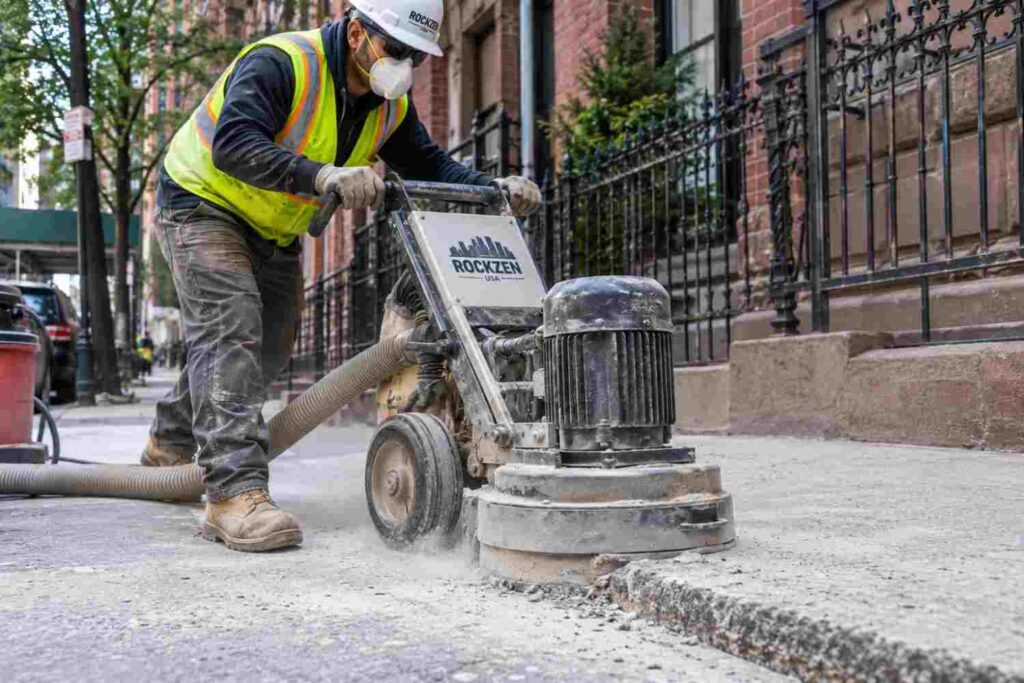
1. Concrete Grinding Definition
Concrete grinding uses diamond-tipped blades to remove material from a raised slab edge. The process creates a slope from the high side down to the level of the adjacent slab. A proper bevel eliminates the trip hazard and restores a smooth walking surface.
Grinding addresses the surface condition, not the underlying cause of raising. Tree roots, soil movement, or frost heave that caused the raise continue without additional treatment. Combining grinding with root barrier installation or drainage correction extends the repair lifespan.
2. Trip Hazard Size Limits for Grinding
Concrete grinding works effectively for height differences up to one inch. Beyond one inch, grinding removes too much material and weakens the slab edge. Larger height differences require lifting the lower slab or addressing the raised slab cause.
The ADA bevel requirement calls for a maximum 2-to-1 slope at the ground transition. A one-inch height difference requires a two-inch bevel area. This guides the grind angle and confirms the maximum treatable height.
3. Grinding Process and Timeline
A professional concrete grinder removes a trip hazard in 15 to 30 minutes per location. The contractor assesses the height, marks the grind area, and creates the bevel in passes. Final passes smooth the transition to the surrounding surface.
Sidewalks return to foot traffic immediately after grinding. No curing time is required. This makes grinding the most schedule-friendly repair option for occupied residential and commercial properties.
4. Grinding Lifespan and Durability
A properly ground sidewalk edge lasts 5 to 10 years before the height differential may reassert itself. Lifespan depends on whether the underlying cause was addressed. Grinding without root removal on a tree-root problem requires repeat treatment.
Combining grinding with root barrier installation extends the repair lifespan. Addressing the root cause alongside the surface correction delivers the best long-term value.
How Does Mudjacking Lift a Sunken Sidewalk?
Mudjacking pumps a cement and soil slurry beneath a sunken slab to fill voids and raise the concrete back to grade. The cost falls significantly below full replacement. Foot traffic returns within 24 to 48 hours after completion.
1. Mudjacking Definition
Mudjacking, also called slabjacking, involves drilling small holes through a sunken concrete slab. A mixture of cement, soil, and water is pumped through those holes under pressure. The slurry fills voids and hydraulic pressure lifts the concrete back to original grade.
The American Concrete Institute recognizes mudjacking as a standard concrete lifting technique. The method has been used in commercial and residential applications for over 80 years. Concrete slabs are strong enough to lift intact when the method is applied correctly.
2. Mudjacking Process Steps
Contractors drill 1.5 to 2 inch holes through the slab at calculated locations. Slurry pumps inject fill material under controlled pressure. The contractor monitors slab elevation and stops injection at the target height.
Holes are patched with concrete mix after lifting completes. The surface accepts foot traffic within 24 to 48 hours. A typical residential slab repair takes 2 to 4 hours from start to finish.
3. Slab Size Limitations
Mudjacking works effectively on slabs between 4 and 8 inches thick. Thin decorative slabs risk cracking under injection pressure. Heavily fractured slabs require replacement because the concrete cannot hold together during the lifting process.
Slabs over 200 square feet benefit from multiple injection points. Proper point placement distributes the lift evenly and prevents differential settlement after the repair.
Mudjacking Lifespan
A properly executed mudjacking repair lasts 5 to 10 years on average. Lifespan depends on soil stability, drainage conditions, and whether the underlying erosion cause was resolved. Areas with ongoing water infiltration or tree root growth see shorter repair lifespans.
How Does Polyurethane Foam Injection Level Concrete?
Polyurethane foam injection fills voids beneath sunken concrete and lifts slabs with precision using expanding polymer foam. The method is faster, lighter, and more controlled than mudjacking. Foam injection suits precision leveling on residential driveways, patios, and sidewalks where lightweight accuracy matters.
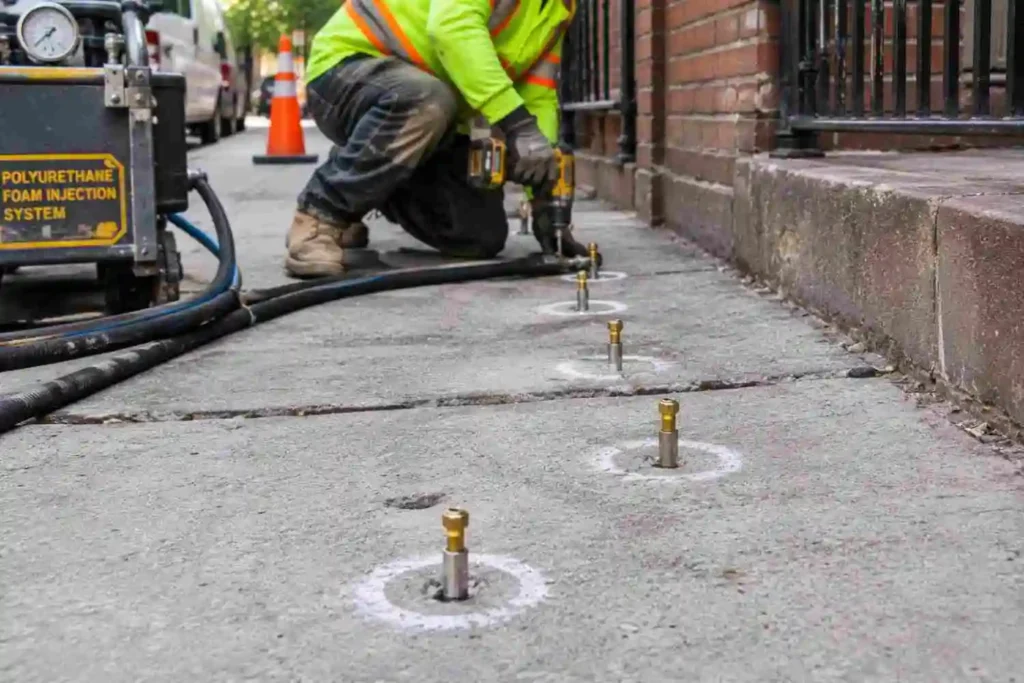
1. Polyurethane Foam Injection Definition
Polyurethane foam injection pumps two-component polymer foam through small ports drilled in the slab. The foam expands on contact, filling voids and generating lifting force. The expansion is measured and controlled by the contractor, allowing precise elevation adjustment.
The foam cures within 15 minutes of injection. Slabs return to full service within 30 minutes of repair completion. This rapid return to use distinguishes foam injection from all other repair methods.
2. Foam Lifting vs Mudjacking Differences
Foam injection uses smaller drill holes at 5/8 of an inch compared to 1.5 to 2 inches for mudjacking. Foam weighs approximately 2 pounds per cubic foot compared to 100 pounds per cubic foot for mud slurry. Foam adds no significant weight to soil that may already be compromised.
Foam cures in minutes rather than hours. Foam is waterproof and will not wash out under the slab. Mudjacking slurry is susceptible to future erosion in high-water-table areas.
3. Foam Lifting Advantages
The precision of foam injection suits applications where exact elevation control matters. Pool decks, garage floors, and commercial sidewalks benefit from controlled lifting. Lightweight material is also preferred near foundations where additional soil loading is a concern.
Foam injection leaves smaller holes that are less visible after patching. The repair surface looks cleaner than mudjacking on finished concrete.
4. Foam Lifting Lifespan
Polyurethane foam injection repairs last 10 to 15 years or longer. The foam material resists moisture, biological degradation, and freeze-thaw cycling. Long-term stability makes foam injection the highest-lifespan repair option short of full replacement.
Which Sidewalk Repair Method Is Best?
The best repair method depends on whether the slab is raised or sunken, the height differential, the slab condition, and the underlying cause. No single method solves every problem. Matching the method to the damage type delivers the most cost-effective and lasting result.
Grinding vs Mudjacking vs Foam Lifting Comparison
The table below compares all major repair methods by application, lifespan, cost, and return-to-use time.
| Method | Best Application | Lifespan | Average Cost | Return to Use |
|---|---|---|---|---|
| Concrete Grinding | Raised edges and trip hazards | 5 to 10 years | $80 to $250 per hazard | Immediate |
| Mudjacking | Sunken slabs with soil voids | 5 to 10 years | $3 to $7 per sq ft | 24 to 48 hours |
| Polyurethane Foam | Precision lifting of sunken slabs | 10 to 15 years | $7 to $15 per sq ft | 30 minutes |
| Concrete Overlay | Surface unevenness on sound slab | 5 to 10 years | $5 to $10 per sq ft | 24 to 48 hours |
| Patching Compound | Minor surface cracks and chips | 3 to 5 years | $50 to $300 | 24 hours |
| Full Replacement | Structural failure or widespread damage | 25 to 40 years | $10 to $25 per sq ft | 3 to 7 days |
1. Best Method by Damage Type
Raised slab from tree roots: grind the edge and install a root barrier. Sunken slab with void from erosion: mudjack or foam inject. Sunken slab near a foundation or pool: foam inject for lightweight precision. Surface cracking under 30 percent: patch and seal. Wide surface unevenness on a sound slab: concrete overlay.
Combining methods often produces the best outcome. A slab raised by roots may be ground for immediate trip hazard removal while a root barrier prevents recurrence.
2. Longest Lasting Repair Method
Polyurethane foam injection provides the longest lifespan among lifting methods at 10 to 15 years. Full replacement lasts longest overall at 25 to 40 years. For the balance of cost and lifespan on a sound slab, foam injection delivers the best long-term return.
3. Return to Use After Repair
Return-to-use time varies significantly by method. Concrete grinding allows immediate return. Foam injection allows foot traffic within 30 minutes. Mudjacking requires 24 to 48 hours. Concrete overlay requires 24 to 48 hours. Full replacement requires 3 to 7 days for foot traffic and 28 days for full structural load.
Planning return-to-use time matters on occupied residential properties and commercial sidewalks. Foam injection and grinding suit time-sensitive repairs on active pedestrian routes.
How Do You Repair Sidewalk Damage Caused by Tree Roots?
Tree root sidewalk repair requires assessing root damage, cutting or redirecting roots, lifting or replacing the slab, and installing a barrier to prevent recurrence. Skipping any step means the root continues growing and the problem returns. NYC has specific rules about tree pruning near sidewalks that affect how root cutting proceeds.
1. Root Damage Assessment
Walk the raised section and observe the direction of lift. Most root lifting pushes one edge higher than the other. Probe beneath the slab edge with a rod to locate root diameter and depth.
Photograph the slab from multiple angles. Note whether the slab is cracked, intact, or partially fractured. An intact slab over a lifting root is the best candidate for grinding or lifting. A fractured slab over a root typically requires replacement.
2. Root Cutting Before Repair
Tree roots near sidewalks fall under NYC Department of Parks and Recreation (DPR) guidelines. DPR governs how and when roots can be cut near street trees. Cutting roots larger than 2 inches in diameter requires a permit. Damaging a protected street tree carries significant fines.
Contact NYC DPR before cutting any street tree roots. A certified arborist assessment determines which roots can be safely removed without tree damage.
3. Tree Root Repair Process
After root cutting approval and completion, remove the affected slab section. Compact the soil beneath and install a root barrier membrane along the soil boundary. Pour a new concrete slab with proper joint placement accommodating future movement.
For intact slabs over smaller roots, grinding removes the trip hazard without disturbing the root. Combined with a root deflector at the joint, this approach extends repair lifespan without full slab removal.
4. Root Barrier Installation
A root barrier is a vertical membrane installed in the soil between the tree root zone and the sidewalk. The barrier deflects root growth downward and away from the concrete. Root barriers extend sidewalk repair lifespan significantly in areas with mature street trees.
Install barriers at a depth of 18 to 24 inches. Position barriers within 6 inches of the slab perimeter. Properly installed barriers last 15 to 20 years and prevent repeat lifting damage.
How Much Does Uneven Sidewalk Repair Cost?
Uneven sidewalk repair costs range from $80 for a single grinding repair to over $25 per square foot for full replacement. Most NYC residential sidewalk repairs fall between $500 and $3,000 per section. Understanding cost by method prevents overpaying for the wrong solution.
The table below shows typical repair costs for uneven sidewalk work.
| Repair Type | Typical Cost |
|---|---|
| Concrete grinding per trip hazard | $80 to $250 |
| Mudjacking per square foot | $3 to $7 |
| Polyurethane foam injection per sq ft | $7 to $15 |
| Concrete overlay per square foot | $5 to $10 |
| Patching compound DIY | $50 to $300 |
| Full slab replacement per sq ft | $10 to $25 |
1. Concrete Grinding Cost
Concrete grinding costs $80 to $250 per trip hazard location. Most residential jobs involve 3 to 8 hazard locations at a total of $300 to $1,500. NYC grinding prices sit at the upper end of this range due to labor costs and access constraints.
2. Mudjacking Cost Per Square Foot
Mudjacking costs $3 to $7 per square foot in most markets. A typical 50-square-foot sunken slab section costs $150 to $350. NYC mudjacking prices run $5 to $10 per square foot due to equipment access and labor rates.
3. Foam Injection Cost Per Square Foot
Polyurethane foam injection costs $7 to $15 per square foot. The higher material cost is partially offset by faster completion time. A 50-square-foot section costs $350 to $750. The longer lifespan of foam injection improves the cost-per-year calculation compared to mudjacking.
4. Full Replacement Cost
Full sidewalk replacement costs $10 to $25 per square foot in standard markets. New York City replacement runs $20 to $40 per square foot including permits, disposal, and concrete. A typical 100-square-foot replacement runs $2,000 to $4,000.
5. Factors Affecting Total Cost
Five factors determine final repair cost in NYC: total repair area, damage type and method required, permit fees from the NYC Department of Transportation (DOT), site access and equipment mobilization, and disposal of broken concrete.
6. DIY vs Professional Cost Comparison
DIY patching saves money on surface repairs under $300. Professional repairs for grinding, mudjacking, and foam injection require equipment costing significantly more. Professional work on structural repairs delivers better lifespan and warranty protection than DIY alternatives.
Should You Repair or Replace an Uneven Sidewalk?
Repair when damage is isolated, the slab is structurally intact, and the cause is addressable. Replace when damage is widespread, structural failure has occurred, or repeated repairs have failed. The decision framework below guides the choice clearly.
Repair vs Replacement Decision Matrix
The table below shows recommended actions by damage condition.
| Damage Condition | Recommended Action |
|---|---|
| Single raised edge under 1 inch | Grind |
| Sunken slab with solid intact concrete | Mudjack or foam inject |
| Surface cracking under 30 percent | Patch and seal |
| Wide surface unevenness on sound slab | Concrete overlay |
| Tree root lifting with intact slab | Root cut and grind or lift |
| Multiple sunken slabs with base failure | Replace |
| Cracking over 30 percent of slab area | Replace |
| Slab fractured into 3 or more pieces | Replace |
| Previous lift attempts that have failed | Replace |
Replacement Triggers
Replace when structural concrete cracking crosses more than 30 percent of the slab surface. Replace when the base material has collapsed and void filling is no longer viable. Replace when the slab has been repaired more than twice in five years.
Repeated minor repairs on a failing slab cost more over five years. A single replacement often delivers better long-term value.
Property Value Impact
A well-maintained sidewalk contributes to property curb appeal and prevents liability claims. Unaddressed trip hazards reduce property value and create legal risk. Professional repair documentation also supports property sale disclosures and building permit applications.
How Do You Prevent Sidewalks From Becoming Uneven Again?
Preventing sidewalk unevenness requires maintaining expansion joints, managing tree roots, improving drainage, inspecting annually, avoiding salt damage, and sealing concrete surfaces. Prevention costs a fraction of repair. NYC property owners who maintain sidewalks proactively avoid the violation notices that come from Department of Transportation inspections.
1. Expansion Joint Maintenance
Clean expansion joints annually in the fall before winter arrives. Remove packed debris, stones, and vegetation. Fill deteriorated joints with a flexible backer rod and flexible concrete caulk.
Properly functioning joints absorb thermal movement that would otherwise transmit into slab-to-slab pressure. A joint that costs $20 to maintain prevents a slab replacement costing $2,000.
2. Flexible Caulk for Joint Sealing
Standard concrete caulk cracks when slabs move. Flexible polyurethane joint caulk stretches and recovers with slab movement. Apply flexible caulk at all expansion joint locations after cleaning.
Flexible caulk blocks water infiltration at the joint. Water infiltration at joints is the primary driver of freeze-thaw damage and soil erosion beneath slabs. Reapply caulk every 3 to 5 years for continuous protection.
3. Tree Root Management
Install root barriers when planting trees near sidewalks. Choose species with less aggressive root systems for street tree pits. Inspect tree pit edges annually for root intrusion signs.
Contact NYC DPR at the first sign of root lifting. Early intervention prevents a small root from becoming a full slab replacement situation. Documentation of proactive maintenance also protects property owners from DOT violations.
4. Drainage Improvement Around Slabs
Grade soil along the sidewalk perimeter away from the concrete. Ensure downspouts discharge water away from sidewalk slabs. Install drainage channels where surface water concentrates near the sidewalk.
Water is the primary driver behind soil erosion beneath slabs. Improving drainage addresses the root cause of settlement damage rather than treating the surface symptom repeatedly.
5. Salt Avoidance After Repair
Never apply rock salt or chemical deicers to repaired or freshly installed concrete. Salt accelerates surface spalling and weakens the cement paste near the surface. Damage from salt application compounds with every freeze-thaw cycle.
Use brick sand instead. Brick sand provides traction on ice without chemical damage to the concrete. Sweep the sand away in the spring before debris accumulates in joints.
6. Inspection Schedule
Inspect the full sidewalk every spring after freeze-thaw season ends. Check for new height differences, surface cracking, rocking slabs, and joint deterioration. Document conditions with photographs.
NYC property owners are legally responsible for safe sidewalk conditions under Administrative Code Section 7-210. An annual inspection creates a maintenance record demonstrating due diligence and supporting liability protection.
7. Concrete Sealer Application
Apply a penetrating concrete sealer to the entire sidewalk every 3 to 5 years. Sealer blocks water infiltration driving freeze-thaw damage and soil erosion beneath slabs. Apply in dry conditions above 50°F for proper penetration.
A sealed, properly maintained uneven cement sidewalk repair lasts far longer than an unsealed one. Addressing the problem early, repairing correctly, and maintaining consistently keeps the sidewalk safe, compliant, and liability-free for decades.
What Do Property Owners Ask About Uneven Sidewalk Repair?
Fixing an Uneven Cement Sidewalk
Concrete grinding removes raised edges creating trip hazards. Mudjacking and foam injection lift sunken slabs back to grade. Concrete overlay resurfaces wide areas of unevenness on structurally sound slabs. The right method depends on whether the slab is raised, sunken, or surface-damaged.
Repair Without Replacement
Yes. Most uneven cement sidewalks can be repaired without full replacement. Grinding, lifting, overlay, and patching address the majority of residential unevenness. Replacement becomes necessary only when structural damage exceeds 30 percent of the slab area.
Grinding vs Mudjacking
Neither is universally better. Grinding suits raised slabs with edges creating trip hazards. Mudjacking suits sunken slabs with void formation below. Grinding is a surface correction. Mudjacking is a structural lift. They solve different problems and are not interchangeable.
Sidewalk Leveling Cost
Concrete grinding costs $80 to $250 per trip hazard. Mudjacking costs $3 to $7 per square foot. Polyurethane foam injection costs $7 to $15 per square foot. Full replacement costs $10 to $25 per square foot in standard markets and $20 to $40 per square foot in NYC.
Causes of Uneven Sidewalks
Tree root lifting, soil erosion, clay soil expansion and contraction, freeze-thaw cycle damage, expansion joint failure, and poor original installation cause sidewalk unevenness. NYC sidewalks most commonly become uneven from tree roots and freeze-thaw cycling. Both causes are preventable with proper installation and maintenance.
Tree Root Lifting
Yes. Tree roots lift sidewalks by growing beneath slabs and generating upward pressure as the root thickens. Mature roots lift slabs several inches. NYC street tree root cutting requires a permit from DPR before any root work begins.
Concrete Leveling Lifespan
Mudjacking repairs last 5 to 10 years. Polyurethane foam injection lasts 10 to 15 years. Concrete grinding lasts 5 to 10 years before the height differential may require attention again. Addressing the underlying cause extends all repair lifespans.
Replacement Decision
Replace when damage covers more than 30 percent of slab area, when structural base failure has occurred, or when previous repair attempts have failed. Repair when the slab is structurally sound and the damage is isolated to raised edges, sunken sections, or surface deterioration.
Legal Liability for Uneven Sidewalks
Yes. NYC property owners bear legal responsibility for sidewalk safety under Administrative Code Section 7-210. A trip hazard that injures a pedestrian creates direct liability for the adjacent property owner. Prompt repair and documented maintenance reduce this exposure significantly.
Insurance Coverage for Sidewalk Repair
No. Homeowner insurance policies generally do not cover routine sidewalk repair or maintenance. Coverage may apply when sudden damage from a covered event causes unevenness. Review the specific policy terms before assuming coverage and contact the insurer before beginning repairs.
Need Help Repairing an Uneven Cement Sidewalk?
Rockzen Construction helps NYC property owners repair uneven, raised, and sunken cement sidewalks. Every job starts with a free on-site inspection to identify whether grinding, leveling, lifting, or replacement is appropriate. You receive a written cost estimate with the recommended repair and next steps. Most inspections are booked within 48 hours.