

Concrete can be poured in cold weather when proper precautions are taken. The concrete temperature should remain above 50°F (10°C) during curing. Fresh concrete needs protection from freezing using insulated blankets, heated enclosures, or accelerating admixtures. Following ACI 306R cold weather concreting standards prevents strength loss, cracking, and early age frost damage.
This guide covers minimum temperature requirements, cold weather concrete mix design, step-by-step placement procedures, and frost protection methods. You get the technical facts, the right materials, and the decisions that separate a successful winter pour from a failed one.
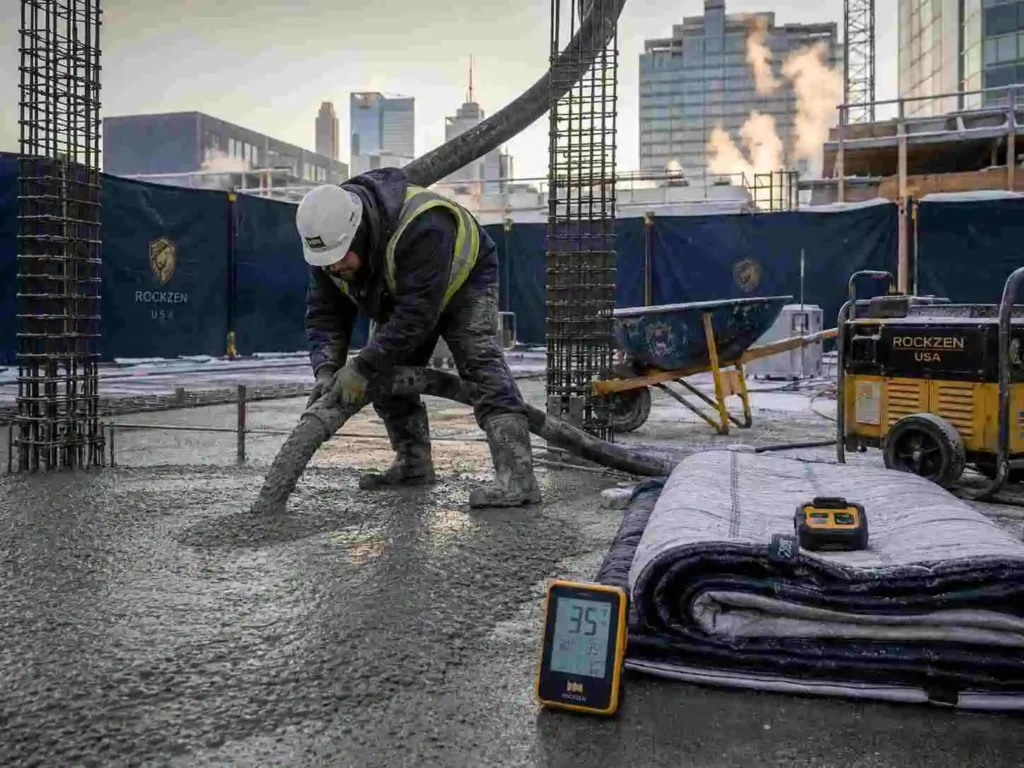
What Is Considered Cold Weather for Concrete?
Cold weather concreting begins when air temperature drops below 40°F (4°C) for more than three consecutive days. The American Concrete Institute (ACI) defines this threshold in ACI 306R, the industry standard for cold weather concrete placement. Understanding this definition prevents costly decisions based on guesswork.
Temperature affects concrete differently at each stage. Air temperature, concrete temperature, and ground temperature all matter. Ignoring any one of them creates cold joints, delayed setting, or early age frost damage.
The 40°F Cold Weather Threshold
ACI 306R sets 40°F as the cold weather concreting trigger point. Below this temperature, hydration heat slows significantly. Concrete placed without protection risks incomplete strength development.
The threshold applies to air temperature, not concrete temperature. Concrete mix temperature and ambient temperature are two separate measurements. Both must be managed throughout placement and curing.
Air Temperature vs Concrete Temperature
Air temperature and concrete temperature are not the same value. A concrete mix warmed with heated mixing water may arrive at 65°F. The surrounding air at 30°F will strip that heat within hours.
Concrete temperature logging throughout the curing period tracks this difference accurately. ASTM C1064 provides the standard method for measuring concrete temperature at delivery. Monitoring both values prevents thermal shock in cold pours.
Why 50°F Matters During Curing
Concrete must maintain 50°F for a minimum 14-day curing period per ACI 306R. Below this temperature, the hydration process slows to a near stop. Strength gain becomes unreliable.
The 50°F minimum applies to the concrete surface, not the air around it. Insulating curing blankets maintain this temperature against cold ambient conditions. Removing protection too early before this threshold is the most common cold weather mistake.
Can You Pour Concrete Below 50°F?
Yes. Concrete can be placed below 50°F when proper cold weather protocol is followed. The concrete mix itself must stay above 50°F during placement and curing. Air temperature below 50°F requires protective measures, not a work stoppage.
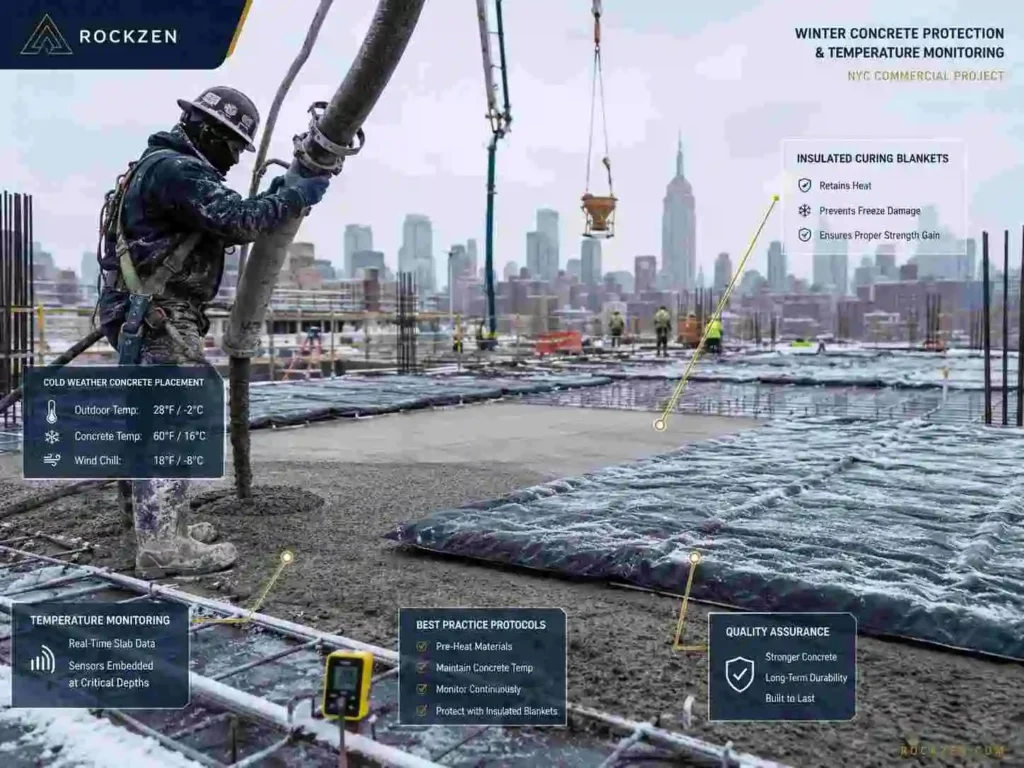
Pouring Between 40°F and 50°F
This temperature range is manageable with basic precautions. Warm mixing water raises the fresh concrete temperature. Insulating concrete pump lines prevents heat loss during delivery.
Place concrete quickly and cover immediately with thermal blankets. Monitor internal concrete heat of hydration throughout the first 24 hours. Curing compound application after finishing protects surface moisture.
Is It Okay to Pour Concrete in 30°F Weather?
Pouring at 30°F is possible but requires significant preparation. The concrete mix needs heated aggregate storage and warm water to achieve minimum placement temperature above 55°F. Preheating subgrade before pouring removes ground frost that strips heat from the fresh mix.
An enclosed heated area around the pour is strongly recommended at this temperature. Without it, surface freezing happens before adequate strength develops. Post-pour thermal blanket removal must wait until concrete reaches at least 500 psi.
Pouring Below Freezing
Concrete placed in below-freezing air without protection will freeze before hydration completes. Ice formation in fresh concrete disrupts the cement paste structure permanently. That concrete cannot recover full strength even after thawing.
Below 32°F, a heated enclosure for curing is not optional. Calcium chloride accelerator dosage must be calculated against the mix design to avoid overacceleration. Non-chloride accelerators are required for reinforced concrete to prevent rebar corrosion.
How Late in Fall Can You Pour Concrete?
Concrete pours extend into late autumn when daytime temperatures hold above 40°F. The risk is overnight freeze during the critical first 24 hours. Continuous temperature monitoring log entries overnight confirm safe curing conditions.
Fall concrete preparation for upcoming freeze-thaw conditions should include anti-freeze admixture ratio planning before the pour begins. Waiting until temperatures consistently drop below 40°F overnight without protection capability is the practical cutoff.
Will Concrete Freeze at 32°F?
Fresh concrete will not freeze immediately at 32°F because the hydration reaction generates internal hydration heat. However, thin sections and concrete with low cement content freeze faster. ACI 306R states concrete is at serious risk once internal temperature drops below 27°F (-3°C).
At What Temperature Does Concrete Freeze?
Concrete freezes at approximately 27°F (-3°C) due to dissolved salts in the pore water. Pure water freezes at 32°F. The salt content in concrete mix water depresses the freezing point slightly.
Early age frost damage prevention requires keeping concrete above this threshold for the first 24 hours minimum. Concrete maturity — the combination of time and temperature — must reach a safe threshold before protection is removed.
Is Concrete Ruined if It Freezes?
Concrete frozen before reaching 500 psi compressive strength suffers permanent damage. The expanding ice crystals disrupt the cement paste matrix. Surface scaling, cracking, and reduced durability result.
Concrete that freezes after reaching 500 psi can recover most of its strength once thawed. The Portland Cement Association confirms this recovery is partial, not complete. Prevention through frost protection duration and insulated blankets is always better than remediation.
Will Concrete Freeze the First Night?
Fresh concrete can freeze the first night without insulation. Heat of hydration protects the interior but not the surface. Thin slabs lose heat fastest.
Post-pour thermal blanket removal should never happen the first night regardless of forecast temperature. Blanket insulation on the surface maintains the minimum 50°F curing temperature through early morning low points. This single step prevents most first-pour freeze failures.
What Is the Ideal Temperature for Pouring Concrete?
The ideal concrete placement temperature falls between 55°F and 65°F (13°C to 18°C). This range ensures proper setting time, workability, and strength development. Concrete placed within this band requires less protective intervention.

Ideal Concrete Placement Temperature
Concrete arriving at the site between 55°F and 65°F has optimal workability. The mix stays fluid long enough for proper consolidation. Setting begins at a predictable rate allowing finishing windows to be planned accurately.
Above 75°F, concrete sets too fast. Below 55°F, setting slows and strength gain becomes unpredictable. Cold weather concrete mix design adjusts water-cement ratio and admixture dosing to maintain this window in winter conditions.
Minimum Safe Curing Temperature
ACI 306R sets the minimum curing temperature at 50°F for most concrete applications. This minimum must be maintained at the concrete surface, not the air. Insulated forms and thermal blankets maintain this surface temperature.
Concrete below 50°F during curing gains strength at a fraction of normal rate. At 40°F, strength gain is approximately 50 percent slower than at 70°F. At 30°F, hydration nearly stops.
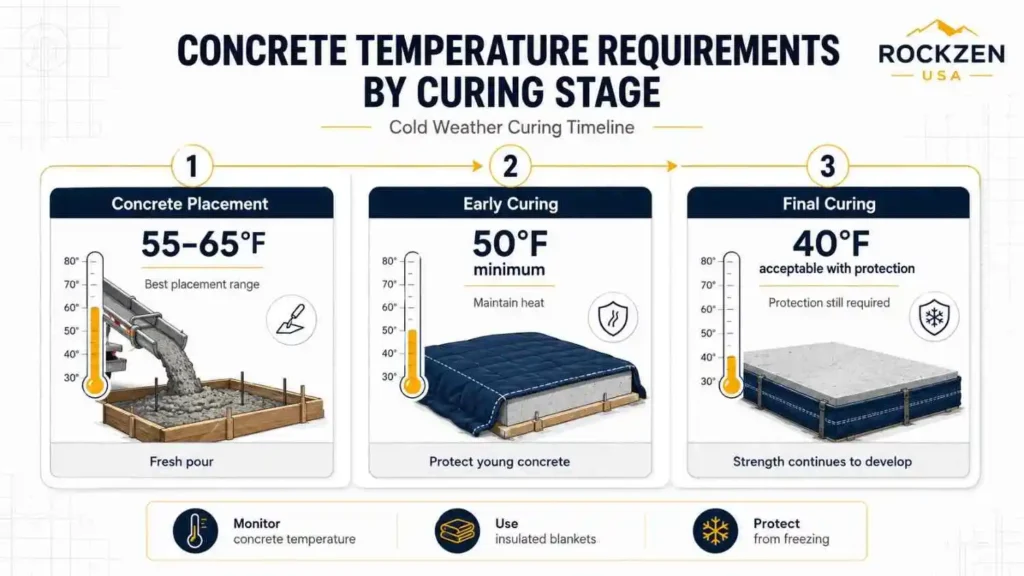
Temperature by Curing Stage
Three stages require separate temperature management:
| Curing Stage | Minimum Temperature | Duration |
|---|---|---|
| Fresh placement | 55°F (13°C) | At delivery |
| Early curing | 50°F (10°C) | First 24 hours |
| Protection period | 50°F (10°C) | Minimum 7 days |
| Form removal | 40°F (4°C) | After 500 psi |
How Does Cold Weather Affect Concrete Curing and Strength?
Cold weather slows the hydration process, reduces compressive strength development, and increases the risk of cracking and surface damage. Understanding these effects helps plan the right protection strategy. ACI 306R documents the full relationship between temperature and concrete strength development.
How Cold Slows the Hydration Process
Concrete gains strength through a chemical reaction between cement and water called hydration. Cold temperatures slow this reaction by reducing molecular activity. Low temperature hydration kinetics means strength development takes significantly longer.
At 50°F, hydration continues but at reduced speed. At 40°F, the process slows to roughly half the normal rate. Below 32°F, hydration effectively stops until temperature rises.
Strength Loss From Early Freezing
Concrete frozen before reaching 500 psi loses 50 percent or more of its design strength. The National Ready Mixed Concrete Association documents this as one of the most costly cold weather failures. Recovery after thawing is partial at best.
Temperature-matched curing strength testing uses concrete cylinders cured in actual field temperatures. This method reveals real strength gain rather than lab-condition estimates. Specifying Type III cement for cold weather projects accelerates early strength gain reducing the vulnerability window.
What Happens if Concrete Freezes at Night
Overnight freezing on an unprotected fresh pour disrupts the cement paste. Surface scaling appears first. Deeper damage reduces structural capacity.
Concrete temperature logging overnight confirms whether protection held. If a freeze event occurs, do not attempt repairs until the concrete fully thaws and dries. Test cylinders before loading or removing forms.
Risk of Cracking and Scaling
Thermal shock in cold pours occurs when warm concrete meets frozen ground or cold air suddenly. The temperature differential causes internal stress. Preventing thermal shock requires preheating subgrade before pouring and gradual temperature management during protection removal.
Surface scaling from freeze-thaw damage appears as flaking and pitting. Air-entraining agents reduce this risk by creating micro air bubbles that absorb freeze-thaw expansion pressure. Cold weather concrete mix design should specify air entrainment for any exposed slab.
What Is the 90-Minute Rule for Concrete?
The 90-minute rule states that ready-mixed concrete must be discharged within 90 minutes of water contacting the mix. This is an ASTM C94 and industry standard requirement. Cold weather affects how this rule applies in practice.
How the 90-Minute Rule Works
Ready-mix trucks must discharge concrete within 90 minutes to prevent over-mixing and strength loss. The clock starts when water enters the drum. Extended mixing breaks down the cement paste structure.
Cold weather slows the hydration reaction, which can extend workability beyond 90 minutes. However, the 90-minute limit still applies regardless of temperature. Concrete exceeding this limit must be rejected on site.
How Cold Weather Affects Set Time
Cold temperatures extend concrete setting time significantly. Concrete that sets in 4 hours at 70°F may take 8 to 12 hours at 40°F. This extended window seems helpful but creates scheduling and protection problems.
Longer setting time means the concrete stays vulnerable to frost damage longer. Wind chill factor compounds this by stripping surface heat faster than air temperature alone suggests. A windbreak setup reduces this effect on exposed pours.
How Long Does 2 Inches of Concrete Take to Set?
A 2-inch concrete slab sets in 24 to 48 hours under normal conditions. In cold weather at 40°F, the initial set extends to 48 to 72 hours. Final set and adequate strength for foot traffic may take 5 to 7 days.
Thin slabs lose heat faster than thick ones. Blanket insulation on 2-inch sections is critical. Concrete maturity tracking using time-temperature data gives the most accurate picture of actual strength development.
What Tools and Materials Are Needed for Cold Weather Concreting?
Cold weather concreting requires insulating blankets, temperature monitoring tools, heated water equipment, and accelerating admixtures. Having the right materials staged before the pour prevents scrambling after placement. A cold weather protocol checklist ensures nothing is missed.
Insulating Blankets and Enclosures
Insulating curing blankets are the primary frost protection tool. They trap hydration heat against the concrete surface. Standard blankets provide R-values between 1 and 4 depending on thickness.
Heated enclosures for curing use propane or electric heaters inside a poly tent frame. They suit larger pours or work below 20°F where blankets alone are insufficient. Industrial-grade concrete heaters maintain consistent internal temperatures without hot spots.
Heated Water and Warm Aggregates
Warm mixing water raises fresh concrete temperature efficiently. Heated aggregate storage prevents frozen clumps that create cold joints in the mix. A heated mixer maintains temperature during transit on long hauls.
Warm water temperature should not exceed 140°F when mixing with cement directly. Hot water combined with cement can cause flash set. Add water to aggregates first then introduce cement.
Accelerating Admixtures
Accelerating admixtures speed up the hydration process compensating for cold temperatures. Calcium chloride accelerator dosage typically runs at 1 to 2 percent of cement weight. It is the most cost-effective accelerator for plain concrete.
Non-chloride accelerators are required for reinforced concrete to prevent rebar corrosion. Using non-chloride accelerators for reinforced concrete is a specification requirement, not optional. Adjusting water-cement ratio for below-freezing pours also reduces mix water that could freeze.
Temperature Monitoring Tools
Continuous temperature monitoring log data protects against undetected freeze events. Digital temperature data loggers record hourly readings without manual checks. Reading ASTM C1064 provides the standard procedure for placement temperature measurement.
Concrete maturity meters calculate the maturity index from time and temperature data. This gives a direct strength estimate without waiting for lab cylinder breaks. They are standard on commercial and Department of Transportation projects.
How Do You Pour Concrete in Cold Weather Step by Step?
Cold weather concrete placement follows five steps from site preparation through curing monitoring. Skipping any step increases the risk of frost damage, cold joints, or strength loss. Following ACI 306R guidelines at each step ensures reliable results.
Step 1: Prepare and Warm the Site
Remove all snow and ice from the subgrade before work begins. Snow and ice removal methods include propane torches, ground heaters, and mechanical removal. Never pour on frozen ground — preheating subgrade before pouring is mandatory.
Check ground temperature before concrete arrives. Frozen ground at the surface strips heat from fresh concrete immediately. Ground temperature should be above 32°F to a depth matching the slab thickness.
Step 2: Warm the Materials and Mix
Order concrete with heated aggregate storage and warm mixing water specified. Request a cold weather concrete mix design with the appropriate accelerator dosing. Confirm the mix arrives above 55°F using ASTM C1064 measurement at discharge.
Set up a windbreak setup on exposed sites before the truck arrives. Wind chill factor pulls heat from fresh concrete faster than air temperature alone. A simple poly barrier reduces surface heat loss significantly.
Step 3: Pour the Concrete
Place and consolidate concrete quickly to minimize heat loss. Insulated concrete pump lines prevent temperature drop during pumping. Ensure proper consolidation in cold concrete mixes using a vibrator — cold concrete is stiffer and traps air more easily.
Avoid managing concrete bleeding and segregation by adding water on site. Extra water lowers the water-cement ratio strength and increases freeze vulnerability. Keep the mix as delivered.
Step 4: Protect the Surface
Cover finished surfaces with insulating curing blankets immediately after finishing. Overlap blanket edges by at least 12 inches to prevent cold air infiltration. Seal perimeter edges where heat escapes fastest.
For temperatures below 20°F, move to a heated enclosure for curing. Set heaters to maintain 50°F minimum at the concrete surface. Monitor for overheating use heated blankets without overheating concrete by keeping surface temperature below 95°F.
Step 5: Monitor Curing Temperature
Place temperature sensors at the concrete surface and at mid-depth. Record readings every 2 to 4 hours during the first 48 hours. Continuous temperature monitoring log data should confirm surface temperature stays above 50°F throughout.
Calculate the concrete maturity index from logged data to estimate strength gain. Do not remove protection until maturity calculations confirm minimum 500 psi strength. Post-pour thermal blanket removal before this threshold causes most cold weather concrete failures.
How Do You Protect Fresh Concrete From Freezing?
Fresh concrete needs frost protection from placement through the minimum 14-day curing period under cold conditions. The protection method depends on temperature range and project type. ACI 306R provides specific protection duration guidance by temperature band.
Insulated Blankets and Curing Covers
Insulated blankets are the standard frost protection for most residential and commercial pours. Thermal blankets trap hydration heat keeping surface temperature above 50°F. A single layer typically handles temperatures down to 20°F.
Double layering provides protection to approximately 10°F. Secure blankets against wind to prevent displacement overnight. Check blanket placement each morning before temperatures rise.
Heated Enclosures and Ground Heaters
Heated enclosures enclose the entire pour in a temporary structure with internal heat sources. They suit large flatwork, walls, and foundation pours in extreme cold. Propane heaters provide the most heat output but require CO monitoring.
Ground heaters thaw frozen subgrade before placement and maintain temperature during curing. They run hydronic lines beneath the slab location. This is standard practice for mid-winter concrete repair in subzero conditions.
Emergency Response to a Freeze
Do not attempt to thaw recently frozen concrete with direct heat. Rapid heating causes thermal stress and surface cracking. Cover with insulating blankets first and allow gradual temperature recovery.
Test cylinders before making any structural decisions after a freeze event. Concrete that froze before 500 psi is compromised. Preventing concrete popouts from frost heave damage requires full protection from the start rather than emergency recovery after the fact.
How Do Heated Water and Accelerating Admixtures Help?
Heated water and accelerating admixtures raise concrete temperature and speed hydration during cold weather. Used together they compensate for cold ambient conditions. ACI 306R recommends both as primary cold weather concreting tools.
Using Heated Mixing Water
Warm mixing water is the most practical way to raise fresh concrete temperature. Water holds heat efficiently and distributes it throughout the mix during drum rotation. Heated mixing water at 140°F raises mix temperature by approximately 10°F to 15°F.
Do not add hot water directly to cement. Flash set occurs when hot water contacts cement without aggregates present. Add warm water to aggregates first in the drum.
Calcium Chloride and Non-Chloride Accelerators
Calcium chloride accelerator dosage at 1 to 2 percent of cement weight is the most effective and affordable accelerator. It accelerates the hydration reaction reducing setting time and increasing early strength. One percent calcium chloride raises 24-hour compressive strength by approximately 20 percent in cold conditions.
Non-chloride accelerators perform similarly without the corrosion risk. Using non-chloride accelerators for reinforced concrete prevents chloride-induced rebar corrosion. The choice between accelerated curing methods depends on the concrete mix design and reinforcement present.
When Admixtures Are Worth It
Accelerating admixtures provide the most value when temperatures fall between 25°F and 40°F. Above 40°F, heated water alone typically maintains adequate temperature. Below 25°F, admixtures alone are insufficient without enclosure heating.
Anti-freeze admixture ratio calculations should match the specific temperature range expected. Over-dosing calcium chloride causes rapid set, reduced long-term strength, and corrosion risk. Always follow manufacturer dosage guidelines and ACI 306R recommendations.
What Common Cold Weather Concrete Mistakes Should You Avoid?
The most costly cold weather mistakes are pouring on frozen ground, removing protection early, skipping temperature monitoring, and adding water on site. Each mistake is preventable. ACI 306R provides specific guidance on avoiding all four.
Pouring on Frozen Ground
Frozen ground is the single most dangerous placement condition. It draws heat from fresh concrete immediately. The contact surface freezes before adequate strength develops.
Always check ground temperature before the pour begins. Preheating subgrade before pouring is required when ground is frozen to any depth matching slab thickness. Ground heaters running 24 hours before placement ensure safe conditions.
Removing Protection Too Early
Post-pour thermal blanket removal before the minimum 14-day curing period is the most common failure cause. Contractors remove blankets when air temperature seems acceptable. The concrete surface temperature drops suddenly and hydration stops.
Use concrete maturity tracking to confirm safe removal time. Never remove protection based on calendar days alone. Concrete maturity accounts for actual temperature history, not assumed conditions.
Skipping Temperature Monitoring
Continuous temperature monitoring log data is not optional on cold weather pours. Visual inspection cannot detect a temperature drop at 3am. An undetected overnight freeze on an unprotected pour causes permanent strength loss.
Data loggers cost less than remediation. Place sensors at the surface and mid-depth for the first 48 hours minimum. Review data each morning before any work begins.
Using Too Much Water in the Mix
Adding water on site to improve workability is always wrong. In cold weather it is especially damaging. Extra water raises the water-cement ratio, reduces strength, and increases the volume of freezable water in the mix.
Cold concrete stiffness is normal. Do not compensate with water. Request a properly designed cold weather concrete mix design with appropriate admixture adjustments from the ready-mix supplier instead.
How Long Does Concrete Take to Cure in Cold Weather?
Concrete curing takes significantly longer in cold weather than under normal conditions. The minimum protection period per ACI 306R is 7 days for most applications. Achieving design strength may take 28 days or longer at 40°F.
Curing Timeline at 50°F
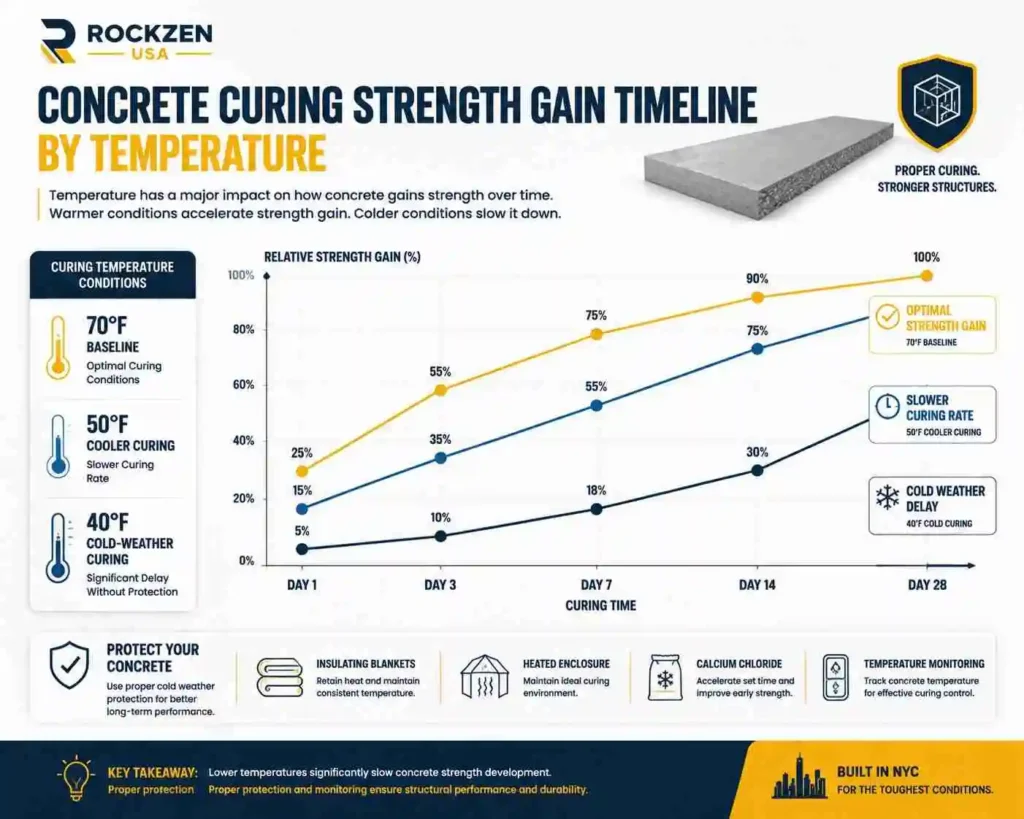
At 50°F, concrete reaches approximately 50 percent of 28-day strength in 7 days. Full 28-day design strength develops in 28 to 35 days. The minimum 14-day curing period at 50°F provides adequate protection for most residential applications.
Curing compound application after finishing helps retain moisture during this extended curing period. Vapor barriers and blankets together maintain both temperature and moisture. Both factors are required for proper curing.
Curing Timeline at 40°F and Below
At 40°F, strength gain slows to approximately half the rate at 70°F. The table below shows typical strength development.
| Temperature | 3-Day Strength | 7-Day Strength | 28-Day Strength |
|---|---|---|---|
| 70°F (21°C) | 40% | 65% | 100% |
| 50°F (10°C) | 28% | 50% | 90% |
| 40°F (4°C) | 20% | 35% | 75% |
| 32°F (0°C) | 10% | 20% | 50% |
Source: Portland Cement Association, adapted from ACI 306R
When Concrete Reaches Full Strength
Full design strength at 40°F may not develop within 28 days. Extended curing at low temperatures requires additional time. Calculate concrete maturity index using logged temperature data to determine actual strength rather than relying on calendar-based estimates.
Do not apply loads, remove forms, or begin construction above a cold-weather slab without maturity confirmation. Loading before adequate strength carries structural risk. Test concrete cylinders cured in cold conditions from the actual pour for reliable data.
Should You DIY or Hire a Contractor for Winter Concrete?
DIY cold weather concrete works for small residential pours with proper preparation. Professional contractors are better for structural work, large pours, and projects requiring ACI 306R compliance documentation. The complexity increases significantly below 20°F.
When DIY Cold Weather Pouring Works
DIY suits small flatwork like steps, small patios, and repair work. Conditions between 35°F and 45°F with no overnight freeze forecast are the safest DIY range. Cold weather concrete service near me searches often surface local suppliers who can advise on mix design.
Basic cold weather protocol for DIY includes warm mixing water, insulating curing blankets, and a temperature thermometer. Remove snow and ice, heat the ground, place quickly, cover immediately. Monitor temperature for 48 hours.
When to Hire a Professional
Structural foundations, commercial flatwork, and pours below 20°F require professional cold weather concreting expertise. ACI 306R compliance documentation, continuous temperature monitoring log records, and maturity testing are standard on professional winter projects.
Professional cold weather concrete consulting adds real value when the project cannot be delayed and conditions are severe. Contractors with heated enclosure capability, insulated concrete pump lines, and concrete maturity meters handle conditions that DIY methods cannot safely manage.
Cost of Winter Concrete Pouring
Cold weather concrete costs 10 to 25 percent more than summer work. Heated aggregate storage, warm mixing water, accelerating admixtures, and thermal protection all add cost. Commercial heated concrete mixer rental and heated enclosure setup are the largest additional line items.
Factor these costs against the cost of delaying the project. For time-sensitive commercial work, winter pouring at higher cost beats project schedule delays. For non-urgent residential work, waiting for spring thaw is often the more economical choice.
Frequently Asked Questions About Cold Weather Concrete
What temperature is too cold to pour concrete?
Concrete should not be poured when air temperature falls below 40°F without protective measures. Below 32°F without a heated enclosure, frost damage risk is severe. ACI 306R defines 40°F as the cold weather concreting threshold.
Is it okay to pour concrete in 30°F weather?
Yes, with a heated enclosure, warm mixing water, calcium chloride accelerator dosage, and preheating subgrade before pouring. Without these measures, concrete placed at 30°F will freeze before reaching adequate strength.
Will concrete freeze the first night?
Yes, without thermal blankets or a heated enclosure. Fresh concrete loses heat quickly overnight. Post-pour thermal blanket removal must not happen until concrete reaches minimum 500 psi.
Is concrete ruined if it freezes?
Concrete frozen before reaching 500 psi suffers permanent strength reduction. Recovery after thawing is partial. Concrete that freezes after 500 psi can regain most of its strength but should be tested before loading.
At what temperature does concrete freeze?
Fresh concrete freezes at approximately 27°F (-3°C) due to dissolved salts lowering the freezing point. Thin sections at low temperatures freeze faster. Early age frost damage prevention requires continuous surface temperature monitoring.
What destroys concrete quickly in cold weather?
Freeze-thaw cycles destroy concrete faster than any other cold weather factor. Water enters cracks, freezes, expands by 9 percent, and widens the crack. Air entrainment reduces freeze-thaw damage by absorbing expansion pressure.
How long does 2 inches of concrete take to set in cold weather?
A 2-inch slab sets in 48 to 72 hours at 40°F compared to 24 hours at 70°F. Foot traffic should wait 5 to 7 days. Thin sections need insulated blankets throughout the full minimum 14-day curing period.
What is the 90-minute rule for concrete?
Ready-mixed concrete must be discharged within 90 minutes of water contacting the mix per ASTM C94. Cold weather extends workability but does not extend this limit. Concrete exceeding 90 minutes must be rejected.
What is the best cold weather concrete accelerator?
Calcium chloride at 1 to 2 percent of cement weight is the most effective and affordable option for plain concrete. Non-chloride accelerators are required for reinforced concrete to prevent rebar corrosion. Both accelerate hydration heat and reduce setting time.
Need Professional Concrete Work in Cold Weather?
Rockzen Construction helps NYC property owners complete concrete work in cold weather with proper temperature control, placement, protection, and curing practices. Every project starts with a free on-site assessment to determine the right approach for the weather and concrete conditions. You receive a written cost estimate with clear project details and next steps. Most assessments are booked within 48 hours.