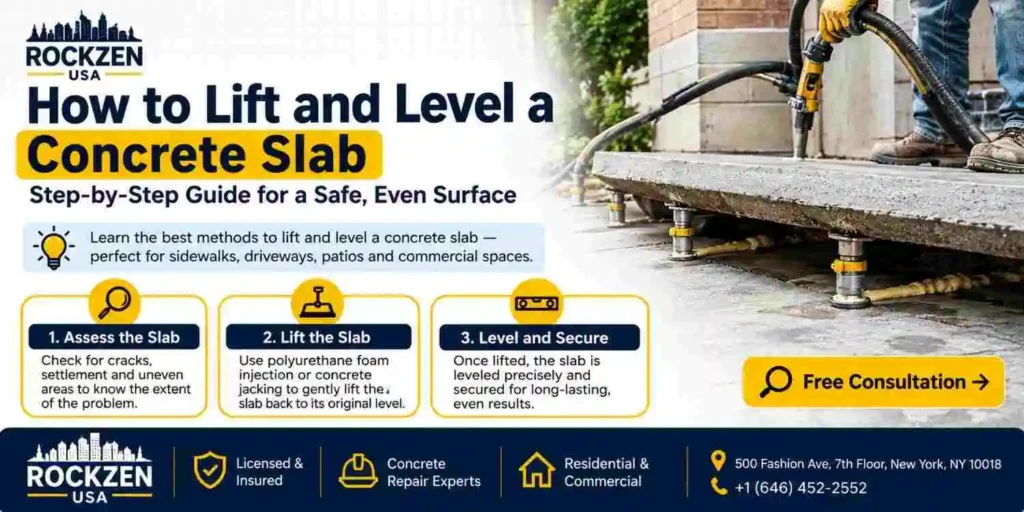
A sunken concrete slab does not always need to be replaced. Mudjacking and polyurethane foam injection can fill voids beneath the slab and raise it back to the correct elevation. Severe or ongoing soil settlement may require piering or another structural repair.
What Does It Mean to Lift and Level a Concrete Slab?
Lifting and leveling a concrete slab means raising a sunken section back to its original elevation and grade. The process restores a flat, even surface without removing the existing concrete. Slab jacking, mudjacking, and polyurethane foam injection are the three primary lifting techniques used by a concrete contractor today.
Concrete Slab Settlement
Concrete slab settlement happens when the ground beneath the slab gives way. The slab itself usually stays intact. Settlement is a soil problem wearing a concrete disguise.
Sunken vs Uneven vs Tilted Slabs
A sunken slab has dropped evenly across its full area. An uneven slab has one section lower than the rest. A tilted slab has settled more on one side, creating a slope. Each pattern points to a different void location beneath the concrete.
Lifting vs Leveling vs Resurfacing
Lifting raises the slab back to grade using injected material. Leveling is the result, a flat and even surface. Resurfacing applies a new layer over a slab that is sound but worn, and does not address settlement underneath.
Interior vs Exterior Slab Considerations
Exterior slabs like driveways and patios face soil erosion and freeze-thaw cycles directly. Interior slabs such as basement floors and garage floors settle more slowly but raise dust and access concerns during lifting. Interior lifting work often pairs with a concrete leveling compound for the final finish.
What Causes a Concrete Slab to Sink?
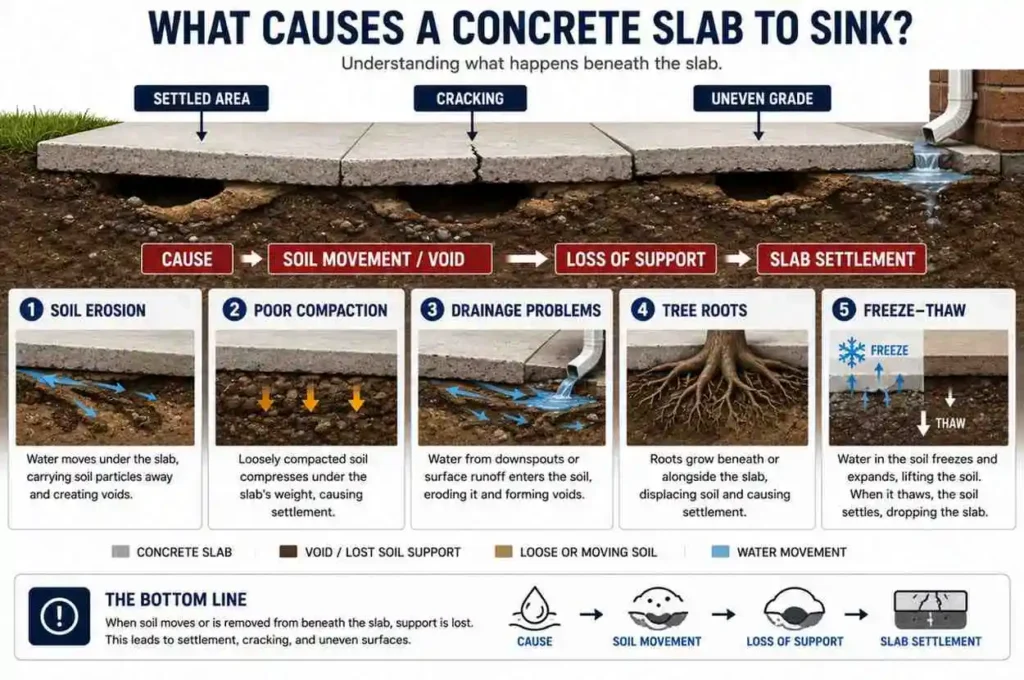
A concrete slab sinks when the soil beneath it loses volume or shifts position. Soil erosion, poor compaction, tree roots, and freeze-thaw cycles are the most common causes. NYC properties see all four causes regularly. Old fill soil and harsh winters make this common.
Soil Erosion Beneath the Slab
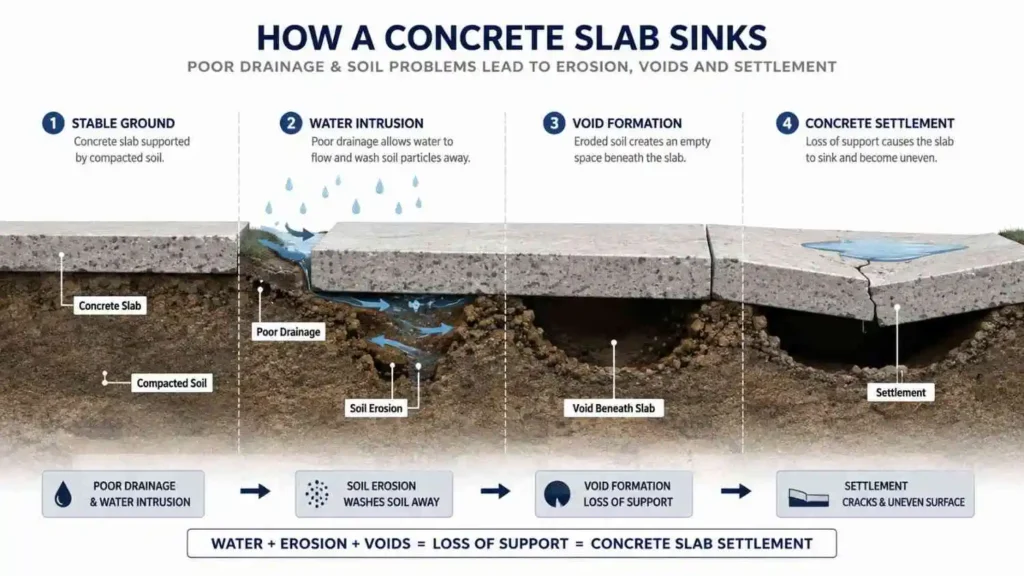
Water carries soil particles away from beneath the slab over time. A void forms where solid ground used to be. The slab has nothing left to rest on and drops into the gap.
Poor Soil Compaction at Installation
Concrete poured over loose, uncompacted soil settles as that soil compresses under weight. This is one of the most common causes of slab sinking in new construction. Subgrade soil compaction testing before pouring prevents this outcome entirely.
Drainage and Tree Root Issues
Poor drainage directs water under the slab edge instead of away from it. Tree roots growing nearby disturb soil structure and create channels for water. Both conditions accelerate soil erosion beneath nearby concrete.
Freeze-Thaw and Seasonal Soil Movement
New York winters bring 30 to 50 freeze-thaw cycles each year. Water in the soil freezes, expands, and shifts the ground. Spring thaw inspection often reveals new settlements. This settlement was not visible the previous fall.
Climate and Soil Type Differences
Clay soil expands when wet and shrinks when dry, moving slabs in both directions. Sandy soil erodes faster but compacts more predictably. NYC neighborhoods built on filled land see faster settlement. Parts of Brooklyn and Queens show this most, settling faster than areas on natural bedrock.
How Do You Diagnose a Sunken Concrete Slab Before Repair?
Diagnosing a sunken slab means measuring the drop and checking for voids. The settlement pattern then points to the right repair method. A home inspector or concrete contractor completes this in under 30 minutes. Skipping diagnosis leads to the wrong method and a repair that fails.
Settlement Diagnosis Checklist
Walk the full slab and note every location where water pools after rain. Measure the height difference at each joint with a straightedge. Press on slab corners and edges to check for rocking or flex.
Measuring Slab Drop and Tilt
A laser level or string line across the slab reveals the total drop in inches. A tilted slab shows a consistent slope from one edge to the other. A sunken slab shows a dip in the middle or at one corner.
Detecting Voids Beneath the Slab
A hollow sound when tapping the slab indicates a void below. Ground penetrating radar or core sampling confirms void size on larger commercial slabs. Most residential jobs rely on sound testing and visual settlement patterns alone.
Slab Sinking Again After a Previous Repair
A slab that sinks again after a prior repair points to a real problem. The cause is usually unresolved drainage or new soil erosion nearby. Concrete releveling in this situation should address the water source first. Repeating the same lift without fixing drainage produces the same result within a few years.
Signs Leveling Will Not Work
Leveling will not work on a slab broken into three or more pieces. It will not work when the slab has lost over 30 percent of its concrete. These slabs need replacement, not lifting.
What Safety Risks Should You Check Before Lifting a Slab?
Lifting a concrete slab safely requires three checks first. Look for rebar, nearby foundation walls, and buried utility lines before drilling begins. A licensed concrete contractor identifies these risks during the inspection visit. Missing any of the three can turn a routine lift into an expensive mistake.
Rebar and Reinforcement Mesh
Slabs poured with rebar or wire mesh resist cracking better during a gradual lift. Drilling locations must avoid cutting through reinforcement steel. A contractor checks slab thickness and reinforcement type before marking injection points.
Proximity to Foundation Walls
Slabs poured against a foundation wall, like a porch or stoop, need careful pressure control. Excess pressure near a foundation wall can transfer force into the structure itself. A structural engineer reviews foundation-adjacent lifts on older NYC rowhouses and brownstones.
Utility Lines Beneath the Slab
Gas lines, water lines, and electrical conduit often run beneath driveways and patios. International Code Council (ICC) guidelines and NYC code both require utility marking before drilling. Hitting a utility line during injection creates a hazard that stops the entire project.
Can a Concrete Slab Be Lifted Instead of Replaced?
Yes. Most sunken concrete slabs can be lifted instead of replaced. Mudjacking, foam injection, and piering address most residential and commercial settlement issues. Replacement becomes necessary only when the slab itself has failed structurally, not just sunk.
When Lifting Is the Right Choice
Lifting works when the slab is intact, with cracks limited to surface hairlines. It works when the settlement is caused by a void rather than ongoing soil failure. Most driveway, patio, and sidewalk settlement fall into this category.
When Replacement Is Required Instead
Replacement is required when the slab has fractured into multiple large pieces. It is required when reinforcement steel has corroded and lost structural value. A structural engineer or foundation repair specialist confirms this threshold during assessment.
Repair Method Decision Tree
A simple decision path applies. Intact slab with a void below points to mudjacking or foam injection. Intact slab but soil still actively failing points to piering alongside lifting. Fractured slab or major structural cracks points to replacement. A general contractor or foundation repair specialist walks through this decision during the site visit.
How Do You Lift a Concrete Slab Using Mudjacking?
Mudjacking lifts a sunken slab using pumped grout. The cement and soil mixture goes beneath the slab through small drilled holes. The grout fills the void below. Hydraulic pressure then raises the slab back to grade. The American Concrete Institute recognizes mudjacking as a standard method. Contractors have used it for over 80 years.
Mudjacking Definition
Mudjacking, also called slab jacking, drills holes between 1.5 and 2 inches through the slab. A mudjacking pump forces a slurry of cement, soil, and water through those holes. The slurry fills voids and the resulting hydraulic pressure lifts the slab.
Mudjacking Process Steps
The contractor marks injection points based on the void map. Holes are drilled and the pump injects grout while monitoring slab elevation. Injection stops once the slab reaches level, and holes are patched with concrete.
Drill Hole Size and Slurry Mix
The slurry mix resembles thick pancake batter. It mixes easily through the pump while holding its shape under the slab. Slurry mix ratios vary by soil type. Sandier soils need thicker mixes to resist washing away.
Mudjacking Curing and Return to Use
Foot traffic returns to a mudjacked slab within hours. Vehicle traffic should wait 24 hours for the grout to gain enough strength. The patched holes blend into the surface within days.
How Does Polyurethane Foam Injection Lift Concrete?
Polyurethane foam injection lifts a sunken slab with a two-part foam. The foam expands on contact and fills voids beneath the concrete. The foam cures within 15 minutes and the slab returns to use shortly after. The Polyurethane Foam Association recognizes this as a modern alternative to traditional mudjacking.
Foam Injection Definition
Foam injection uses ports as small as five eighths of an inch. This is far smaller than mudjacking holes. Two liquid components mix at the injection point and react, expanding into a dense foam. The expanding foam fills voids and lifts the slab as it grows.
Foam Injection Process Steps
The contractor drills small ports at calculated points across the settled area. The injection gun delivers foam in controlled bursts while monitoring slab movement. Lifting stops the moment the slab reaches target elevation, and ports are patched.
Foam Injection Curing and Return to Use
The foam reaches full cure in about 15 minutes. The slab is ready for foot and vehicle traffic shortly after the lift completes. This rapid return to use is the method’s defining advantage over mudjacking.
Weather Considerations for Foam Lifting
Polyurethane foam injection can proceed in nearly any weather, including light rain and cold temperatures. The foam is waterproof once cured and will not wash out under wet soil conditions. Mudjacking, by comparison, needs dry conditions for the grout to set properly.
What Is Concrete Piering for Severe Slab Settlement?
Concrete piering stabilizes a slab or foundation using steel piers. The piers reach down to load-bearing soil or bedrock. Piering addresses settlement caused by failing soil rather than a simple void. A foundation repair specialist installs piers when lifting alone will not hold. The Concrete Foundation Association recognizes piering as standard practice for ongoing settlement.
Push Pier and Helical Pier Basics
Push piers are driven straight down using the weight of the structure as resistance. Helical piers screw into the ground like a large bolt, reaching stable soil at depth. Both transfer the slab’s load away from the failing soil layer above.
When Piering Is Needed Instead of Lifting
Piering becomes necessary when soil keeps settling year after year. This happens despite repeated lifting attempts. It is common on porches and additions experiencing foundation settlement. A structural engineer typically recommends piering after reviewing repeated lift failures.
How Do You Finish a Concrete Slab Lift?
Finishing a concrete slab lift has three parts. The slab gets raised gradually while pressure is monitored. Drill holes get patched once level is reached. This Old House contractor Roger Cook said it best. Raise the slab little by little to avoid cracks. Rushing the lift is the most common cause of a cracked slab during repair.
Lifting the Slab Gradually to Avoid Cracking
A slab lifted too quickly in one spot cracks first. The rest of the slab has not caught up yet. Working across multiple injection points in small increments keeps the slab moving as one piece. Patience during this step protects the slab being repaired.
Monitoring Injection Pressure
A pressure gauge on the pump shows how much force is reaching the slab. Pressure that climbs too fast signals a blocked void or a slab edge lifting unevenly. Some contractors also use leveling sensors to track slab elevation in real time during the lift. Watching these readings is how an experienced contractor prevents fractures during the lift.
Patching and Sealing Drill Holes
Once the slab reaches level, injection holes get filled with mortar. Portland cement gives this patch its strength. A concrete crack filler or epoxy seals any hairline cracks that appeared during the lift. Sealed holes become nearly invisible within a season.
Final Inspection After Lifting
A final inspection confirms the slab sits level across its full surface and at every joint. The contractor checks that drainage now slopes away from the structure as intended. This step closes out the repair and confirms the fix held.
How Do You Lift a Small Concrete Slab Yourself?
Lifting a small concrete slab yourself works for certain areas. A single stepping stone or an air conditioning (AC) pad are good examples. A hydraulic jack or a DIY foam injection kit handles these small jobs. Larger slabs, driveways, and anything near a foundation should go to a professional. DIY lifting carries real risk of cracking the slab without proper technique.
DIY Lifting With a Hand Jack
A hydraulic jack placed in an excavated void can raise a small slab manually. This method works only where the slab edge is accessible. The void must also be shallow enough to dig safely. It demands patience, precision, and a full day of work for a small area.
DIY Concrete Lifting Foam Kits
Small polyurethane foam injection kits are sold for driveway crack and minor slab lifting projects. These kits use the same expanding foam principle as professional equipment, scaled down. Results depend heavily on correct mixing ratios and even distribution.
When DIY Is Not Recommended
General purpose spray foam is not engineered for structural lifting. Common consumer brands will not safely raise a concrete slab. Some jobs need a licensed concrete contractor instead. This includes slabs near foundations, slabs over 100 square feet, and slabs with utility lines below. The cost difference rarely justifies the risk on these jobs.
Mudjacking vs Foam Jacking vs Piering vs Resurfacing: Which Is Best?
The best method depends on four things. These are slab condition, void size, soil situation, and how fast the area needs to return to use. No single method fits every job. Matching the method to the diagnosis is what makes a repair last.
Method Comparison Table
The table below compares all four approaches by application, lifespan, and cost.
| Method | Best Application | Lifespan | Average Cost | Return to Use |
|---|---|---|---|---|
| Mudjacking | Sunken slabs with soil voids | 5 to 10 years | $3 to $7 per square foot | 24 hours |
| Polyurethane Foam | Precision lifting, weather-sensitive jobs | 10 to 15 years | $7 to $15 per square foot | 15 minutes |
| Concrete Piering | Ongoing foundation settlement | 25 plus years | $1,000 to $3,000 per pier | Varies by project |
| Resurfacing | Worn but unsunk slab surfaces | 5 to 10 years | $5 to $10 per square foot | 24 to 48 hours |
Concrete Resurfacing as an Alternative
Resurfacing applies a new overlay to a structurally sound slab. This works for surfaces that are worn, cracked, or faded. It does not lift a sunken slab and does not fill voids beneath it. Resurfacing solves an appearance problem, while mudjacking and foam injection solve a settlement problem.
Best Method by Application
A driveway with a single sunken corner suits foam injection for speed. A large patio with multiple settled areas suits mudjacking for cost efficiency. A porch with ongoing foundation settlement suits piering. A sound but tired-looking garage floor suits resurfacing.
Large Slabs and Multi-Slab Projects
Commercial slabs and multi-slab walkways need a void map first. This map covers the entire area before injection begins. Multiple injection points spread the lift evenly. This prevents one section from rising faster than its neighbors. Industrial floor projects often combine mudjacking for bulk lift with foam injection for final precision.
Lifespan Comparison by Method
Mudjacking and resurfacing both last 5 to 10 years under normal conditions. Polyurethane foam lasts 10 to 15 years. The cured foam resists moisture and will not erode like grout. Piering, when installed to load-bearing soil, lasts 25 years or longer.
How Much Does Concrete Slab Leveling Cost?
Concrete slab leveling costs vary widely by method. Mudjacking starts around $3 per square foot. Foundation piering can run over $3,000 per pier. Most residential slab lifting projects in NYC cost between $400 and $2,000. The total depends on method and area. The table below breaks down typical costs by method.
| Method | Typical Cost Range |
|---|---|
| Mudjacking | $3 to $7 per square foot |
| Polyurethane foam injection | $7 to $15 per square foot |
| Concrete piering | $1,000 to $3,000 per pier |
| Resurfacing | $5 to $10 per square foot |
| DIY foam kit | $50 to $200 per kit |
Mudjacking Cost
A typical 50-square-foot sunken patio section costs $150 to $350 using mudjacking. NYC pricing runs toward the higher end of this range. Labor rates and access conditions in dense neighborhoods drive this. Larger driveways scale up proportionally with some savings per square foot.
Foam Injection Cost
The same 50-square-foot section costs $350 to $750 using polyurethane foam injection. The higher material cost reflects faster labor time and longer lifespan. Many property owners choose foam for high-traffic areas where downtime matters.
Piering Cost
A typical residential piering job uses 4 to 8 piers depending on the affected area. Total piering costs commonly run $4,000 to $12,000 for porch or foundation corner stabilization. This cost reflects the structural nature of the repair compared to slab-only lifting.
Resurfacing Cost
Resurfacing a 200-square-foot garage floor or patio runs $1,000 to $2,000 depending on finish. Decorative finishes such as stamping or staining add to the base resurfacing cost. Resurfacing remains the most economical option when settlement is not the issue.
DIY vs Professional Cost
A DIY foam kit costs $50 to $200 for a small area. This sits far below professional rates. Professional work adds equipment, void mapping, and pressure monitoring. It also adds a warranty that DIY kits cannot match. For anything beyond a single small slab, professional work pays off. The value per year of lifespan is typically better.
When Should a Concrete Slab Be Replaced Instead of Lifted?
A concrete slab needs replacement instead of lifting in three cases. The slab has fractured into multiple pieces. The slab has lost significant structural concrete. The drop is too large for lifting to close. Replacement also applies when reinforcement steel has corroded beyond repair. A structural engineer or foundation repair specialist confirms this threshold.
Replacement Triggers
Replace the slab when cracks run through more than 30 percent of its area. Replace when the slab rocks freely with no solid contact point remaining. Replace when previous lifting attempts have failed to hold.
Cracked Concrete and Leveling Limits
Hairline cracks can be sealed before or after lifting without issue. Wide structural cracks running the full slab thickness often widen further during a lift. A contractor evaluates crack depth before committing to a leveling approach over replacement.
Large Drops and Leveling Limits
A drop of an inch or two lifts cleanly with mudjacking or foam injection. A drop of four inches or more on an interior floor often needs a combination approach. The slab gets lifted partially. A concrete leveling compound finishes the remaining gap. Extremely large drops point toward replacement as the more reliable fix.
How Long Does Concrete Slab Leveling Last?
Concrete slab leveling lasts 5 to 15 years depending on the method. Lifespan also depends on whether the underlying cause of settlement was addressed. Polyurethane foam injection lasts longest among lifting methods. Addressing drainage and soil issues alongside the lift extends every method’s lifespan.
Mudjacking Lifespan
Mudjacking repairs typically last 5 to 10 years. The cement grout can erode slowly if water continues moving through the soil beneath it. Lifespan drops when the original drainage problem was never corrected.
Foam Injection Lifespan
Polyurethane foam injection repairs commonly last 10 to 15 years. The cured foam resists moisture, will not erode, and maintains its shape under load. This durability is why foam injection costs more upfront but often costs less per year.
Resurfacing Lifespan
A concrete resurfacing layer lasts 5 to 10 years before wear returns. Lifespan depends on traffic levels and whether a sealer was applied afterward. Resurfacing over hidden settlement issues will crack again. The new surface cannot fix what is happening underneath.
Factors That Shorten Repair Lifespan
Unresolved drainage problems shorten every repair method’s lifespan. Tree roots that continue growing near the slab create new voids over time. Skipping soil compaction or drainage correction before lifting causes most repeat failures.
How Do You Prevent a Concrete Slab From Sinking Again?
Preventing a slab from sinking again comes down to three things. Improve drainage and maintain soil compaction around the perimeter. Seal joints and cracks before water gets in. Prevention costs far less than another lift. A few hours of maintenance each year protects a costly repair. That repair may have cost hundreds or thousands of dollars.
Improving Drainage Around the Slab
Grade soil away from the slab edge in every direction. Direct downspouts and gutters away from the repaired area completely. Standing water near a slab edge is the fastest path to trouble. It leads straight back to soil erosion and a new void.
Soil Compaction and Maintenance
Settled soil along a slab edge needs filling and compacting. Loose dirt on top is not enough. A plate compactor or hand tamper works for small areas. Soil stabilization materials, such as geotextile fabric, help keep compacted soil in place long term. Compacted soil resists the erosion that creates voids in the first place.
Sealing Joints and Cracks
Flexible joint sealant keeps water from entering between slabs and beneath them. Concrete crack filler applied early stops small cracks from becoming entry points for water. Reapplying sealant every 3 to 5 years maintains this protection.
Frequently Asked Questions About Lifting and Leveling Concrete Slabs
Lifting a Slab Without Replacement
Yes. Most sunken slabs can be lifted without replacement. Mudjacking, foam injection, and piering all work. Replacement is needed only when the slab has fractured or lost structural integrity.
Slab Jacking Cost
Slab jacking, another name for mudjacking, costs $3 to $7 per square foot. A typical 50-square-foot section costs $150 to $350. NYC pricing runs toward the higher end due to access and labor rates.
Mudjacking Permanence
No. Mudjacking is not permanent but typically lasts 5 to 10 years. Lifespan depends on whether the original cause was corrected. This means fixing the soil and drainage issue behind the settlement.
Foam vs Mudjacking
Foam injection costs more but lasts longer, cures faster, and works in more weather conditions. Mudjacking costs less and suits larger areas where speed matters less. Neither is universally better, the right choice depends on the project.
Causes of a Sinking Slab
Several causes lead to a sinking slab. These include soil erosion, poor compaction, tree roots, drainage problems, and freeze-thaw cycles. NYC properties commonly experience all five causes. Old fill soil and harsh winters make this common.
Polyurethane Leveling Lifespan
Polyurethane foam injection repairs last 10 to 15 years. The cured foam resists moisture and does not erode the way cement grout can. This makes it the longest-lasting lifting method short of piering.
Leveling Cracked Concrete
Yes, slabs with hairline or surface cracks can be leveled successfully. Slabs with cracks over 30 percent of the area need replacement instead. The same applies to slabs broken into multiple pieces.
Spray Foam for Slab Lifting
No. General purpose spray foam is sold for insulation, not lifting. It is not designed to safely raise a concrete slab. Dedicated polyurethane slab lifting foam is a different, engineered product made specifically for this purpose.
Self-Leveling Concrete Over Existing Floors
Self-leveling concrete is a different process from slab jacking. It is a leveling compound poured over an existing interior floor. The goal is a flat surface before flooring installation. It does not lift a sunken slab or fill voids beneath it.
Leveling a Slab With a Large Drop
A drop of four inches or more on an interior floor often needs a combined approach. Foam injection or mudjacking raises the slab partially. A concrete leveling compound finishes the remaining height difference. Extremely large drops may point toward replacement instead.
The Concrete Mix Ratio Rule
The 1 to 2 to 3 ratio is for mixing new concrete. It means one part cement, two parts sand, three parts aggregate. It relates to pouring new concrete, not lifting or leveling existing slabs. For slab settlement repair, the lifting method matters far more than the original mix ratio.
Where Can You Find More NYC Concrete Repair Guides?
A sunken concrete slab rarely happens in isolation. The same soil movement that drops a patio often shows up nearby too. An uneven cement sidewalk often shares the same roots and freeze-thaw cycles. Rockzen Construction has a full guide on repairing an uneven cement sidewalk. It covers grinding, lifting, and replacement decisions for sidewalk slabs. NYC trip hazard rules under Administrative Code Section 7-210 are also explained.
Driveways and patios sometimes need more than lifting. Rockzen Construction’s masonry and driveway services cover cracked sections, masonry steps, and full rebuilds. Sidewalk slabs under an open Department of Transportation (DOT) violation have a different timeline. Rockzen’s concrete sidewalk repair and violation removal page covers that process first.
A sunken slab caught early is a small job. Left alone through another freeze-thaw season, it becomes a bigger one. Lifting and leveling, done right, keeps the slab level for years. Drainage keeps working the way it should too.