
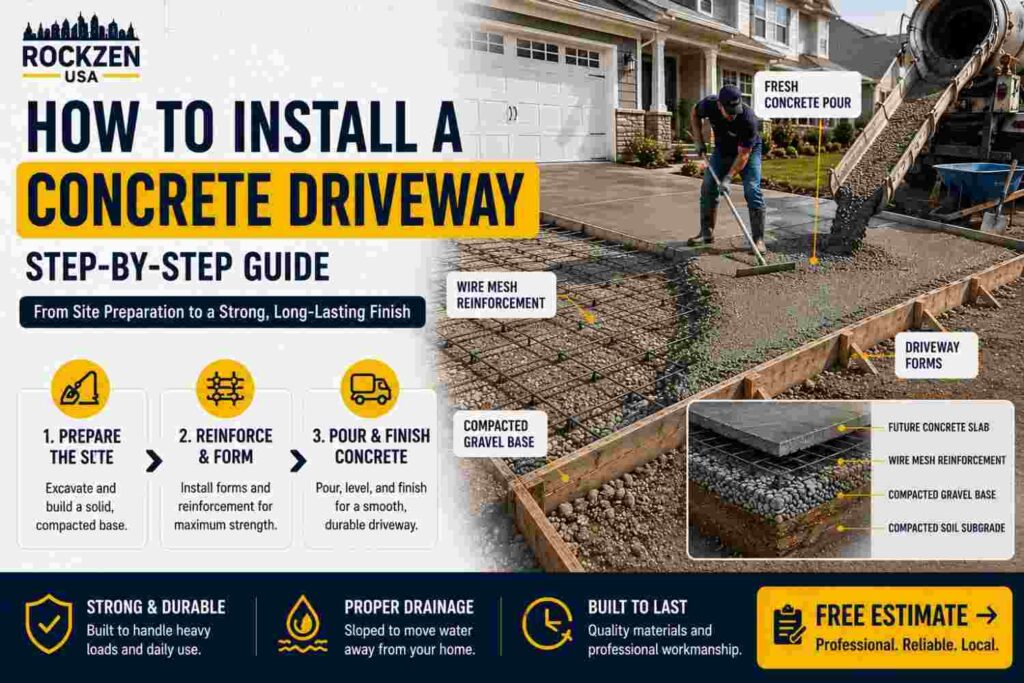
To install a concrete driveway, excavate the area, compact the subgrade, and build a gravel base. Set forms, place reinforcement, pour and finish the concrete, then cut expansion joints. Cure for at least seven days before foot traffic. A four-inch slab with wire mesh handles most residential driveways in New York.
What Is a Concrete Driveway and Why Does Proper Installation Matter?
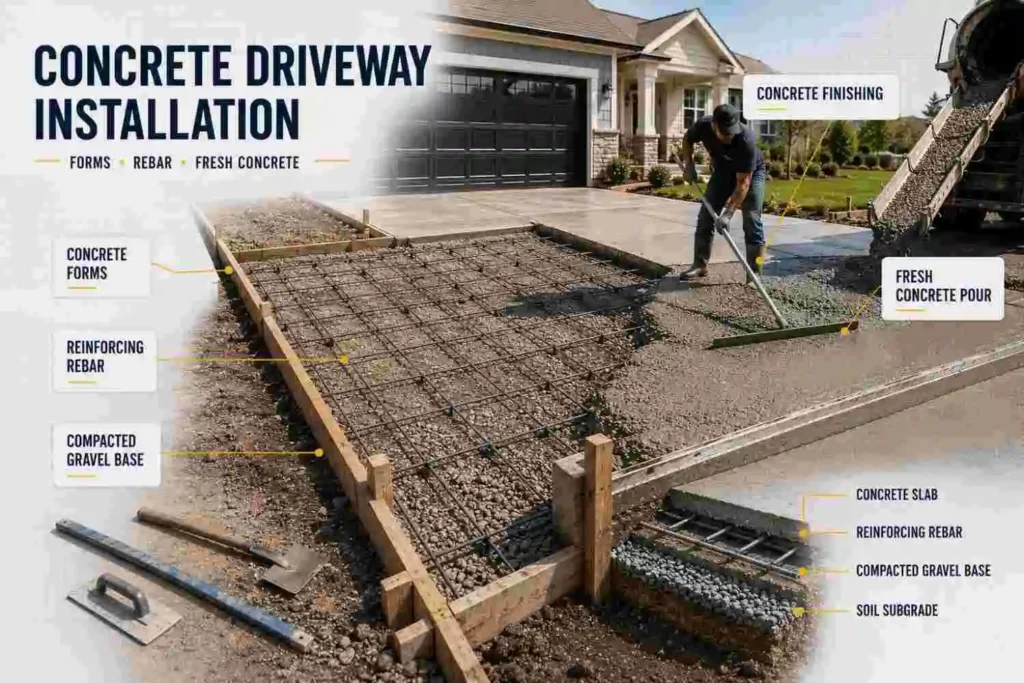
A concrete driveway is a cast-in-place slab over a compacted gravel base. It carries vehicle load every day and handles freeze-thaw cycles every winter. Get any layer wrong and no amount of sealing or patching fixes what’s underneath. The installation process determines the lifespan before the first car rolls across it.
Concrete Driveway Structure and Load-Bearing Performance
A concrete driveway transfers vehicle weight downward through three layers: the slab, the gravel base, and the compacted subgrade. Each layer carries part of the load. A weak layer at any level causes the ones above it to fail, usually within a few years.
Durability and Lifespan Expectations
A properly built concrete driveway lasts thirty to fifty years. Poor base preparation cuts that to ten or fifteen. The slab doesn’t wear out under residential traffic. The base beneath it does.
Residential vs Commercial Driveway Applications
A residential driveway carries passenger cars and light trucks. A commercial driveway handles delivery trucks and heavy equipment. Thickness and reinforcement requirements differ between the two, and confusing the two categories is one of the more expensive mistakes a homeowner can make.
Concrete Driveway vs Asphalt vs Paver
Concrete costs more upfront than asphalt but needs less maintenance over time. Pavers cost more than concrete and allow easier spot repair later. For most New York residential driveways, concrete is the default for durability and long-term value.
What Should Be Planned Before Installing a Concrete Driveway?
Skip planning and the problems show up on day one of the pour, not ten years later. Slope, drainage, permits, and load requirements all need confirmed answers before excavation starts. A driveway that drains toward the garage or fails a permit inspection is more expensive to fix than to plan correctly.
Driveway Dimensions and Square Footage
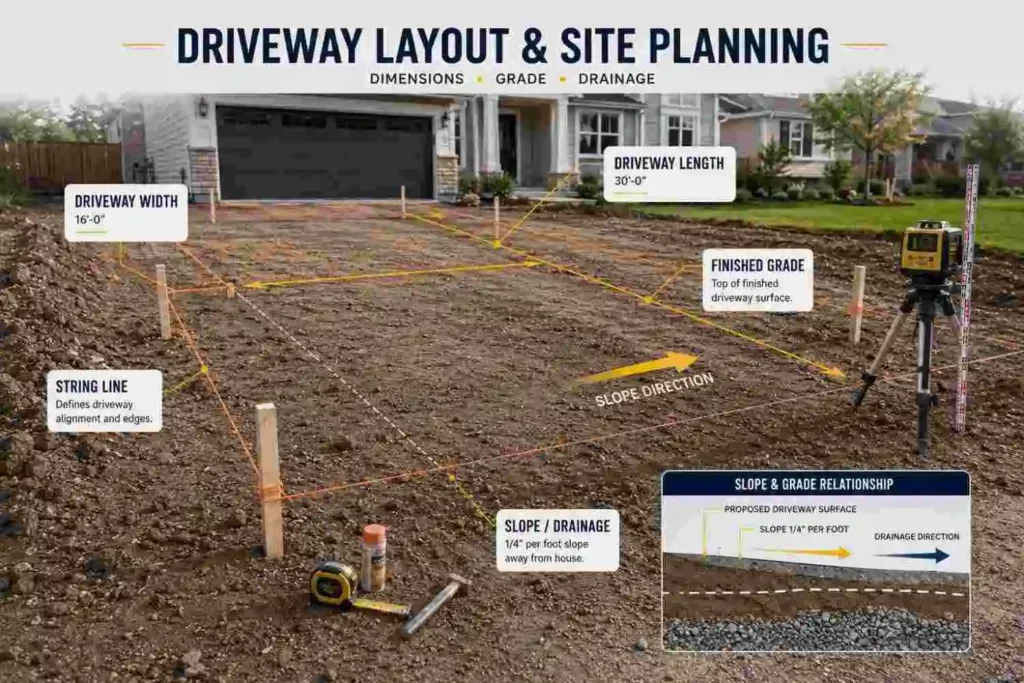
A single-car driveway needs at least nine to ten feet of width. A two-car driveway needs eighteen to twenty feet. Standard parking depth runs eighteen to twenty feet per space.
Property Layout and Slope Assessment
The surface should slope away from the garage at two percent. Check this with a level and string before anything else happens. Correcting slope after the base is poured means starting over.
Vehicle Load and Weight Requirements
Four inches of concrete handles passenger cars and light trucks. Recreational vehicles, loaded trailers, and delivery trucks need six inches. Reinforcement selection also changes with expected load, and upgrading later isn’t possible.
Local Building Codes and Permits
New York City requires permits for most new driveway installations. A licensed contractor files this application. Starting without a permit is a real risk at resale.
Drainage Planning and Water Management
All surface water should move away from the building. A cross-slope or channel drain handles flat sites. Poor drainage is the most common cause of early driveway failure in New York.
Culvert Installation Under a Driveway
A culvert is a pipe installed under the driveway where it crosses a low area or ditch. Culvert sizing depends on how much water the drainage area produces. It goes in during excavation, before any base material, and can’t be added after the pour.
How Do You Prepare the Ground for a Concrete Driveway?
Get the subgrade wrong and nothing above it holds. The soil underneath the gravel base carries the load the slab transfers down. Soft or poorly drained soil causes settling and cracking no matter how thick the slab above it is.
Site Clearing and Vegetation Removal
Remove all grass, roots, and organic material from the driveway footprint. Organic matter decomposes and leaves voids under the slab. The cleared area should extend a foot wider than the finished driveway on each side.
Excavation Depth and Process
Dig down to accommodate the gravel base, the slab thickness, and a slight crown. For a standard four-inch slab on a six-inch base, that’s about ten to twelve inches below finished grade. Keep depth consistent across the full area.
Soil Evaluation and Subgrade Behavior
Sandy soil drains well and compacts predictably. Clay holds water and expands when frozen, which is what creates frost heave on New York driveways every spring. Soil that stays wet after rain is clay and needs a thicker base.
Subgrade Compaction Techniques
Compact the exposed soil with a plate compactor before any base material goes down. Run overlapping passes until the surface doesn’t move underfoot. Skipping this is the leading cause of slab settling within the first few years.
Slope and Grade for Drainage
Grade the excavated surface to match the planned drainage slope. Check with a level and string line before adding base material. Fixing slope errors after the base is compacted costs more than confirming them now.
Pouring a Concrete Driveway on a Slope or Hill
A sloped site needs stepped forms to keep the slab thickness consistent. Concrete on a steep slope can slide before it sets. Pour from the bottom upward and use a stiffer mix to control flow.
Why Is a Gravel Base Necessary for a Concrete Driveway?
A concrete slab poured directly on soil cracks and settled within a few years on most New York sites. The gravel base drains water that would otherwise collect under the slab and freeze. It also distributes vehicle load across a wider soil area. Without it, concentrated stress goes straight to the subgrade.
Base Thickness Requirements
Four inches of gravel suits stable soil on residential driveways. Six inches suits clay soil or driveways carrying heavy vehicles. New York winters add another reason to use the thicker option, frost penetration runs deep here.
Crushed Stone vs Gravel Selection
Angular crushed stone compacts into a locked matrix. Rounded gravel rolls and doesn’t compact the same way. Three-quarter-inch minus crushed stone is the standard for driveways.
Drainage Benefits of a Proper Base
Water drains downward through the base instead of pooling under the slab. Trapped water freezes in winter, expands, and pushes the slab upward. The base is the drainage layer, not the concrete.
Preventing Settlement and Cracking
A compacted base spreads vehicle load across a wider footprint. Without it, concentrated load finds soft spots in the subgrade and the slab cracks to bridge them. Settlement voids under concrete are invisible until the surface collapses into them.
What Goes Under a Concrete Driveway
From bottom to top: compacted subgrade, crushed stone base, optional vapor barrier, reinforcement, and concrete. None of these layers substitute for another. Each has a specific structural job.
Vapor Barrier Between Base and Concrete
A polyethylene vapor barrier between the gravel and the slab reduces moisture migration upward through the concrete. On decorative driveways, it also reduces surface efflorescence. It’s more common in commercial work but worth including on wet sites.
How Are Forms Installed for Concrete Placement?
Forms define the slab’s shape, thickness, and edges before any concrete arrives. A form that moves or flexes during the pour produces a wavy edge and inconsistent thickness. Setting forms right is what makes the finished slab match the plan.
Form Materials and Selection
Two-by-four or two-by-six lumber suits standard four-inch residential slabs. Metal forms suit longer commercial pours. The form’s face needs to be straight, not just cut square.
Layout, Alignment, and Slope Requirements
Drive stakes every two to three feet and check alignment with a string line. Confirm the drainage slope with a level at multiple points along the form. A form that’s off by half an inch at one end can mean a two-inch drop across a twenty-foot run.
Edge Preparation and Bracing
Stake the outside of forms closely enough that they can’t bow under concrete pressure. A bowed form produces an edge that curves where it should be straight. Once concrete sets against a bowed form, the only fix is a saw.
Pouring a Concrete Driveway in Sections
Large driveways pour in sections with planned joints between them. Section breaks become expansion joints. Plan breaks at logical intervals so the joints look intentional rather than patched.
Driveway Apron and Extension Forming
The apron connects the driveway to the street and often slopes more steeply to match the road grade. An extension tied to an existing slab needs a bonding agent on the old concrete face before the new pour. Without it, the two sections separate along the joint within a few years.
Does a Concrete Driveway Need Reinforcement?
Yes. Concrete handles compression well but fails under tension, and driveways experience tension every time a wheel passes over a soft spot or a joint. Reinforcement holds both sides of a crack together so the surface stays level. Without it, a crack that forms under load becomes a trip hazard within a season.
Rebar vs Wire Mesh Selection
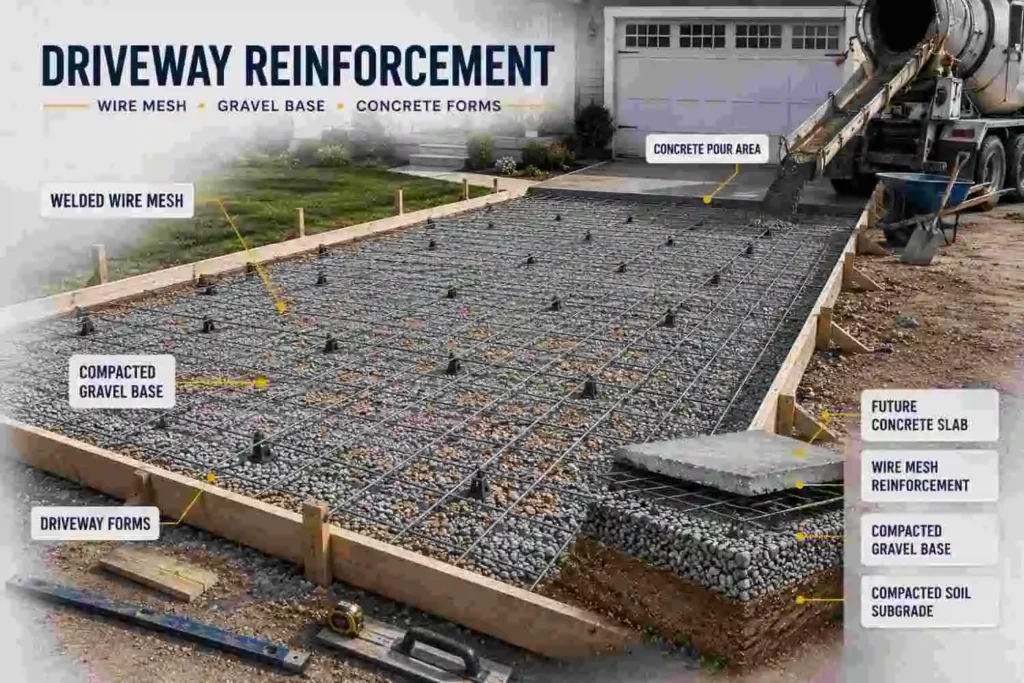
Rebar suits heavy vehicle traffic and unstable soil. Wire mesh suits standard residential driveways. Both need to sit mid-slab, raised on chairs during the pour. Flat on the base, either option provides almost no benefit.
Fiber Reinforcement as an Alternative
Polypropylene fibers mixed directly into the concrete control surface cracking without a separate reinforcement layer. Fiber reinforcement doesn’t replace structural rebar or mesh on load-bearing driveways. It supplements them.
Reinforcement Spacing and Placement
Rebar spaces six to twelve inches on center depending on load. Wire mesh laps overlap six inches at seams. Position both mid-slab before the pour and keep them there. A reinforcement layer that migrates to the base during pouring provides no tensile benefit.
Load Distribution and Crack Prevention
Reinforcement keeps crack faces locked together. One side can’t drop relative to the other because the steel bridging the crack holds them in alignment. This is what separates a hairline crack from a settled step.
Reinforcement for Heavy Vehicle Traffic
Regular truck traffic or RV storage needs rebar on twelve-inch centers, not wire mesh. Six-inch slab depth goes with it. Wire mesh on a driveway that takes that kind of load cracks within a few years.
Climate Effects on Reinforcement Selection
New York’s freeze-thaw cycles move concrete more than warmer climates. Deformed rebar bonds more reliably through that repeated movement than smooth wire. This is less about strength and more about the steel staying connected to the slab as it expands and contracts.
How Is Concrete Mixed and Poured for a Driveway?
Ready-mix concrete arrives by truck, already proportioned to the right ratio. Mixing on site is only practical for very small pours. The concrete’s PSI rating, workability, and timing window all determine whether the pour goes cleanly or turns into a scramble.
Choosing the Right Concrete Mix
A 3,000 to 3,500 PSI (pounds per square inch) mix suits standard residential driveways. New York’s winters justify a 4,000 PSI mix for better freeze-thaw resistance. Higher PSI means denser concrete that absorbs less water and corrodes reinforcement more slowly.
PSI Requirements for Driveways
A 3,000 PSI mix reaches design strength after 28 days of proper curing. A 4,000 PSI mix is denser, more expensive, and lasts longer on exposed driveways in cold climates. The extra cost per yard is small relative to the total project.
Ready-Mix vs Site-Mixed Concrete
Ready-mix is the only practical choice for anything larger than a small patio. Site-mixing in a drum mixer can’t match the consistency of a plant-batched load. Inconsistent mix produces variable strength across the slab.
Concrete Delivery Methods
A ready-mix truck discharges directly into forms where access allows. A pump carries concrete to areas the truck can’t reach. Wheelbarrows work for small pours on tight sites but slow the process.
Pouring Techniques and Consistent Thickness
Start at the far end from the truck and work back. Spread concrete with a rake as you pour. Check thickness at multiple points with a depth gauge during the pour, not after.
Pouring Concrete on a Slope
On a sloped driveway, start at the low end and pour uphill. Concrete flows, and working uphill controls that movement. A stiffer mix, lower slump, helps on slopes steeper than a few percent.
How Is a Concrete Driveway Leveled and Finished?
Finishing starts the moment the pour ends and stops when the surface is too stiff to work. The window varies by temperature, mix design, and humidity. Miss it and the surface is rough, uneven, and impossible to texture correctly.
Screeding the Surface
Pull a screed board across the tops of the forms in a sawing motion. Two people work the screed while a third fills and removes concrete ahead of it. Screeding sets the final grade.
Bull Floating
A bull float follows the screed immediately. It embeds aggregate below the surface and brings paste up for finishing. Work it before bleed water appears on the surface.
Edge Finishing
An edging tool rounds the slab perimeter after the bull floats. Rounded edges resist chipping better than sharp square ones. This also defines the clean line between the slab and the form face.
Surface Texturing Options
A broom finish is the standard choice for driveways, slip-resistant and durable. Exposed aggregate removes the surface paste to reveal the stone below for a more decorative look. Stamped concrete presses patterns into the surface before it sets.
Broom Finish Application
Drag a stiff-bristled broom across the surface in one direction after bleed water evaporates. Consistent pressure produces a uniform texture. Light passes for a smoother feel, heavier passes for more grip in icy conditions.
Why Are Expansion and Control Joints Necessary in a Concrete Driveway?
Concrete moves. It expands in summer heat and contracts through a New York winter. Without joints, that movement produces random cracking across the surface. Joints give the concrete a predictable crack plane, at the joint rather than wherever stress builds up.
How Concrete Moves and Why Joints Matter
A thirty-foot concrete driveway changes length by roughly a quarter inch between winter cold and summer heat. Small movement, large consequence if nowhere to go. Joints absorb that movement before it becomes a crack.
Control Joint Placement and Spacing
Cut control joints every eight to twelve feet. Divide the slab into roughly square panels. Long rectangular panels crack across the middle, not at the joints.
Expansion Joint Materials
Expansion joints use compressible fiberboard or foam backer rod between sections. The material compresses as concrete expands and rebounds as it contracts. Place expansion joints at the garage floor, between day-one and day-two pours, and at the street apron.
Saw-Cut Joints vs Tooled Joints
Saw-cut joints go in after the slab hardens. Tooled joints groove the surface while the concrete is still plastic. Both create a weakened plane where the slab cracks on purpose.
Long-Term Crack Control Performance
A crack at a joint stays tight because reinforcement holds both sides in alignment. A random crack widens as the two sides move independently over years. The difference in appearance after ten New York winters is stark.
How Long Does Concrete Need to Cure Before Use?
New concrete needs seven days before foot traffic and twenty-eight days before vehicles. Curing isn’t drying. It’s the chemical reaction between water and cement that builds the slab’s final strength. Cutting that short permanently weakens the concrete.
Initial Curing Period and Strength Development
Concrete reaches roughly seventy percent of design strength after seven days of proper curing. Full strength comes closer to twenty-eight days. In cold New York weather, both timelines extend.
Moisture Retention Methods
Cover the slab with wet burlap and plastic sheeting to retain moisture during curing. Curing compounds sprayed on the surface slow evaporation on large pours. The concrete needs to stay damp, not wet, for at least the first seven days.
Weather and Temperature Effects on Curing
Curing stops below forty degrees Fahrenheit because the hydration reaction needs liquid water. Protect fresh concrete in cold weather with insulating blankets. Dry, windy conditions pull moisture out of the surface faster than the concrete can hydrate, causing surface cracking before the pour even finishes.
When You Can Walk on New Concrete
Light foot traffic is generally safe after twenty-four to forty-eight hours. Avoid dragging objects or placing anything heavy during this window. The surface feels solid before the slab has reached structural strength.
When You Can Drive on New Concrete
Wait at least seven days for passenger cars. Heavy vehicles need the full twenty-eight days. Early vehicle traffic leaves permanent impressions and reduces the slab’s load capacity permanently.
Should a New Concrete Driveway Be Sealed?
Yes, and the timing matters. Sealing too early traps moisture that disrupts the curing reaction. Sealing at thirty days, after the full cure, fills the surface pores and reduces water absorption significantly. An unsealed driveway in New York starts scaling within the first few winters.
Benefits of Sealing
A penetrating sealer reduces how much water the concrete absorbs. Less water absorption means less freeze-thaw damage. Sealing also protects reinforcement from moisture-driven corrosion over the long term.
Water and Stain Resistance
Sealed concrete sheds water instead of absorbing it. Oil and road grime don’t penetrate permanently. An unsealed driveway stains in the first season and those stains don’t come out.
Freeze-Thaw Protection in Cold Climates
Water absorbed into unsealed concrete expands when it freezes and flakes the surface. New York’s winters deliver that cycle dozens of times per season. A sealer doesn’t eliminate the risk but extends the surface life measurably.
Sealing Schedule and Reapplication
Apply the first sealer no sooner than thirty days after the pour. Reapply every two to three years. When water stops beading on the surface, it’s time to reseal.
What Common Mistakes Should Be Avoided During Concrete Driveway Installation?
Six mistakes account for most concrete driveway failures. Every one is preventable. Understanding why each matters makes avoiding it concrete rather than abstract.
Poor Soil Compaction
Uncompacted soil settles under slab weight. Settlement voids form under the concrete and the slab cracks to bridge them. No slab thickness compensates for a soft subgrade.
Insufficient Base Thickness
A thin gravel base provides inadequate drainage and load distribution. Water collects under the slab and freezes. A base too thin to spread the load concentrates stress directly into the subgrade.
Incorrect Reinforcement Selection or Placement
Reinforcement resting on the base, not mid-slab, provides almost no tensile benefit. Wire mesh under a driveway that carries heavy vehicles is undersized for the job. Both mistakes are invisible once the concrete sets.
Improper Expansion Joint Placement
Joints placed too far apart leave large panels that crack randomly between them. A joint shallower than one-quarter the slab depth doesn’t create a reliable crack plane. Skip the joints entirely and the concrete decides where to crack on its own.
Inadequate Curing
Fresh concrete allowed to dry rather than cure loses strength permanently. A slab that dries too fast in summer wind or sun develops surface cracking within days. Curing costs almost nothing and is the most commonly skipped step on budget jobs.
Premature Sealing
Sealing before thirty days traps residual moisture inside the slab. The ongoing hydration reaction needs that moisture. Wait for the full cure before applying anything to the surface.
How Long Does a Properly Installed Concrete Driveway Last?
Thirty to fifty years for a well-built driveway. The concrete doesn’t wear out under residential traffic. The base, the drainage, and the curing quality determine whether the slab reaches that range.
Lifespan by Installation Quality
A driveway on a compacted base with proper reinforcement and full curing lasts thirty to fifty years. One with any of those steps missing often fails in ten to fifteen. The difference isn’t visible on the day of the pour.
Maintenance Requirements
Seal every two to three years. Clean oil stains before they penetrate the surface. Address cracks early with flexible sealant before water widens them through freeze-thaw.
Weather and Freeze-Thaw Resistance
A sealed, properly drained driveway handles New York winters for decades. An unsealed or poorly drained one begins scaling within the first five years. Drainage matters more than sealing for long-term performance in cold climates.
Repair Considerations Over Time
Surface scaling and hairline cracking are cosmetic. Structural cracks that shift vertically mean one side dropped relative to the other, which points to base failure. Base failure needs removal and replacement, not a surface patch.
Factors That Shorten Driveway Lifespan
Rock salt for ice removal is the most common cause of early surface deterioration. Heavy vehicles on a slab designed for passenger cars accelerate cracking. Tree roots growing under the slab lift sections unevenly over years, and by the time the rise is visible, the damage underneath is already widespread.
How Much Does It Cost to Install a Concrete Driveway?
Concrete driveway installation runs eight to eighteen dollars per square foot in New York City, fully installed. A standard two-car driveway comes out to four thousand to nine thousand dollars. The range reflects site access, slab thickness, reinforcement choice, and finish type.
| Cost Component | Typical Range |
|---|---|
| Concrete and base materials | $3 to $6 per sq ft |
| Labor | $4 to $8 per sq ft |
| Reinforcement, rebar or mesh | $0.50 to $2 per sq ft |
| Decorative finish upgrades | $2 to $10 per sq ft |
| Total installed, NYC | $8 to $18 per sq ft |
| 20×20 driveway total | $3,200 to $7,200 |
These figures shift based on site access, reinforcement type, and finish. For an exact price on your driveway, Rockzen Construction provides free on-site quotes across NYC.
Material Costs
Concrete and base materials together run three to six dollars per square foot. Ready-mix delivery adds a fixed charge regardless of project size. Matching an existing surface color or aggregate adds a premium.
Labor Costs
Labor runs four to eight dollars per square foot in NYC. Dense boroughs with limited truck access push toward the upper end. Accessible lots in the outer boroughs sit lower.
Reinforcement Costs
Wire mesh adds fifty cents to one dollar per square foot. Rebar adds one to two dollars per square foot. Fiber reinforcement adds a smaller premium to the concrete cost per yard.
Decorative Finish Costs
A broom finish adds nothing beyond standard finishing labor. Exposed aggregate adds two to four dollars per square foot. Stamped concrete adds four to ten dollars depending on the pattern.
Cost Per Square Foot in NYC
NYC runs eight to eighteen dollars per square foot installed. Tight sites, old slab removal, and premium finishes push toward the high end. Straightforward lots with good access land lower.
How Much Does a 20×20 Concrete Driveway Cost
A 20-by-20 driveway is 400 square feet. At eight to eighteen dollars installed, the range runs three thousand two hundred to seven thousand two hundred dollars. Permits, demolition of an existing slab, and decorative finishes add to that number.
Should You Install a Concrete Driveway Yourself or Hire a Contractor?
Concrete doesn’t wait. The pour, finishing, and joint cutting have to happen in the right order before the slab sets. Most DIY driveway attempts fail not from lack of knowledge but from lack of crew and equipment at the right moment. Hiring a licensed contractor is the practical answer for any driveway over a few hundred square feet.
DIY Challenges and Skill Requirements
Screeding, bull floating, and finishing require practiced hands in the time concrete allows. A large pour needs multiple people working simultaneously. A mistake during the finishing window can’t be corrected once the slab hardens.
Equipment Requirements for DIY Installation
A concrete driveway project needs a plate compactor, screed, bull float, edging tools, and a saw for joint cutting. Renting this equipment adds several hundred dollars. Most homeowners also need a concrete pump or enough wheelbarrows to move a full ready-mix truck’s load.
Risks of DIY Concrete Work
An improperly finished slab, a misplaced joint, or premature drying produce permanent results. Redoing a concrete driveway means full demolition and starting over. The cost of a single mistake routinely exceeds the labor savings from doing it yourself.
Contractor Advantages and Long-Term Value
A licensed contractor brings crew size, equipment, and timing experience. Professional finishing produces a more uniform surface than a first attempt. Contractor liability insurance also covers property damage during the project.
Long-Term Cost Comparison
A professionally installed driveway lasting forty years costs less per year than a DIY driveway that needs replacement in fifteen. The upfront labor savings rarely survive the first major repair. Labor is the largest line item in a driveway project because it’s doing the most work.
How Do You Choose a Concrete Driveway Contractor in NYC?
The right contractor names the concrete PSI, the base depth, and the reinforcement type before a single shovel goes in. One who can’t answer those three questions clearly is not the one to call.
Licensing and Insurance Requirements
A New York concrete driveway contractor should carry active general liability insurance. Workers compensation protects the crew. DOT compliance is required wherever work touches the public right of way.
Questions to Ask Before Hiring
Ask what PSI they’re specifying and why. Ask the planned base depth for your specific soil. Ask for a written estimate that breaks out materials, labor, reinforcement, and finishing separately, not a single lump number.
Are Estimates Free
Most reputable NYC concrete contractors provide free on-site estimates. A written estimate specifying concrete PSI, base thickness, and reinforcement type is the minimum worth considering. A verbal-only price is not a real estimate.
Why Choose Rockzen Construction
Rockzen Construction installs and repairs concrete driveways across all five boroughs. Every project starts with the base, not the price, because that’s where a driveway either works or doesn’t. For sidewalk replacement alongside a driveway project, Rockzen’s concrete sidewalk removal and replacement guide covers that process in full.
Frequently Asked Questions About Concrete Driveway Installation
What Is the First Step in Concrete Driveway Installation?
Planning comes first. Confirm dimensions, drainage slope, load requirements, and permit needs before any excavation starts. Starting with excavation before planning produces a site that may not meet code.
How Thick Should a Concrete Driveway Be?
Four inches suits residential passenger car traffic. Six inches suits heavy vehicles. Measure thickness at the thinnest point, not an average across the slab.
Does a Concrete Driveway Need Rebar?
Wire mesh suits standard residential driveways. Rebar suits heavy vehicles, unstable soil, and freeze-thaw climates like New York. Fiber reinforcement supplements but doesn’t replace structural reinforcement.
What Type of Concrete Is Used for Driveways?
A 3,000 to 3,500 PSI ready-mix concrete suits most residential driveways. In New York, 4,000 PSI offers better freeze-thaw resistance. The concrete supplier specifies the mix based on the application.
How Long Does a Concrete Driveway Last?
Thirty to fifty years with a proper base, reinforcement, and full curing. Poor base preparation shortens that to ten to fifteen years. Lifespan depends more on what’s underneath than on the concrete itself.
When Can You Drive on New Concrete?
Passenger cars need at least seven days. Heavy vehicles need the full twenty-eight-day curing period. Early traffic leaves permanent impressions and reduces long-term load capacity.
How Do You Prepare the Ground for a Concrete Driveway?
Remove all vegetation, compact the subgrade, then add a crushed stone base compacted in lifts. Confirm the drainage slope before any concrete arrives. Ground preparation determines long-term performance more than any other step.
What Goes Under a Concrete Driveway?
Compacted subgrade, crushed stone base, optional vapor barrier, and reinforcement go under a concrete driveway in that order. Skipping the base or compaction creates the conditions for early settling and cracking.
Ready to Install a Concrete Driveway?
Rockzen Construction helps NYC property owners complete professional concrete driveway installation with proper site preparation, excavation, base installation, reinforcement, concrete placement, leveling, and finishing. Every project starts with a free on-site assessment to determine the right driveway design and installation approach for your property. You receive a written cost estimate with clear project details and next steps. Most assessments are booked within 48 hours.