
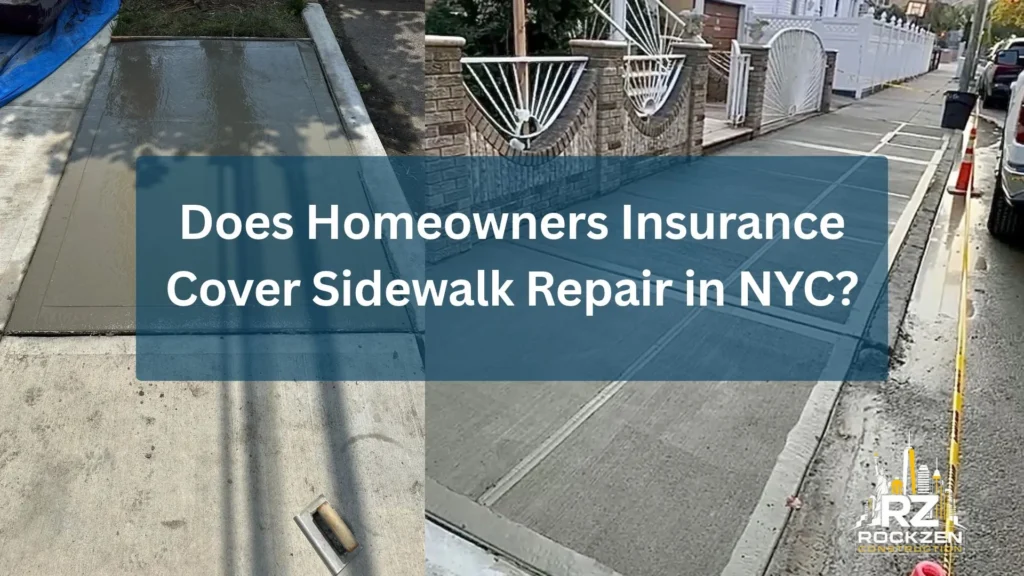
Usually not for the repair itself. A standard homeowners policy excludes wear and tear and the cracking of pavements. It may pay if someone is hurt on your sidewalk, through personal liability and medical payments coverage. Your own policy decides. Read it, or ask your insurer in writing.
What the government guide says about who pays insurance for Sidewalk repair?
The NYC Department of Transportation (DOT) publishes A Property Owner’s Guide to Address Sidewalk Defects. The guide is dated May 2018. It answers 28 questions and does not mention insurance at all. It does settle who pays.
The owner pays. NYC law requires property owners, at their own cost, to install, construct, repave and repair the sidewalk next to their property. That includes the intersection quadrant and pedestrian ramps on corner properties.
The owner is liable. Section 7-210 of the NYC Administrative Code makes owners potentially liable for injuries caused by failing to keep a sidewalk reasonably safe.
The owner clears snow. Owners must keep the sidewalk clean and are responsible for snow removal.
The City covers very little. DOT’s own program replaces more than 2 million square feet of sidewalk a year. The guide says that is less than 1% of the City’s sidewalk area.
So the real question is not “who owns the problem”. The owner does. The question is whether any insurance policy helps pay for it.
Does homeowners insurance pay to repair a sidewalk?
Usually no. Insurance pays for sudden and accidental loss. A sidewalk that cracks, sinks or lifts over years is a maintenance cost.
What a standard policy excludes
The Insurance Information Institute (Triple-I) publishes a sample of the standard ISO HO 00 03 homeowners form. Under the exclusions for dwelling and other structures, it lists:
- “Wear and tear, marring, deterioration.”
- “Settling, shrinking, bulging or expansion, including resultant cracking, of bulkheads, pavements, patios, footings, foundations, walls, floors, roofs or ceilings.”
Most sidewalk damage falls into those two groups: age, frost, settling and root growth. New York State’s Department of Financial Services (DFS) also lists wear and tear among common exclusions in its homeowner FAQ.
Trees are covered only for named events such as fire, lightning, vandalism or a vehicle. Slow root growth that lifts a slab is not one of them.
Why a public sidewalk adds a second question
A sidewalk sits in the City’s right-of-way, not on your lot. The owner must maintain it, but a policy may not treat it as your property. Ask your insurer directly: “Is the public sidewalk next to my building covered property under my policy?” Get the answer in writing.
Does homeowners insurance cover an injury on your sidewalk?
This is where homeowners insurance helps most. It covers claims against you, not the repair.
Personal liability coverage
In the standard form, Coverage E pays up to your limit for damages you are legally liable for because of bodily injury or property damage. The insurer also provides a defense, even if the suit is groundless.
Medical payments to others
Coverage F pays necessary medical expenses for injured people, regardless of fault. It can apply to a person off your property when the injury “arises out of a condition on the ‘insured location’ or the ways immediately adjoining.” A sidewalk next to your home is a way immediately adjoining. It does not apply to you or to people who live in your household.
Liability limits and umbrella policies
Triple-I says standard liability limits commonly start around $100,000. A serious fall can exceed that. An umbrella policy adds higher liability limits for your home, auto and watercraft. Ask your agent whether it makes sense for you.
Can an insurer deny a claim if you ignored a sidewalk violation?
It can. Triple-I’s sidewalk liability article warns that an insurer could deny coverage when the owner knew the sidewalk was unsafe and did nothing to fix it. Treat a DOT notice as a clock.
- You have 75 days from receipt of the violation to start the repair.
- A permit does not extend those 75 days.
- There is no fine, but a copy of the violation is filed with the County Clerk and can complicate a sale or refinance.
Keep every notice and every repair record. They show you acted.
What does the City pay for instead of your insurer?
City-tree damage
If tree roots from a City street tree damaged your sidewalk, the City may pay. NYC311 says the City no longer issues violations or liens for damage caused only by City trees on one-, two- and three-family properties. The City’s Trees and Sidewalks program handles the repair. The guide adds that you cannot cut street tree roots without written permission from NYC Parks.
Buildings with four or more units, commercial buildings and vacant lots do not qualify. Tree damage stays the owner’s responsibility there.
Curbs
The guide says DOT may repair or replace a missing or defective curb at no cost to you.
When the City does the work and bills you
If you do nothing within 75 days, DOT may do the work or hire a contractor. The Department of Finance bills you, and a monetary lien goes on the property. You have 90 days to pay before interest starts. You are responsible only for the defective flags replaced. A flag marked “X” on the inspection report may qualify for free replacement. Payment plans are available. Ask 311 for “Sidewalk Repair Payment Plan”.
What counts as a sidewalk defect under NYC law?
The guide lists defects under Section 19-152 of the NYC Administrative Code. These are the measurable ones.
| Defect | The guide’s measure |
| Missing flag | One or more flags missing, or a sidewalk never built |
| Cracked flag | Full-depth crack from joint to joint, ¼ inch wide or more, so pieces may loosen |
| Undermined or rocking flag | A visible void below the flag, or a flag that rocks |
| Trip hazard | Height difference of ½ inch or more between flags, or a surface defect 1 inch or more across and ½ inch or more deep |
| Improper slope | Flags that hold water instead of draining toward the curb |
| Hardware | Hardware more than ½ inch from flush, or a cellar door that deflects more than 1 inch |
| Patchwork | Less than full-depth repair, or asphalt used instead of concrete |
A defect is the trigger for a violation. It is also the fact an insurer or an injured person will point to.
Who pays for what? A quick reference
| Situation | Who usually pays |
| Cracked or sunken slab from age or frost | Owner. Not insurance |
| Root damage from a City street tree, 1 to 3 family home | The City, through the Trees and Sidewalks program |
| Root damage from a City street tree, 4+ units or commercial | Owner |
| Damage from a utility or its contractor | The company that caused it. Document it and ask them to repair it |
| Damage from a City contractor’s negligence | The City contractor repairs at no cost to you |
| Sidewalk over a vault | Owner. The City will not repair it |
| Someone is injured on your sidewalk | Your liability coverage may respond. The policy decides |
What should you do before you call your insurer?
- Photograph the damage. Include a ruler or coin for scale.
- Check the violation. Find your notice number and the 75-day date.
- Read your liability limit on the declarations page.
- Write down who caused it, if a utility or contractor did.
- Call 311 if a City tree is involved and ask for the Trees and Sidewalks program.
- Get a written estimate from a licensed contractor before you file anything.