Got a NYC Department of Transportation (DOT) violation letter on your Queens property? The 75-day clock started the day it was mailed. Miss it and city crews charge two to three times the private contractor rate. Rockzen USA closes Queens violations end to end.
Rockzen USA is a licensed NYC concrete contractor providing sidewalk repair, replacement, installation, and leveling services throughout Queens. Our crews serve all 14 Queens Community Boards, including Astoria, the Rockaways, Long Island City, Jamaica, Flushing, and Howard Beach.
Rockzen holds active NYC Department of Transportation (DOT) licenses and registrations with the Department of Consumer and Worker Protection (DCWP) and Department of Buildings (DOB). Our team has 10 years of experience working in Queens, with over 500 completed projects. Rockzen maintains an A+ rating from the Better Business Bureau (BBB).
We use air-entrained concrete with a compressive strength of 4,000 psi for every sidewalk repair project in Queens. This concrete meets NYC DOT requirements and helps protect sidewalks against damage caused by freezing and thawing.
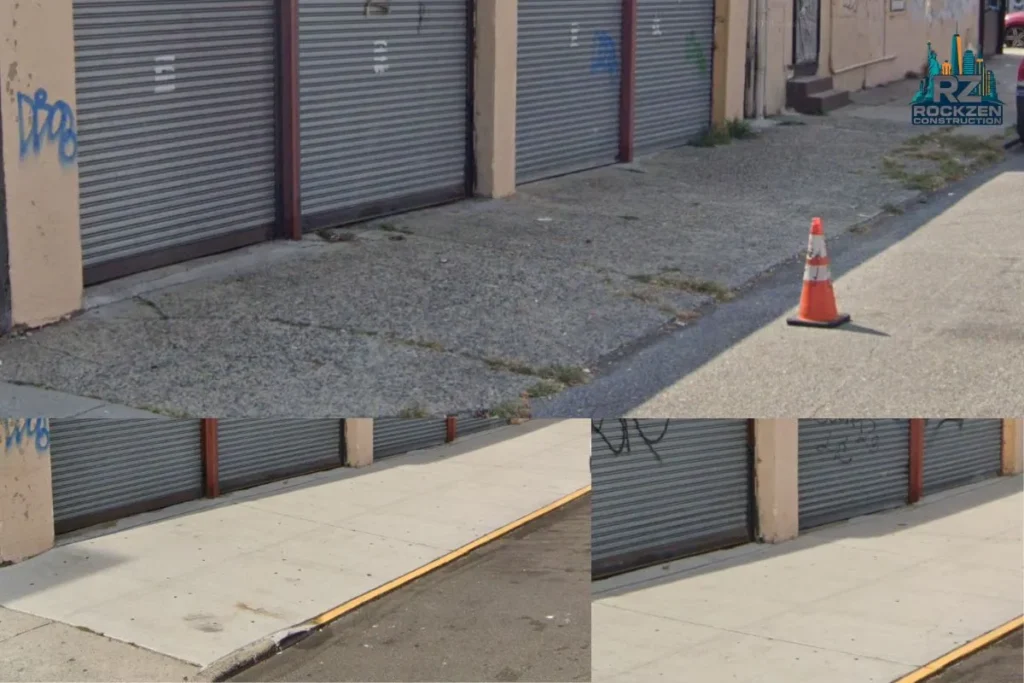
Rockzen offers professional Queens sidewalk repair services. Our services cover residential and commercial property needs across the borough.
Rockzen replaces sidewalk panels on Queens single-family homes across Bayside, Little Neck, Douglaston, Whitestone, Fresh Meadows, and Forest Hills. Owner-occupied homeowners get direct project coordination without property manager layers. Free inspections come with written estimates before any concrete work begins.
Two-family and three-family Queens homes dominate Middle Village, Ridgewood, Maspeth, Glendale, and Woodhaven. Rockzen coordinates with owner-occupants and tenants for two-family sidewalk work. Multi-family properties over four units get full commercial-grade project management.
Rockaway sidewalks need salt-resistant concrete formulations. Rockzen uses higher air-entrainment ratios for Rockaway, Arverne, Belle Harbor, Neponsit, and Broad Channel projects. Coastal exposure demands different mix design than inland Queens neighborhoods.
Marsh subsoil in Jamaica Bay adjacent neighborhoods requires deeper subbase excavation and specialized compaction. Rockzen handles Howard Beach and Broad Channel projects with subsoil expertise. Standard Queens sidewalk work does not translate directly to marsh-adjacent properties.
Rockzen replaces damaged concrete panels on Queens properties. We use 4,000 pounds per square inch (PSI) air-entrained concrete mix. Panels meet NYC DOT thickness standards at four inches minimum.
Trip hazards over half an inch trigger DOT violations. We replace displaced panels to meet DOT standards. Concrete grinding is prohibited by NYC and brings penalties for property owners and contractors.
Rockzen offers sidewalk leveling for sunken panels in Queens. Sunken panels lead to drainage issues and safety risks. Our service restores the right slope for drainage. Concrete resurfacing helps extend the life of borderline panels.
Tree roots cause most Queens sidewalk violations. Rockzen removes damaged panels with certified arborist coordination. We install root barriers to redirect future root growth.
Damaged curbs and driveway aprons create hazards at Queens property boundaries. Our crews repair curb sections using NYC DOT approved concrete. The work meets DOT forming specifications.
Americans with Disabilities Act (ADA) compliance applies to Queens sidewalk work. We install ADA curb cuts with detectable warning surfaces. All work meets the five-foot minimum width and two percent cross-slope rules.
Rockzen provides pre-winter sidewalk sealing across Queens neighborhoods. Sealing surface cracks before freeze-thaw season prevents violation-level damage. Crack filler application extends panel life by 5 to 10 years.
Unsafe classification violations require action within 24 hours. Rockzen mobilizes emergency response across Queens neighborhoods. Same-day dispatch works for calls before noon.
Property owners are responsible for Queens sidewalk repair under NYC Administrative Code Section 19-152. The law applies to Queens residential buildings with more than one unit. It also covers all commercial properties. NYC DOT is responsible only for sidewalks next to city-owned properties.
Property owners hold three legal obligations under Section 19-152. Maintain concrete panels free from cracks and displacement. Complete repairs within the Notice of Violation deadline. Ensure all work meets NYC DOT material and installation specifications.
Section 19-152 creates personal injury liability. Damaged Queens sidewalks cause pedestrian falls. Property owners face slip and fall lawsuits when injuries occur.
A sidewalk violation is removed when the defective slabs are repaired to NYC DOT specifications under a sidewalk construction permit, and a DOT inspector approves the work at a dismissal inspection. The violation carries no fine, but it stays on file with the County Clerk until the city records that satisfactory repairs were made. Until then, it can complicate selling or refinancing the property.
Queens sidewalks fail for six main reasons. Each cause leaves its own damage pattern. Knowing the cause prevents repeat damage after the fix.
Tree roots cause most sidewalk violations across Queens residential blocks. NYC Parks Department maintains thousands of Queens street trees. Root uplift creates vertical displacement triggering DOT trip hazard violations.
New York City experiences 50 to 60 freeze-thaw cycles yearly. Water enters concrete cracks and expands 9 percent when freezing. Panel cracking spreads from inside every Queens spring.
Standing water accelerates concrete surface deterioration. Poor drainage slope pools water against building foundations. Subbase erosion creates settlement voids causing panels to sink over time.
Underground utility work destabilizes subbase soil across Queens. Water main breaks saturate and erode subbase material. Subway vibration from major Queens corridors loosens subbase compaction.
Flushing Main Street carries heavy pedestrian traffic. Jamaica Avenue, Roosevelt Avenue, and Steinway Street also see high volume. Commercial panels show two to three times faster wear than residential sections.
Concrete sidewalk panels last 25 to 40 years under normal Queens conditions. Older Queens neighborhoods show elevated violation activity from age-related failure.
Rockzen visits your Queens home or property. Our team reviews the DOT violation notice with you. Every affected sidewalk flag gets inspected and measured. A written estimate arrives before you sign anything.
Days 2 to 7
Rockzen files every NYC DOT permit for your Queens address through the New York City Department of Buildings (DOB) NOW system. Most Queens homeowners never contact the city. Standard permits take 3 to 7 business days. Unsafe violations get fast-track approval.
Days 7 to 14
Rockzen demolishes damaged flags and pours new 4,000 PSI air-entrained concrete per DOT specifications. Crews protect landscaping, respect your Queens property, and clean up daily. Concrete becomes walkable in 24 to 48 hours.
Days 14 to 21
Rockzen coordinates the final DOT inspection that closes your Queens violation. We handle all follow-up paperwork. Any lien tied to the violation gets removed from your property record. Written dismissal arrives in your inbox.
Rockzen has completed hundreds of Manhattan sidewalk repair projects. Projects span residential and commercial properties in every borough neighborhood. Every project ends with official DOT dismissal.
Rockzen USA is a licensed Queens sidewalk repair business serving the borough. Our team brings 10 years of NYC sidewalk experience. We have completed over 500 New York City construction projects. Queens property owners find us through search, referral, and reviews across every neighborhood.
We know Queens. Astoria pre-war buildings run different from Bayside single-family homes. Flushing Main Street commercial work needs different staging than Jamaica Avenue. Every block has its own story.
Rockzen manages the whole NYC DOT permit process. We file applications through the Department of Buildings (DOB) NOW portal. Queens property owners never talk to city agencies directly.
Rockzen holds active NYC DOT and Department of Consumer and Worker Protection (DCWP) licensing. We carry an A+ Better Business Bureau (BBB) rating. Full liability insurance and workers compensation covers our crews.
Rockzen offers competitive pricing across Queens neighborhoods. Free inspections come with written estimates before any work starts. Our licensed sidewalk repair company beats the city takeover rate on every job. Find affordable sidewalk repair experts near you with a quick quote request.
Rockzen is a local sidewalk repair company. They offer a written guarantee for every project in Queens. Our sidewalk repair specialists complete work to NYC DOT standards. Property owners get sidewalk repair certification documentation after DOT dismissal.
Fixing individual sidewalk slabs in Queens usually runs $5-$15 per sq ft, and tearing out and pouring new slabs costs $12-$25 per sq ft. A typical house ends up paying $1,000-$3,000 overall, with the final figure driven by damage severity, number of panels, and permitting. Lower density than Manhattan or parts of Brooklyn often makes crew access simpler, which tends to keep Queens rates at the modest end of citywide pricing. Site-specific problems can still push totals up fast.
The final cost depends on how many concrete flags need repair.
| Project Size | Estimated Cost | Typical Scope |
|---|---|---|
| Small (1–3 panels) | $700–$1,500 | Minor cracking or uneven spots on a few panels |
| Medium (4–10 panels) | $1,600–$4,200 | About 100 sq ft of frontage, often from moderate root heaving |
| Large (11+ panels or entire frontage) | $4,500–$10,000+ | Long stretches, corner lots, or complete replacement |
| Additional Cost Factor | Estimated Cost | Details |
|---|---|---|
| City Permit | $70–$140 | The NYC DOT construction permit is a flat $70 for up to 300 linear feet. A corner lot with work on two street sides needs two permits ($140). |
| Tree Roots | $250–$1,000+ | Cutting back roots or installing barriers to shield fresh concrete. |
| Free City Option | $0 (If Eligible) | When a city-owned street tree is the sole cause of damage at an owner-occupied 1–3 family home, NYC Parks may fix the sidewalk at no cost through its Trees & Sidewalks Program. |
| Curb Ramps | $500–$2,000 | Reworking an ADA-compliant corner ramp. |
Most Queens sidewalk repair projects finish in 1 to 3 weeks from first call to completion. Actual concrete work runs 1 to 2 days. Single-flag jobs often wrap in one day.
| Stage | Duration | What Happens |
|---|---|---|
| Permit and planning | 3 to 7 business days | Rockzen files paperwork with NYC DOT |
| Scheduling and prep | 1 to 2 weeks | Crew mobilizes after permit clears |
| Concrete work | 1 to 3 days | Demolition, subbase prep, pour |
| Cure to walkable | 24 to 48 hours | Full strength develops over 28 days |
| Final inspection | 1 to 2 weeks | Rockzen coordinates DOT closeout |
Unsafe classifications and emergency work qualify for expedited NYC DOT permits at 3 to 5 business days.
Mid-spring through early fall gives Rockzen the best weather window for Queens sidewalk work. April through June and September through October hit stable temperatures above 50 degrees Fahrenheit, which concrete needs to cure properly.
Concrete cannot pour below 40 degrees Fahrenheit ambient temperature. Wind chill off Jamaica Bay and the Atlantic pushes cold weather into Queens earlier than inland forecasts. Rockaway sees winter arrive before Middle Village. Emergency work runs year-round with cold-weather concrete additives when needed.
Rockzen serves Queens neighborhoods from Astoria to the Rockaways. Each area brings its own building stock and damage patterns. Find local sidewalk repair experts serving your Queens neighborhood.
Rockzen serves Astoria and Long Island City in Western Queens. Pre-war residential buildings and tree-lined blocks fill Astoria. Long Island City rapid development brings heavy pedestrian volume onto older sidewalks.
Rockzen serves Flushing and College Point in Northern Queens. Flushing Main Street carries heavy pedestrian traffic. College Point residential blocks show aging concrete needing consistent inspection.
Rockzen serves Jamaica and Springfield Gardens in Southeast Queens. Jamaica Avenue commercial frontages face aging sidewalk infrastructure. Springfield Gardens near JFK Airport sees heavy vehicle vibration accelerating subbase settlement.
Rockzen serves Forest Hills and Rego Park in Central Queens. Upscale residential properties fill both neighborhoods. Forest Hills Gardens historic district requires careful board coordination before sidewalk work.
Rockzen serves Jackson Heights and Elmhurst in Northern Queens. Roosevelt Avenue sees subway vibration and heavy commercial traffic. Both neighborhoods carry dense pedestrian volume affecting sidewalk lifespan.
Rockzen provides sidewalk repair in Bayside and Fresh Meadows. They also handle violation removal in Eastern Queens. Single-family homes and low-rise apartments dominate both areas. Lower commercial traffic means slower deterioration than in central Queens corridors.
Rockzen serves Ridgewood and Maspeth in Western Queens. Mixed residential and industrial building stock defines both neighborhoods. Older concrete panels approach end of service life in many blocks.
Rockzen serves Sunnyside and Woodside in Western Queens. Pre-war apartment buildings line most residential streets. Tree root uplift from mature street trees causes most violations here.
Rockzen serves Corona near the World’s Fair Marina. Mixed-use commercial and residential frontages generate active DOT inspection cycles.
Rockzen serves Richmond Hill and South Ozone Park in South Queens. Single-family and two-family residential blocks fill both areas. Freeze-thaw and tree root damage account for most violations.
Rockzen serves Queens Village, Hollis, and St. Albans in Eastern Queens. Residential neighborhoods with aging sidewalk infrastructure. Consistent DOT inspection activity runs through these blocks.
Rockzen serves Far Rockaway, Arverne, Belle Harbor, and Howard Beach. Post-Sandy remediation continues affecting sidewalk conditions. Salt air exposure accelerates surface deterioration.
Prevention costs less than repair. Repair costs less than DOT city takeover. Six habits keep Queens sidewalks in good condition.
After freeze-thaw ends, walk your Queens sidewalk. Photograph new cracks or displacement. Rockaway homeowners should walk after coastal storms too.
Properties within a few blocks of Jamaica Bay or the Atlantic benefit from monthly checks between November and March.
A concrete sealer coat in early fall blocks water before the first freeze. Annual sealing adds 5 to 10 years to Queens panel life.
Bayside, Forest Hills, Kew Gardens, and Douglaston homeowners should note tree root movement year over year. Report aggressive roots to NYC Parks Department for coordinated pruning or removal.
Single-family Queens homeowners benefit from one Rockzen inspection per year. Catching small cracks early helps prevent full-flag replacement later. Rockzen uses 4,000 PSI air-entrained concrete on every job.
Sand or calcium magnesium acetate keeps Queens sidewalks safe without eating concrete. Rock salt corrodes surface concrete over 1 or 2 winters.
Call Rockzen Construction for a free Queens sidewalk inspection. Written estimates land the same week. Rockzen emergency response covers all 14 Community Boards within 24 hours.
Yes. Any concrete removal or panel replacement in Queens requires a NYC DOT Sidewalk Construction Permit. Working without one triggers stop-work orders and additional violations. Rockzen files every permit.
No. Standard homeowners policies treat Queens sidewalk maintenance as a property owner expense, not a covered loss.
Yes for owner-occupied 1, 2, and 3-family homes through the NYC Trip and Fall Program. Buildings with 4 units or more do not qualify.
No. NYC prohibits grinding as a fix. Only full panel replacement passes NYC DOT inspection for Queens trip hazard repair.
Yes. Chloride from coastal air pits and scales concrete surfaces. Rockaway Peninsula, Broad Channel, and Howard Beach properties see the most salt damage in Queens.
Rockzen dispatches same-day on calls received before noon. Next-morning dispatch handles later calls across all 14 Community Boards.
Call Rockzen for a free Queens inspection with a written quote. Private contractor pricing runs well below city takeover rates.
Yes. Rockzen covers residential work across Bayside, Forest Hills, Kew Gardens, Douglaston, Whitestone, and every other Queens neighborhood.
Check NYC DOT license and DCWP registration on the NYC city portal. Rockzen shares license numbers and insurance certificates on request.
Call NYC Parks Department first if the tree is city-owned. Book a free Rockzen inspection to document damage. Root barriers install with new panels to help prevent recurrence.
Mudjacking lifts sunken panels by injecting a slurry underneath. Rockzen offers mudjacking, polyurethane foam injection, and leveling compound for non-violation surface issues. DOT violations still need full panel replacement.
Yes. Rockzen handles new sidewalk installation for Queens properties without existing walkways, new construction, driveway conversions, and property line reconfigurations.
NYC Administrative Code 16-123 requires clearing snow within 4 hours of snowfall ending during daylight hours. Fines start at $100 for first offense. Pedestrian injuries from unshoveled Queens snow expose property owners to lawsuits under Section 7-210.