Rockzen Construction repairs, replaces and installs concrete sidewalks in Manhattan. We also remove NYC Department of Transportation (DOT) sidewalk violations for property owners. Tell us what you see, and we will tell you what your sidewalk needs.
A cracked slab is a worry. A DOT notice makes it worse. We get it. The sidewalk is yours to fix, and the clock is running. We will walk you through it, step by step.
Rockzen Construction is a Manhattan sidewalk contractor. We do concrete sidewalk repair, new sidewalk installation, sidewalk replacement and DOT violation removal for property owners.
We’re a concrete and masonry company with an office in Manhattan. Our team visits your property and gives you a quote. We file the permits and do the work. Then we request the DOT dismissal inspection.
We work with owners, building managers and businesses.
Our team files the DOT sidewalk construction permit before work starts.
After the repair, we request the DOT dismissal inspection through 311.
Workmanship warranty of at least 5 years, in writing on your quote.
If DOT does not dismiss your violation because of our work, we correct it at no charge.
Rockzen has completed hundreds of Manhattan sidewalk repair projects. Projects span residential and commercial properties in every borough neighborhood. Every project ends with official DOT dismissal.
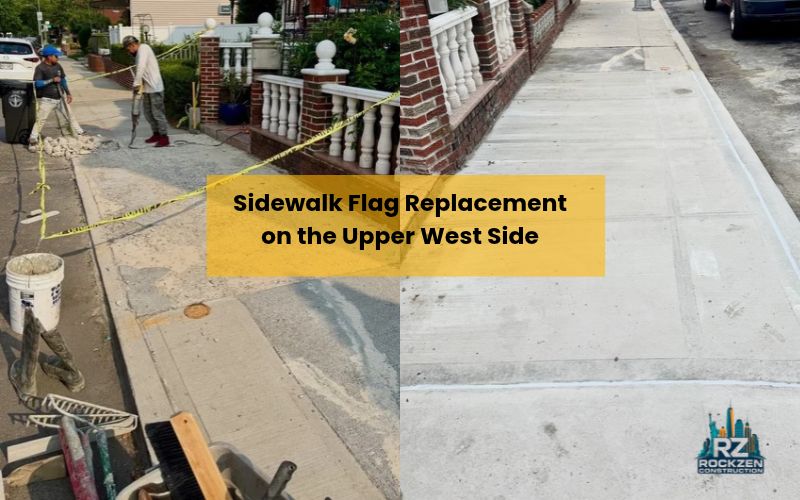
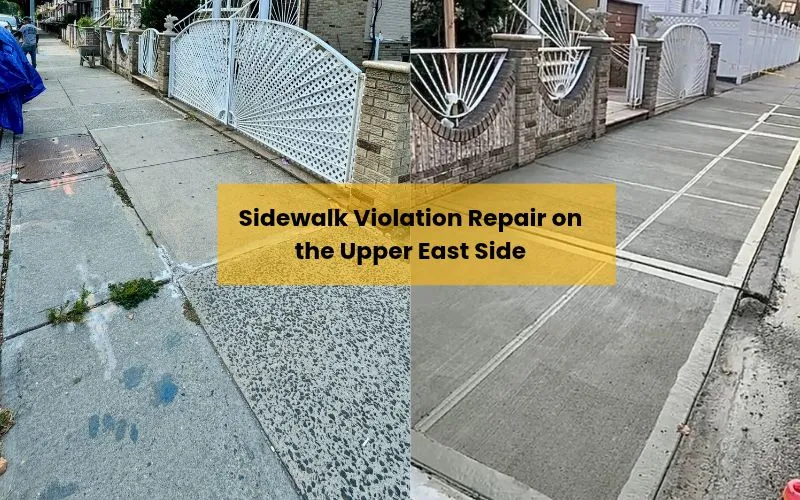
We fix cracked and uneven flags, broken or sunken slabs, tree-root damage, DOT violations, curbs and corners, and new sidewalks. Match what you see to a tab below. Have a DOT notice? Start with the “DOT violation” tab.
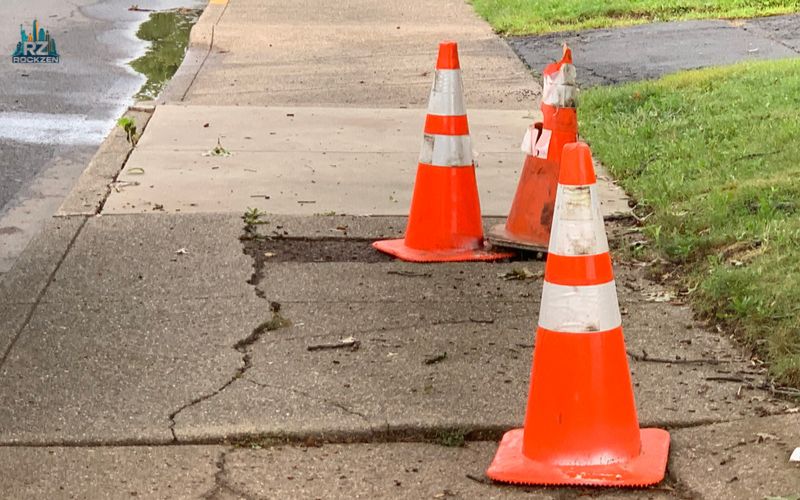
Cracks and trip hazards. Flags raised about ½ inch and holes about 1 inch across can cause injuries. For minor displacement we grind and level the edge. When uplift is severe we replace the panel.
Broken or sunken slabs. These need replacement. A loose, sunken or missing slab is no longer sound. A void under a flag means the base needs repair too.
Tree-root damage. Roots lift slabs and crack concrete. Who pays depends on the building and the tree. See the tree questions in the FAQ.
DOT violation. You have a notice and a deadline. The steps, from permit to dismissal, are in the section below.
Curbs and corners. We repair curbs and gutters. We also build corner ramps and curb cuts.
New sidewalk. New concrete where none exists, or after building construction. A sidewalk construction permit comes first.
A typical residential sidewalk repair in Manhattan costs $1,000 to $5,000 for the whole job. Larger jobs and commercial buildings cost $7,000 to $12,500 or more. Jobs in between depend on size.
Here is how we price it. We inspect your sidewalk first. Then we give you the exact price in writing, before any repair starts. The prices below are typical ranges as of October 2026, not quotes.
Repair type drives most of the cost variation on Manhattan sidewalks. Simple crack filling costs far less than full flag replacement or historic bluestone work.
| Work | Typical Price |
|---|---|
| Minor patching and crack fills | $5 to $15 per square foot |
| Grinding and trip hazard leveling | $6 to $12 per square foot |
| Standard concrete repair | $12 to $28 per square foot |
| Standard flag replacement | $15 to $40 per square foot |
| Single flag replacement (up to about 25 square feet) | $375 to $1,000 |
| Bluestone replacement | $25 to $50+ per square foot |
| Curb repair | $45 to $95 per linear foot |
| Tree-root adjustments | $250 to $1,000+ |
| Corner ramps | $500 to $2,000 per corner |
| Minor vault repairs | $5,000 to $20,000 |
| Full vault replacement | $50,000 to $150,000+ |
| Typical residential job (whole job) | $1,000 to $5,000 |
| Larger or commercial job (whole job) | $7,000 to $12,500 or more |
| DOT sidewalk construction permit | $70 per 300 linear feet |
DOT sets the permit fee. Here is what moves the price:
NYC DOT requires a Sidewalk Construction Permit before any concrete work begins. The permit costs $70 per 300 linear feet. Corner properties need two separate permits at $140 total.
Several site conditions add cost beyond the base repair rate. Property owners should factor these into their budget planning.
Damaged concrete from city tree roots requires special handling. Certified arborist consultation and root expansion cutting add $250 to $1,000 per project.
Corner property owners must upgrade to Americans with Disabilities Act (ADA) compliant pedestrian ramps. Ramp installation adds $500 to $2,000 per corner.
Landmark districts require premium materials like bluestone or tinted concrete. SoHo, Tribeca, and the West Village all fall under these rules. Material costs vary by exact specification.
Older Manhattan buildings often have sidewalks that serve as vault roofs. Minor vault repairs cost $5,000 to $20,000. Full vault ceiling replacement runs $50,000 to $150,000 or more.
Landmark districts require premium materials like bluestone or tinted concrete. SoHo, Tribeca, and the West Village all fall under these rules. Material costs vary by exact specification.
Missing the 75-day repair deadline triggers city takeover. City-contracted work bypasses competitive bidding. City repair runs $50 to $75 per square foot. A 20 percent administrative fee gets added through the Department of Finance. Unpaid bills within 90 days become a property lien.
Send your address, photos and violation number if you have one. We reply within 24 hours.
NYC DOT issues the violation notice after an inspection. Hire a licensed contractor. The contractor files a sidewalk construction permit and repairs the sidewalk to DOT specs. A dismissal inspection is then requested through 311. You have 75 days from the notice date, and a permit does not extend that clock.
Just got a notice? Take a breath. You have time, and the steps are clear. Here is how we handle it, in order:
We read your notice and the Preliminary Inspection Report. We photograph the damage and check that it matches your sidewalk.
You see the price in writing before construction starts.
The permit comes before the repair. DOT lists the fee at $70 per 300 linear feet. Corner or through lots may need more than one permit. Your 75 days keep running, so we file it fast.
We replace every flagged square and correct every listed defect. We pour the concrete to DOT specifications.
We call 311 with the permit number, address, block and lot, and violation number. We keep the whole sidewalk visible for the inspector.
That happens once an inspector confirms the repair was done right
Missing the 75 days. DOT can repair the sidewalk and bill you, and a lien can follow if the bill goes unpaid. There is no fine for the violation itself.
A wrong violation. You can appeal within 75 days of getting the notice. DOT sends a different inspector, and that result is final.
The full rules on deadlines, appeals and liens are in our NYC sidewalk violation removal guide.
Rockzen USA brings ten years of Manhattan sidewalk repair experience and more than 500 completed New York City construction projects across the five boroughs. Our team holds active licensing from the NYC Department of Transportation and the NYC Department of Consumer and Worker Protection (DCWP), which means we can legally pull permits, perform sidewalk work, and file for violation dismissal on your behalf.
Manhattan has more landmark buildings than any other borough, and historic district properties require approval from the Landmarks Preservation Commission (LPC) before any sidewalk work can begin. LPC approval typically adds 3 to 8 weeks to the timeline, and we handle these filings on your behalf.
Midtown sidewalks carry heavy daily foot traffic. We stage work to protect pedestrians. OSHA-compliant work zones on every job.
You never contact NYC DOT directly. We file every permit through DOB NOW. We manage inspections. We deliver the written dismissal.
Manhattan has 12 Community Boards and dozens of Business Improvement Districts (BIDs). We coordinate with local BIDs when work affects commercial corridors. Fewer surprises, smoother projects.
Rockzen Construction brings ten years of Manhattan sidewalk experience and over 500 completed New York City construction projects across the five boroughs. Our team holds active licensing from the NYC Department of Transportation and the NYC Department of Consumer and Worker Protection (DCWP).
Manhattan sidewalk repair usually demands more coordination than most contractors expect, and a Midtown project runs very differently from an Upper East Side residential job. Our crews work every neighborhood from Inwood down to Battery Park City, and we adapt staging plans to fit each area.
Rockzen serves 25+ Manhattan neighborhoods. Coverage runs from Inwood down to Battery Park City. Each area has its own building types and repair patterns.
Rockzen serves the Upper East Side from 59th Street to 96th Street. Pre-war residential buildings and townhouses dominate the area. Central Park foot traffic and tree root damage cause most violations here.
Rockzen serves the Upper West Side along Broadway, Amsterdam, and Columbus Avenue. Large pre-war apartment buildings define the neighborhood. Tree root uplift causes most violations. Coverage extends to Morningside Heights and the Columbia University area.
Rockzen serves Midtown Manhattan along 5th Avenue, Park Avenue, and 42nd Street. Midtown carries heavy daily pedestrian volume. Our crews work around Rockefeller Center and Times Square with pedestrian-safe staging plans.
Rockzen serves Hell’s Kitchen (also known as Clinton) and Hudson Yards. Residential towers and active commercial development mix in these neighborhoods. Ongoing utility work causes recurring sidewalk settlement damage.
Rockzen serves Chelsea and the Meatpacking District. High Line foot traffic and commercial density shape repair scheduling. Cobblestone-adjacent concrete panels need careful coordination.
Rockzen serves the Flatiron District and Union Square area. Historic commercial buildings and office towers line the Broadway corridor. DOT inspection cycles run frequently through this district.
Rockzen serves Gramercy and Murray Hill. Pre-war residential buildings and townhouses fill both neighborhoods. Gramercy Park requires special staging due to private park access rules.
Rockzen serves the East Village and Lower East Side. Historic tenement buildings mix with newer residential construction. Con Edison utility work causes recurring damage in some blocks.
Rockzen serves Greenwich Village and the West Village. Both areas fall largely within LPC historic district designation. LPC approval is required for most sidewalk work here.
Rockzen serves SoHo and Tribeca. Cast iron building districts and heavy commercial activity define both neighborhoods. Historic district designations require LPC coordination.
Rockzen serves Chinatown and Little Italy. Dense commercial activity and heavy pedestrian volume characterize both areas. Older concrete panels often need full frontage replacement.
Rockzen serves Harlem and East Harlem. Pre-war residential building stock fills Central and East Harlem. Tree-lined blocks and active DOT inspection cycles generate frequent violations.
Rockzen serves Washington Heights and Inwood in Upper Manhattan. Pre-war apartment buildings sit across hillside terrain. Freeze-thaw damage runs more pronounced due to elevation.
Rockzen serves Downtown Manhattan, including the Financial District and Battery Park City. Post-Sandy flood damage remediation continues in some areas. Wall Street and Fulton Street corridors see heavy weekday foot traffic.
Find answers to common questions about sidewalk repair, permits and DOT violations in Manhattan
The property owner is. NYC law makes the owner of the building next to the sidewalk install, repair and maintain it. The City does not fix it for you. Owners can be liable if someone is hurt on a defective sidewalk (Administrative Code §7-210). Owners also clear snow, ice and debris.
Yes, but you still need a sidewalk construction permit before any repair starts. Homeowners can apply by mail with a notarized affidavit of ownership. The repair must meet DOT specifications, and a dismissal inspection is still required to clear a violation. Most owners hire a contractor who knows the specifications.
Yes. You need a sidewalk construction permit before construction starts. A licensed contractor applies for it on the NYC DOT permit system, and we do that for our clients. Homeowners can apply by mail with a notarized affidavit of ownership. A permit does not extend the 75-day deadline.
Hire a licensed contractor and get a permit. The City does not take requests to repair your sidewalk. The one exception is tree damage on a one- to three-family home.
Use your violation number with NYC311 to check status or request a copy. Without the number, call 311 and ask about a sidewalk violation search.
DOT can cite voids under the flags, and loose, cracked, uneven or missing sections. It can also cite improper slope that causes drainage problems, and patchwork or hardware sticking out. Holes about 1 inch across or flags raised about ½ inch can cause injuries.
It can complicate one. A copy is filed with the County Clerk until the repairs are certified, and an open violation or lien can slow a sale or refinance.
It is the City's Trees and Sidewalks program. NYC does not charge owners of one-, two- and three-family homes for damage caused by City street trees or their roots. Co-ops, condos, buildings with four or more units, commercial properties and vacant lots do not qualify. Request it through NYC311. An inspector decides if you qualify.
You hire a licensed contractor and get the permits, including a Parks Tree Work Permit. We remove the damaged panels, and the Parks guidelines decide what we can do near the tree. Do not cut City tree roots yourself. It is prohibited. For buildings with four or more units, commercial buildings and vacant lots, tree-root defects stay the owner's responsibility.
Fix small cracks early, before they widen. Keep drainage clear so water does not undermine the base. Watch for tree-root lifting and call 311 for City trees. Clear snow and ice, which is also your legal duty.
Most of our Manhattan jobs run one to three weeks from start to a sidewalk ready for DOT inspection. The concrete pour itself takes about one to five business days. Concrete needs 24 to 48 hours to cure before foot traffic and about 28 days to reach full strength. Permit and inspection dates depend on DOT's schedule.
Yes. We repair sidewalks for homes, brownstones and apartment buildings. A standard residential job costs about $1,000 to $5,000 in total.
Yes. We work with building managers and businesses as well as owners. Larger and commercial repairs cost about $7,000 to $12,500 and up. Some commercial zoning districts need pigmented concrete when you replace more than half the sidewalk.
Yes. Call +1 646 452 2552, Monday to Saturday, 9am to 6pm. We will tell you how soon a crew can get there.
It depends on your policy. Ask your insurer in writing before repairs start, and ask if liability coverage applies when someone is hurt on your sidewalk. Keep the notice, photos and quote. Your insurer will ask for them.
No. Repairs over a vault are private, and the cost is yours.
Start with the company that caused it. Document the damage with photos and letters, then ask them to fix it. To find who worked on your street, call 311 and ask for "Status of Active Street or Sidewalk Construction Permits".
Sometimes. In districts C4-4 through C4-7, C5 and C6, DOT requires pigmented concrete when you replace more than 50 percent of a lot's sidewalk. Landmarked districts are excluded.
Rockzen USA offers free Manhattan sidewalk inspections. Written estimates come before any work begins. Emergency response runs within 24 hours across every Manhattan neighborhood.